

Quick Answer
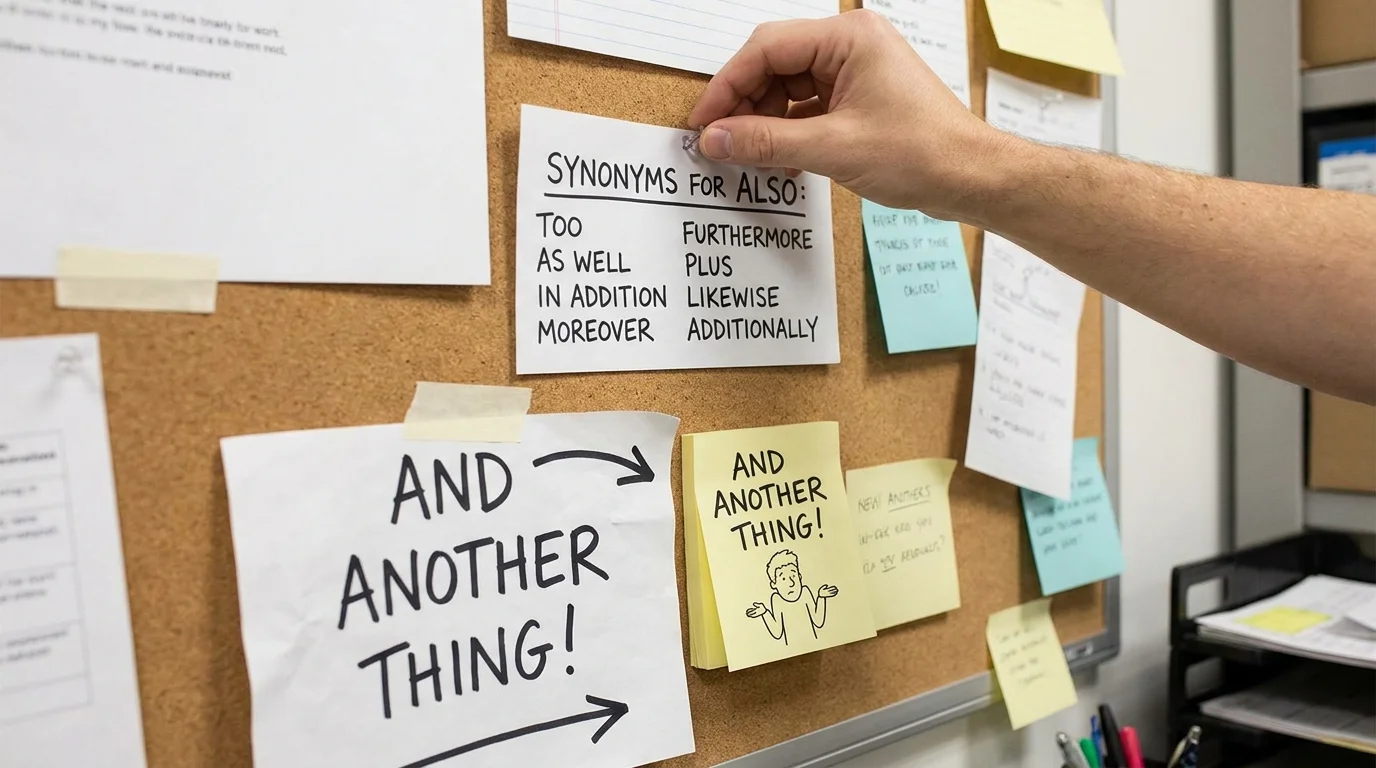
Common synonyms for also include too, as well, additionally, furthermore, moreover, in addition, likewise, similarly, besides, and further. The best choice depends on grammar and tone. Too and as well are natural in everyday writing, while additionally, furthermore, and moreover are better suited to formal or academic contexts.
Quick List: Synonyms for Also
- Too
- As well
- Additionally
- In addition
- Furthermore
- Moreover
- Besides
- Likewise
- Similarly
- Further
- Along with
- Plus
- What’s more
- Equally
- Not to mention
- Coupled with
- Together with
- In addition to
- As an added benefit
- On top of that
What Does “Also” Mean?
Also is an adverb used to add another fact, idea, person, action, or point to something already mentioned.
Example:
“She speaks Spanish and also speaks French.”
In this sentence, also adds another piece of information.
Depending on the sentence, also can express:
- Addition
- Another point
- An extra fact
- Similarity
- An additional action
- An added benefit
Because also is so common, replacing it with a more precise alternative can make writing less repetitive and better suited to the situation.
The Closest Synonyms for Also
1. Too
Too is one of the most natural alternatives to also in everyday English.
Example:
“I enjoyed the movie too.”
Best for: Casual and conversational writing.
Note: “Too” often appears at the end of a sentence.
2. As Well
As well has almost the same meaning as too and is common in everyday communication.
Example:
“She wants to attend the conference as well.”
Best for: Conversations, emails, and general writing.
3. Additionally
Additionally means “in addition” and works particularly well when introducing another point.
Example:
“The software is affordable. Additionally, it is easy to use.”
Best for: Professional, academic, and informational writing.
4. In Addition
In addition clearly signals that another fact or idea is being added.
Example:
“In addition, the company offers free training.”
Best for: Essays, reports, articles, and formal writing.
5. Furthermore
Furthermore introduces another supporting point, often one that strengthens the previous idea.
Example:
“The plan is affordable. Furthermore, it can be implemented quickly.”
Best for: Formal and academic writing.
6. Moreover
Moreover adds information that supports or reinforces what was just stated.
Example:
“The proposal is practical. Moreover, it requires very little funding.”
Best for: Formal, academic, and persuasive writing.
7. Besides
Besides can mean “in addition” or “apart from that.”
Example:
“Besides being affordable, the product is durable.”
Best for: Conversational and general writing.
Watch out: Depending on the sentence, besides can sometimes sound more informal than also.
8. Likewise
Likewise means “in the same way” rather than simply “also.”
Example:
“Sarah enjoyed the presentation, and Mark felt likewise.”
Best for: Showing similarity rather than simply adding information.
9. Similarly
Similarly is useful when adding an idea that resembles a previous one.
Example:
“Exercise improves physical health. Similarly, regular sleep supports overall well-being.”
Best for: Academic, analytical, and professional writing.
10. What’s More
What’s more introduces an additional point, often one that makes the previous statement even stronger.
Example:
“The hotel is affordable. What’s more, it is close to the city center.”
Best for: General, persuasive, and conversational writing.
Formal and Professional Synonyms for Also
For business documents, reports, applications, and professional communication, these alternatives usually work well:
- Additionally
- Furthermore
- Moreover
- In addition
- Further
- In addition to
- Along with
- Coupled with
- As an added benefit
- Equally
Examples
Basic:
“The service is reliable. It is also affordable.”
Professional:
“The service is reliable. Additionally, it is affordable.”
More formal:
“The service is reliable. Furthermore, it is competitively priced.”
The goal is not to replace also every time. Use a formal alternative when it improves the flow or clearly shows the relationship between ideas.
Academic Synonyms for Also
Academic writing often benefits from precise transition words rather than repeatedly using also.
Good choices include:
- Additionally
- Furthermore
- Moreover
- In addition
- Similarly
- Likewise
- Further
- Equally
Examples
Basic:
“The study examines income levels. It also considers educational background.”
Academic:
“The study examines income levels. Additionally, it considers educational background.”
Stronger academic connection:
“The study examines income levels. Furthermore, it considers the role of educational background.”
Use furthermore or moreover when the second point strengthens the argument. Use similarly or likewise when the second point is comparable to the first.
Casual Alternatives to Also
In everyday conversations, simpler alternatives usually sound more natural:
- Too
- As well
- Plus
- Besides
- And
- What’s more
- On top of that
Examples:
“I want to go too.”
“She invited her brother as well.”
“The restaurant is cheap, plus the food is good.”
“I don’t want to go. Besides, I’m tired.”
In casual writing, too and as well are usually better than overly formal words such as furthermore.
Synonyms for Also at the Beginning of a Sentence
When also appears at the beginning of a sentence, alternatives such as additionally, furthermore, moreover, and in addition are often more natural.
Original:
“Also, the course includes practical exercises.”
Alternatives:
- “Additionally, the course includes practical exercises.”
- “Furthermore, the course includes practical exercises.”
- “Moreover, the course includes practical exercises.”
- “In addition, the course includes practical exercises.”
For everyday writing, you can simply use:
- “The course includes practical exercises too.”
- “The course also includes practical exercises.”
Also vs Too vs As Well
These three expressions are often interchangeable, but their placement differs.
| Word/Phrase | Typical Position | Tone | Example |
|---|---|---|---|
| Also | Before main verb or after “be” | Neutral | She also works here. |
| Too | Usually at the end | Casual/neutral | She works here too. |
| As well | Usually at the end | Neutral | She works here as well. |
Important Grammar Difference
Also:
“He also plays tennis.”
Too:
“He plays tennis too.”
As well:
“He plays tennis as well.”
All three communicate a similar idea, but their sentence positions are different.
Also vs Additionally
These words are close, but they are not identical in every situation.
Also is more versatile and natural in ordinary sentences.
“She also teaches English.”
Additionally is more commonly used as a transition introducing another point.
“Additionally, the course includes weekly tests.”
Use also for simple addition. Use additionally when you want to clearly connect one point to another.
Also vs Furthermore
Also simply adds information.
Furthermore often adds a point that strengthens or develops an argument.
Example:
“The device is inexpensive. It is also lightweight.”
“The device is inexpensive. Furthermore, it is lightweight and easy to transport.”
The second example gives the additional fact more argumentative weight.
Also vs Moreover
Moreover is generally more formal and often emphasizes that the next point provides additional support.
Also:
“The plan is affordable and also practical.”
Moreover:
“The plan is affordable. Moreover, it can be implemented immediately.”
Use moreover mainly when the second idea adds significant support or emphasis.
Also vs Besides
Also simply adds information.
Besides can add information while suggesting that the additional point is another reason or consideration.
Also:
“She is experienced and also highly qualified.”
Besides:
“Besides being experienced, she is highly qualified.”
Besides can also mean “apart from”:
“Who else was there besides John?”
That meaning cannot always be replaced with also.
Also vs Likewise
These words are sometimes confused because both can relate to addition.
Also means another thing is true.
Likewise means something is true in the same way.
Also:
“John enjoys hiking. He also enjoys cycling.”
Likewise:
“John enjoys hiking. His sister feels likewise.”
Use likewise when you want to emphasize similarity.
Also vs Similarly
Similarly focuses on resemblance between ideas, situations, or actions.
Example:
“The first study found a link between exercise and sleep. Similarly, the second study reported a connection between physical activity and better rest.”
Simply using also would not communicate the comparison as clearly.
How to Choose the Right Synonym for Also
Choose your alternative based on grammar, tone, and meaning.
For everyday conversation
Use:
- Too
- As well
- Plus
- Besides
For professional writing
Use:
- Additionally
- In addition
- Further
- Moreover
For academic writing
Use:
- Additionally
- Furthermore
- Moreover
- Similarly
- Likewise
To show similarity
Use:
- Similarly
- Likewise
To add emphasis
Use:
- Furthermore
- Moreover
- What’s more
To keep the sentence simple
Keep also.
A synonym is useful only when it improves clarity, tone, or variety.
Sentence Transformations
Example 1
Original:
“She also works on weekends.”
Better Alternative:
“She works on weekends too.”
Why:
“Too” sounds natural in casual communication.
Example 2
Original:
“Also, the company provides health insurance.”
Better Alternative:
“Additionally, the company provides health insurance.”
Why:
“Additionally” works well as a formal transition.
Example 3
Original:
“The method is inexpensive. It is also effective.”
Better Alternative:
“The method is inexpensive. Furthermore, it is effective.”
Why:
“Furthermore” gives the second point more emphasis.
Example 4
Original:
“She is talented and also hardworking.”
Better Alternative:
“She is talented and hardworking as well.”
Why:
“As well” provides a natural alternative to “also.”
Example 5
Original:
“Tom enjoys football. Sarah also enjoys football.”
Better Alternative:
“Tom enjoys football. Sarah enjoys football likewise.”
Why:
“Likewise” emphasizes similarity between the two people.
Example 6
Original:
“The hotel is comfortable. It is also close to the airport.”
Better Alternative:
“The hotel is comfortable. Moreover, it is close to the airport.”
Why:
“Moreover” works well when the second benefit strengthens the recommendation.
Example 7
Original:
“The study examines age. It also examines income.”
Better Alternative:
“The study examines age. In addition, it examines income.”
Why:
“In addition” is clear and appropriate for academic writing.
Example 8
Original:
“She bought a notebook and also a new pen.”
Better Alternative:
“She bought a notebook and a new pen as well.”
Why:
“As well” can make the sentence sound natural without adding unnecessary formality.
Example 9
Original:
“The product is affordable. It is also environmentally friendly.”
Better Alternative:
“The product is affordable. What’s more, it is environmentally friendly.”
Why:
“What’s more” adds emphasis and works well in persuasive writing.
Example 10
Original:
“The first group improved its results. The second group also showed improvement.”
Better Alternative:
“The first group improved its results. Similarly, the second group showed improvement.”
Why:
“Similarly” makes the relationship between the two results explicit.
Common Mistakes With Synonyms for Also
1. Using “Furthermore” Everywhere
Furthermore is formal and can sound unnatural in casual writing.
Better:
Use too or as well in everyday conversation.
2. Treating Every Alternative as Identical
Words such as also, similarly, likewise, and moreover have related but different functions.
Choose the word based on the relationship between ideas.
3. Misplacing “Too”
Incorrect or awkward placement can make a sentence sound unnatural.
Natural:
“I want to go too.”
Natural:
“I too want to go.”
The second version is more formal or emphatic.
4. Confusing “Besides” With “Also”
Besides can mean “apart from,” so it cannot always replace also.
5. Using Formal Transitions in Casual Messages
Words such as moreover and furthermore may sound stiff in a text message.
6. Using “Likewise” When There Is No Similarity
Likewise should normally connect comparable ideas, actions, or situations.
7. Overusing Transition Words
Replacing every instance of also with a transition word can make writing feel forced.
Sometimes also is the clearest choice.
When Not to Replace “Also”
You do not need to replace also simply to make writing sound sophisticated.
Keep also when:
- The sentence is already clear.
- The tone is neutral.
- The word fits naturally.
- You are writing simple instructions.
- You want a concise sentence.
- A stronger transition would change the meaning.
For example:
“The app also works offline.”
This is already clear and natural. Replacing it with “Furthermore” would make the sentence unnecessarily formal.
True Synonyms vs Related Alternatives
| Word | Relationship to Also | Main Meaning | Direct Replacement? |
|---|---|---|---|
| Too | True synonym | In addition | Usually |
| As well | True synonym | In addition | Usually |
| Additionally | Close synonym | In addition | Often |
| In addition | Close synonym | Another point | Often |
| Furthermore | Related alternative | Additional supporting point | Context-dependent |
| Moreover | Related alternative | Additional emphasis | Context-dependent |
| Besides | Near synonym | In addition/apart from | Sometimes |
| Likewise | Related alternative | In the same way | No |
| Similarly | Related alternative | In a similar way | No |
| Plus | Informal alternative | In addition | Sometimes |
| What’s more | Phrase-level alternative | Additional emphasis | Context-dependent |
Editor’s Choice: Best Alternatives to Also
If you need one strong option for each situation, these are reliable choices:
- Best everyday alternative: Too
- Best neutral alternative: As well
- Best professional alternative: Additionally
- Best academic alternative: Furthermore
- Best for adding emphasis: Moreover
- Best for showing similarity: Similarly
- Best for casual writing: Plus
- Best simple choice: Also
The best synonym is not necessarily the most sophisticated one. It is the word that communicates your intended relationship between ideas most clearly.
FAQs About Synonyms for Also
What is the best synonym for “also”?
Too is one of the closest and most natural synonyms for “also.” As well, additionally, in addition, furthermore, and moreover are useful alternatives depending on sentence structure and formality.
What is a formal synonym for “also”?
Common formal alternatives include additionally, furthermore, moreover, in addition, and further. The best choice depends on whether you are simply adding information or strengthening an argument.
What can I use instead of “also” in an essay?
For essays, useful alternatives include additionally, furthermore, moreover, in addition, similarly, and likewise. Choose based on whether you are adding information, emphasizing a point, or showing similarity.
Is “too” the same as “also”?
Too and also often have the same meaning, but their usual placement differs. Also commonly appears before the main verb, while too often appears at the end of a sentence.
Is “moreover” the same as “also”?
Not exactly. Moreover adds another point, usually with greater emphasis or argumentative value. Also is more neutral and simply adds information.
What is a casual synonym for “also”?
Too, as well, plus, and on top of that can work well in casual communication. Too is usually the simplest choice.
What is the difference between “also” and “likewise”?
Also means that another thing is true or happens in addition. Likewise means something happens or is true in the same way. Therefore, they are not always interchangeable.
Key Takeaways
- Also is a neutral and versatile word for adding information.
- Too and as well are the closest natural alternatives for everyday English.
- Additionally, furthermore, and moreover work especially well in formal and academic writing.
- Similarly and likewise are better when the goal is to show similarity rather than simple addition.
- The best synonym depends on meaning, grammar, tone, and context—not on choosing the most complicated word.