
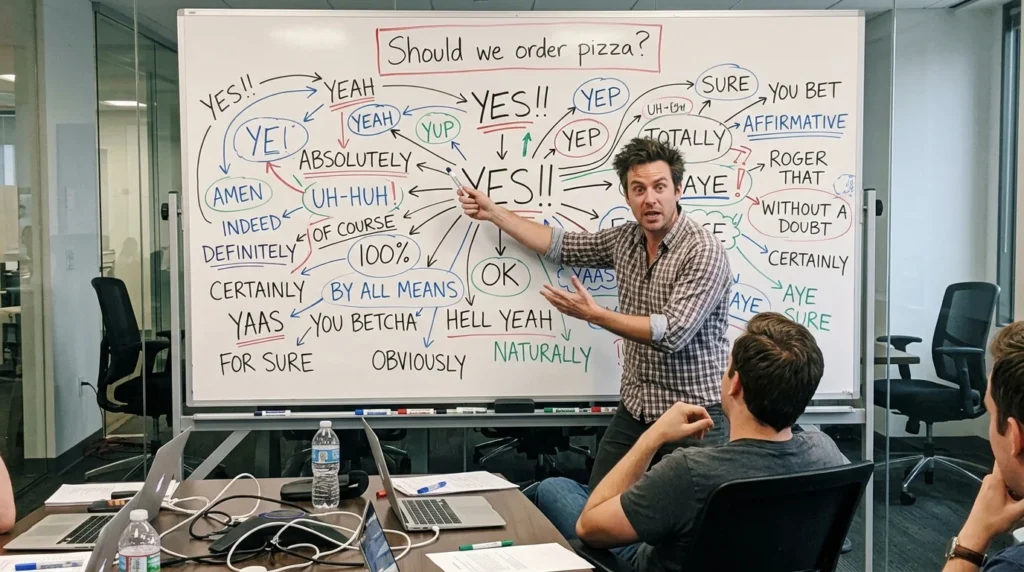
Quick Answer
Some of the best synonyms for “yes” are certainly, absolutely, definitely, indeed, of course, agreed, affirmative, gladly, willingly, sure, okay, correct, exactly, undoubtedly, and for sure. The best choice depends on context. Use certainly for polite agreement, absolutely for strong enthusiasm, agreed to accept a proposal, and gladly to express willingness.
What Does “Yes” Mean?
Yes is a word used to express agreement, confirmation, acceptance, permission, or an affirmative response to a question or statement.
For example:
Are you ready?
Yes, I am.
Here, “yes” confirms that the person is ready.
Would you like some coffee?
Yes, please.
Here, “yes” expresses acceptance.
Do you agree with the plan?
Yes, absolutely.
Here, “yes” expresses strong agreement.
The word can serve several purposes, including:
Answering a question positively
Agreeing with someone’s opinion
Accepting an invitation
Confirming information
Giving permission
Expressing enthusiasm
Showing willingness
Reassuring someone
Accepting a suggestion or proposal
Because “yes” has several uses, no single synonym works naturally in every situation. The right alternative depends on what you want to communicate and how formal or enthusiastic you want to sound.

40+ Synonyms for Yes
| Synonym or Alternative | Meaning | Best Context |
|---|---|---|
| Certainly | Definitely; without hesitation | Polite and professional |
| Absolutely | Completely or unquestionably | Strong agreement |
| Definitely | Without doubt | Certainty |
| Of course | Naturally; certainly | Friendly responses |
| Sure | Willing agreement | Casual conversation |
| Indeed | Truly; certainly | Formal or emphatic |
| Affirmative | A formal positive response | Official communication |
| Agreed | Accepting an opinion or proposal | Discussions and negotiations |
| Correct | Confirming that something is accurate | Questions about facts |
| Exactly | Confirming precise agreement | Conversation |
| Precisely | Exactly right | Formal or precise agreement |
| Right | Confirming correctness | Casual conversation |
| True | Agreeing that a statement is accurate | Discussion |
| Undoubtedly | Without doubt | Formal emphasis |
| Unquestionably | Beyond reasonable doubt | Formal writing |
| For sure | Certainly | Informal conversation |
| Without a doubt | Definitely | Strong certainty |
| You bet | An enthusiastic yes | Informal conversation |
| You got it | Yes; I’ll do that | Friendly requests |
| No problem | Willing agreement or reassurance | Casual requests |
| Gladly | Willingly and happily | Offers and requests |
| Willingly | Without reluctance | Cooperation |
| Happily | With pleasure | Friendly acceptance |
| With pleasure | Glad acceptance | Polite responses |
| I’d be happy to | Willingness to help | Professional and friendly |
| Certainly, sir/ma’am | Respectful agreement | Formal service settings |
| Absolutely right | Strong confirmation | Discussions |
| That’s right | Confirming a statement | Everyday conversation |
| Sounds good | Accepting a suggestion or plan | Casual planning |
| Works for me | Accepting an arrangement | Informal or workplace |
| I’m in | Agreeing to participate | Casual invitations |
| Count me in | Agreeing to join an activity | Social plans |
| Deal | Accepting an agreement | Negotiations and casual use |
| Approved | Officially accepted or authorized | Administrative settings |
| Accepted | Agreeing to receive or take something | Formal situations |
| Granted | Permission or an acknowledged point | Formal or specific contexts |
| Very well | Accepting a decision or request | Formal or restrained |
| All right | Accepting or agreeing | General conversation |
| Okay | Accepting or acknowledging | Everyday conversation |
| OK | Alternative spelling of okay | Everyday communication |
| Naturally | Indicating that something is expected | Reassurance |
| Without hesitation | Immediate and willing agreement | Emphatic writing |
| By all means | Encouraging permission or acceptance | Polite requests |
| Certainly so | Affirming a statement | Formal or emphatic |
Important: These alternatives are not all interchangeable. Some express agreement, some confirm facts, and others accept requests or invitations. Choose the one that matches your intended meaning.
Best Synonyms for Yes
Certainly
Certainly is a polite and versatile alternative to “yes.” It is especially useful when responding to requests or offering assistance.
Can you send me the report?
Certainly. I’ll send it shortly.
It sounds professional without being overly formal.
Best for: Workplace communication, customer service, polite requests, and formal conversation.
Absolutely
Absolutely expresses strong agreement, enthusiasm, or certainty.
Do you think we should try this idea?
Absolutely!
It often communicates more excitement than a simple “yes.”
Best for: Enthusiastic agreement, encouragement, and confident responses.
Definitely
Definitely emphasizes certainty or a firm intention.
Are you coming to the event?
Definitely!
It communicates that the answer is clear and decisive.
Best for: Confirming plans, expressing certainty, and informal or professional conversation.
Of Course
Of course is a friendly response that often means something is natural, expected, or readily accepted.
Could you help me with this?
Of course!
Depending on tone, it can sound reassuring and welcoming. In some situations, however, it may sound impatient, as if the answer should have been obvious.
Best for: Friendly requests, reassurance, and everyday conversation.
Sure
Sure is one of the most natural alternatives to “yes” in informal English.
Can I borrow your pen?
Sure.
It is short, relaxed, and commonly used in conversation.
Best for: Friends, casual requests, and everyday communication.
Indeed
Indeed is a more formal or emphatic alternative. It can confirm a statement or reinforce a point.
Is this an important issue?
Indeed, it is.
It can sound polished in formal writing, though it may feel stiff in casual conversation.
Best for: Formal discussions, speeches, essays, and emphatic statements.
Agreed
Agreed indicates that you accept an opinion, proposal, decision, or arrangement.
Let’s meet at 10 a.m.
Agreed.
It is more specific than a general “yes” because it emphasizes agreement on a particular point.
Best for: Meetings, negotiations, planning, and discussions.
Affirmative
Affirmative is a formal word meaning that the answer is yes or positive.
Is the system operational?
Affirmative.
It is often used in technical, military, aviation, or official communication.
Best for: Formal confirmation, technical communication, and situations where an unambiguous response is important.
Gladly
Gladly communicates that you are willing and happy to do something.
Would you help me prepare for the interview?
Gladly!
It expresses willingness rather than simply confirming a fact.
Best for: Offers of help, requests, and friendly acceptance.
Exactly
Exactly confirms that something is completely correct or matches what you mean.
So we need to finish the report before Friday?
Exactly.
It works best when confirming a statement rather than answering every type of yes-or-no question.
Best for: Clarifying details, confirming understanding, and agreeing with a precise point.
Synonyms for Yes Meaning “I Agree”
When you want to show agreement with an opinion, argument, or suggestion, consider:
Absolutely
Agreed
Exactly
Indeed
Definitely
That’s right
True
Precisely
I agree
You’re right
Without a doubt
Couldn’t agree more
Examples
Original:
Do you agree that the plan needs improvement?
Alternatives:
Absolutely.
I agree.
You’re right.
Exactly.
Couldn’t agree more.
Note: “Couldn’t agree more” is a strong expression of agreement. It does not simply mean that you accept a request or confirm a fact.
Synonyms for Yes Meaning “Certainly”
If you want to express certainty, useful alternatives include:
Certainly
Absolutely
Definitely
Undoubtedly
Unquestionably
Without a doubt
For sure
Of course
Indeed
No doubt
Examples
Will the changes improve the process?
Possible responses:
Certainly.
Definitely.
Without a doubt.
The best choice depends on how confident or emphatic you want to sound.
Synonyms for Yes Meaning “I Accept”
When accepting an invitation, offer, proposal, or arrangement, use:
Sure
Absolutely
Sounds good
Deal
Agreed
Accepted
I’d love to
Count me in
I’m in
With pleasure
Gladly
That works for me
Examples
Invitation:
Would you like to join us for dinner?
Natural responses:
Yes, I’d love to.
Absolutely!
Sounds great.
I’d be happy to.
Count me in.
Proposal:
Shall we move the meeting to Thursday?
Natural responses:
Agreed.
That works for me.
Sounds good.
Yes, let’s do that.
The right response depends on whether you are accepting a social invitation or agreeing to a practical arrangement.
Synonyms for Yes Meaning “I Will”
Sometimes “yes” means that you are willing to complete a task.
Useful alternatives include:
Certainly
Sure
Gladly
Will do
You got it
No problem
I’d be happy to
Of course
Consider it done
Examples
Can you email the document today?
Possible responses:
Certainly.
Will do.
You got it.
I’d be happy to.
Use “consider it done” only when you genuinely intend to complete the task.
Synonyms for Yes in Formal Writing
In formal communication, the best alternative depends on the purpose of the response.
Useful choices include:
Certainly
Affirmative
Agreed
Approved
Accepted
Confirmed
Indeed
Correct
I concur
I agree
Examples
Question:
Can you confirm your attendance?
Response:
I can confirm my attendance.
Question:
Do you support the proposal?
Response:
I agree with the proposal.
Question:
Has the request been authorized?
Response:
The request has been approved.
Be careful: “approved,” “accepted,” and “confirmed” are not universal synonyms for “yes.” Each has a specific meaning.
Synonyms for Yes in Professional Communication
At work, you may need to agree politely, confirm information, or accept a responsibility.
Useful alternatives include:
Certainly
Absolutely
Confirmed
Agreed
Understood
Will do
That works for me
I agree
I can do that
I’d be happy to
Examples
Manager:
Can you send the updated file before noon?
Professional responses:
Certainly. I’ll send it before noon.
Yes, I’ll take care of that.
Understood. I’ll complete it before noon.
“Understood” confirms that you have received or comprehended the instruction; it does not always mean that you agree with it.
Synonyms for Yes in Text Messages
For casual texting, natural alternatives include:
Yep
Yeah
Yup
Sure
Absolutely
Definitely
For sure
Of course
Sounds good
OK
Cool
I’m in
Count me in
You bet
Bet
Examples
Want to watch a movie tonight?
Possible replies:
Yep!
Yeah, sure.
Absolutely!
Sounds good.
I’m in.
Bet.
Tone matters: “Yeah,” “yep,” and “yup” are informal. “Bet” is slang in some varieties of English and may not be understood or appropriate in every setting.
Synonyms for Yes in an Email
Email responses often benefit from clarity and politeness.
Accepting a request
Certainly. I’ll complete the task by Friday.
Confirming attendance
Yes, I can confirm my attendance.
Accepting an invitation
Thank you for the invitation. I’d be delighted to attend.
Agreeing with a proposal
I agree with the proposed approach.
Confirming receipt or understanding
Understood. I’ll follow the instructions provided.
Choose the expression that communicates whether you are accepting, agreeing, confirming, or promising to do something.
Synonyms for Yes When Giving Permission
When “yes” means allowing someone to do something, useful expressions include:
Of course
Certainly
By all means
Go ahead
You may
Feel free
Permission granted
That’s fine
Yes, you can
Examples
May I open the window?
Natural responses:
Of course.
By all means.
Go ahead.
Yes, you may.
“Permission granted” sounds official or humorous in ordinary conversation, so use it according to the situation.
Synonyms for Yes When Showing Enthusiasm
When you want to express excitement or strong willingness, consider:
Absolutely!
Definitely!
I’d love to!
Count me in!
I’m in!
You bet!
For sure!
Without a doubt!
Sounds amazing!
Yes, please!
Examples
Do you want to go on a road trip?
Instead of a plain “yes,” you could say:
Absolutely! That sounds amazing.
Or:
I’d love to!
Or:
Count me in!
These responses communicate enthusiasm as well as agreement.
Synonyms for Yes in Academic Writing
In academic writing, “yes” often appears in direct answers or discussions. Depending on the purpose, more precise alternatives include:
Indeed
Correct
This is correct
This is accurate
The evidence supports this
I agree
This interpretation is valid
The findings confirm this
Examples
Casual:
Yes, the results support the hypothesis.
More formal:
The results support the hypothesis.
In academic writing, you can often remove “yes” and state the conclusion directly. Avoid using “indeed” or “certainly” if the evidence does not justify the certainty.
Synonyms for Yes in Customer Service
Customer service communication often requires warmth, clarity, and professionalism.
Useful responses include:
Certainly
Absolutely
Of course
I’d be happy to help
Yes, we can assist with that
That is possible
I’ll take care of that
Let me arrange that for you
Example
Customer:
Can you help me update my account details?
Response:
Certainly. I’d be happy to help you update your account details.
This is warmer and more informative than simply saying “yes.”
Synonyms for Yes in Negotiations
When accepting a proposal or reaching an agreement, consider:
Agreed
Accepted
Deal
I concur
That works for me
We have an agreement
I accept the terms
Approved
Examples
Shall we proceed with the revised offer?
Possible responses:
Agreed.
I accept the revised offer.
That works for me.
We have an agreement.
Use “approved” only when you have the authority to authorize the proposal or when the decision has actually been approved.
Yes vs. Yeah
Yes is neutral and works in almost every context.
Yeah is more casual and conversational.
Compare:
Yes, I understand.
Yeah, I understand.
Both are correct, but “yeah” is more informal.
Use yes in formal emails, official conversations, and situations where a clear response matters. Use yeah with friends or in relaxed conversation.
Yes vs. Yep
Yep is an informal alternative to “yes.”
Are you ready?
Yep!
It sounds relaxed and friendly. It may be too casual for formal business communication or official correspondence.
Yes vs. Sure
Sure often expresses willingness or acceptance.
Can you help me?
Sure.
However, “sure” can sometimes sound less enthusiastic than “absolutely.” Its tone depends on context and delivery.
Use sure for everyday requests and certainly when you want to sound more formal or polished.
Yes vs. Absolutely
Absolutely is generally stronger than “yes.”
Do you support the idea?
Yes.
Absolutely!
The second response communicates more enthusiasm or conviction.
However, “absolutely” may sound excessive when the question requires only a simple confirmation.
Yes vs. Certainly
Certainly is a polite and professional alternative.
Can you send me the details?
Certainly.
It is particularly useful when agreeing to do something. It often sounds more formal than “sure” and less emotionally emphatic than “absolutely.”
Yes vs. Indeed
Indeed can affirm a statement or reinforce an idea.
Is the situation serious?
Indeed, it is.
Unlike “yes,” “indeed” often sounds formal or literary. It is not always natural as a direct answer to a casual request.
Yes vs. Agreed
Agreed means that you accept a proposal or share an opinion.
Let’s begin at nine.
Agreed.
A simple “yes” might confirm that you heard the suggestion, while “agreed” more clearly communicates acceptance.
Yes vs. Affirmative
Affirmative is a formal way to give a positive answer.
Is the device active?
Affirmative.
It is common in specialized or official communication but may sound unnatural in everyday conversation.
Yes vs. Of Course
Of course often communicates that something is natural, expected, or readily accepted.
Can I ask you a question?
Of course.
Depending on the tone, it can sound welcoming or slightly impatient. A neutral “yes” avoids that potential ambiguity.
Stronger Alternatives to Yes
If you want to express firm agreement or certainty, consider:
Absolutely
Definitely
Certainly
Undoubtedly
Unquestionably
Without a doubt
I wholeheartedly agree
Couldn’t agree more
Examples
Simple:
Yes, I agree.
Stronger:
Absolutely, I agree.
Very emphatic:
I couldn’t agree more.
Choose an emphatic response only when you genuinely feel strongly about the matter.
Softer Alternatives to Yes
If you want to sound relaxed, polite, or less emphatic, consider:
Sure
Okay
All right
I suppose so
That sounds fine
I think so
Probably
I believe so
These expressions do not all mean exactly the same thing.
For example, “I think so” expresses uncertainty, while “okay” can indicate acceptance without strong enthusiasm.
If you need to give a definite answer, avoid softer expressions that could make your response sound uncertain.
10 Sentence Transformations Using Synonyms for Yes
1. Polite agreement
Original:
Yes, I can help you.
Alternative:
Certainly, I can help you.
Why: “Certainly” sounds polite and professional.
2. Strong agreement
Original:
Yes, that is a great idea.
Alternative:
Absolutely, that is a great idea.
Why: “Absolutely” adds enthusiasm.
3. Confirming a fact
Original:
Yes, that answer is correct.
Alternative:
Correct.
Why: “Correct” directly confirms accuracy.
4. Accepting an invitation
Original:
Yes, I want to come.
Alternative:
I’d love to come.
Why: This expresses enthusiasm rather than simple acceptance.
5. Accepting a plan
Original:
Yes, we can meet on Friday.
Alternative:
Friday works for me.
Why: This clearly accepts the proposed arrangement.
6. Agreeing with an opinion
Original:
Yes, I agree with you.
Alternative:
Exactly. I agree with you.
Why: “Exactly” emphasizes agreement with the point being made.
7. Accepting a request
Original:
Yes, I will send the file.
Alternative:
Will do. I’ll send the file.
Why: “Will do” is concise and natural in informal or workplace communication.
8. Giving permission
Original:
Yes, you can use my computer.
Alternative:
Of course, you can use my computer.
Why: This sounds welcoming and reassuring.
9. Enthusiastic participation
Original:
Yes, I want to join the team.
Alternative:
Count me in!
Why: This is an informal and enthusiastic way to accept participation.
10. Professional confirmation
Original:
Yes, I received your email.
Alternative:
I can confirm that I received your email.
Why: This is clearer and more professional when confirming receipt matters.
Best Synonyms for Yes by Context
| Context | Best Alternatives |
|---|---|
| General conversation | Sure, yeah, absolutely |
| Formal communication | Certainly, affirmative, indeed |
| Strong agreement | Absolutely, exactly, I agree |
| Certainty | Definitely, undoubtedly, without a doubt |
| Accepting an invitation | I’d love to, gladly, with pleasure |
| Accepting a request | Certainly, sure, will do |
| Giving permission | Of course, go ahead, by all means |
| Workplace | Certainly, understood, will do |
| Certainly, I agree, confirmed | |
| Text messages | Yep, yeah, sure, bet |
| Academic discussion | Indeed, correct, the evidence supports this |
| Negotiation | Agreed, accepted, deal |
| Customer service | Certainly, I’d be happy to help |
| Enthusiasm | Absolutely, count me in, I’d love to |
| Confirming facts | Correct, exactly, that’s right |
| Casual invitation | I’m in, sounds good, count me in |
| Official confirmation | Affirmative, confirmed |
| Willingness to help | Gladly, happily, I’d be happy to |
Common Mistakes When Using Synonyms for Yes
Using “absolutely” for every question
“Absolutely” is strong and enthusiastic.
Would you like a glass of water?
A simple “yes, please” or “sure” may sound more natural.
Using “affirmative” in casual conversation
“Affirmative” can sound overly formal or robotic.
Instead of:
Affirmative, I’ll meet you there.
Say:
Sure, I’ll meet you there.
Using “agreed” when you only mean confirmation
“Agreed” indicates acceptance or shared opinion.
If someone asks:
Did you receive the document?
The natural answer is:
Yes, I did.
“Agreed” does not answer the question.
Using “exactly” when you mean willingness
“Exactly” confirms that a statement is correct. It does not normally mean that you are willing to complete a task.
Instead of:
Can you help me? Exactly.
Say:
Sure, I can help.
Using “of course” in a way that sounds impatient
Depending on tone, “of course” can imply that the answer should have been obvious.
If you want to sound neutral, use:
Certainly.
Or:
Yes, that’s fine.
Using “confirmed” as a universal synonym
“Confirmed” means that information, an arrangement, or a fact has been verified.
It is not a general replacement for “yes.”
Do you like this song?
“Confirmed” would sound unnatural as an answer.
Better:
Yes, I do.
Using “I think so” when certainty is required
“I think so” expresses some uncertainty.
If you are completely sure, say:
Definitely.
Or:
Certainly.
Using informal slang in professional writing
Words such as “yep,” “bet,” and “you bet” may be inappropriate in formal emails or official communication.
Choose the expression according to your audience.
Treating acceptance and agreement as identical
Accepting an invitation is different from agreeing with an opinion.
I’d love to join you.
accepts an invitation.
I agree with your argument.
expresses agreement.
Choose a phrase that communicates the right action.
Replacing “yes” when it is already clear
Sometimes a simple “yes” is the best response.
Are you ready?
Yes.
This is natural and direct. A longer or more formal alternative may make the conversation awkward.
When Should You Keep the Word “Yes”?
You do not always need to replace yes.
“Yes” is clear, direct, and appropriate in nearly every kind of communication.
Keep yes when:
You are answering a straightforward question.
You need an unambiguous response.
You are confirming a fact.
You want to sound neutral.
The situation is formal and clarity is essential.
A synonym would change the meaning.
You do not need to communicate extra enthusiasm or emotion.
For example:
Have you completed the assignment?
Yes, I have.
This is perfectly natural. Replacing it with “affirmative” would usually sound unnatural.
Use alternatives when you want to communicate a particular tone, stronger agreement, willingness, enthusiasm, or formal confirmation.
How to Choose the Right Synonym for Yes
Ask yourself what you want your response to communicate.
Do you want to sound polite?
Use certainly, of course, or with pleasure.
Do you strongly agree?
Use absolutely, exactly, or couldn’t agree more.
Do you want to express certainty?
Use definitely, undoubtedly, or without a doubt.
Are you accepting a proposal?
Use agreed, accepted, or that works for me.
Are you accepting an invitation?
Use I’d love to, gladly, or count me in.
Are you willing to complete a task?
Use will do, certainly, or I’d be happy to.
Are you giving permission?
Use go ahead, by all means, or of course.
Are you confirming a fact?
Use correct, exactly, or that’s right.
Are you texting a friend?
Use yeah, yep, sure, or sounds good.
Are you communicating formally?
Use certainly, I agree, or a direct statement that confirms the information.
The best alternative is the one that communicates your meaning clearly and fits the situation.
True Synonyms vs. Related Alternatives
| Alternative | Relationship to “Yes” | Interchangeable? | Best Use |
|---|---|---|---|
| Certainly | Close synonym | Usually | Polite agreement |
| Absolutely | Stronger affirmation | Often | Enthusiastic agreement |
| Definitely | Certainty marker | Often | Firm confirmation |
| Of course | Contextual equivalent | Often | Friendly acceptance |
| Sure | Informal equivalent | Often | Casual agreement |
| Indeed | Emphatic affirmation | Sometimes | Formal statements |
| Affirmative | Formal equivalent | In specific contexts | Official responses |
| Agreed | Agreement marker | In specific contexts | Proposals and opinions |
| Correct | Confirmation marker | In specific contexts | Facts and answers |
| Exactly | Precise agreement | In specific contexts | Confirming a point |
| Gladly | Willingness marker | In specific contexts | Offers and requests |
| With pleasure | Polite acceptance | In specific contexts | Invitations and favors |
| Sounds good | Acceptance phrase | In specific contexts | Plans and suggestions |
| Count me in | Participation agreement | In specific contexts | Invitations and activities |
| Will do | Commitment to act | In specific contexts | Requests and instructions |
| Approved | Authorization | Rarely | Official decisions |
| Confirmed | Verification | Rarely | Facts and arrangements |
| Okay | Acceptance or acknowledgment | Often | Everyday conversation |
| Yeah | Informal affirmative | Usually in casual speech | Friends and relaxed settings |
| I think so | Qualified agreement | Sometimes | Uncertain answers |