
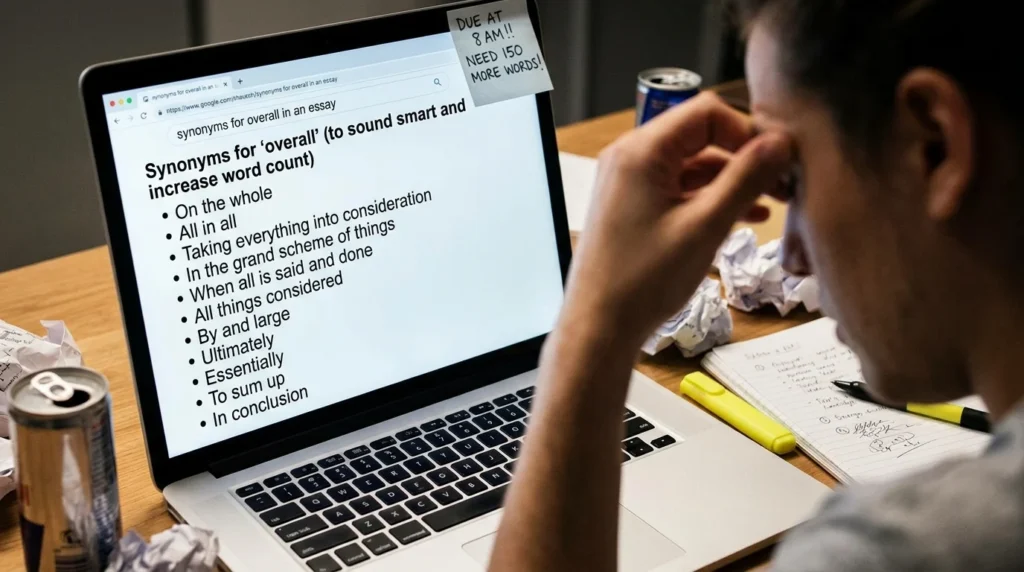
Quick Answer: Best Synonyms for Overall in an Essay
The best synonyms for overall in an essay include on the whole, generally, in general, broadly speaking, taken together, all things considered, in summary, in general terms, and considering everything. Use on the whole for a general evaluation, taken together to synthesize evidence, and in summary to introduce a brief recap. The best choice depends on the sentence’s purpose.
What Does “Overall” Mean in an Essay?
In academic writing, overall commonly has two uses:
General evaluation: Describing the general quality, result, or situation without focusing on every detail.
Summary or synthesis: Presenting the main conclusion after considering several points.
Examples:
Overall, the results suggest that regular exercise improves well-being.
Here, “overall” introduces a general conclusion.
The overall impact of the policy was positive.
Here, “overall” describes the combined impact.
Because these uses are different, the best replacement depends on whether you are evaluating a situation, summarizing an argument, or combining evidence.
33+ Synonyms for Overall in an Essay
| Alternative | Meaning | Best Use |
|---|---|---|
| On the whole | Considering the situation generally | General evaluation |
| In general | In most cases or broadly speaking | General statements |
| Generally | Usually or in a broad sense | Trends and observations |
| Broadly speaking | Considering the main points rather than details | Academic discussion |
| Taken together | Considered as a combined set | Research and evidence |
| All things considered | After considering the relevant factors | Evaluation and conclusions |
| In summary | Briefly restating the main points | Summaries |
| In general terms | Without discussing every detail | Broad explanations |
| On balance | After weighing advantages and disadvantages | Evaluations |
| As a whole | Considering something in its entirety | Systems, groups, and works |
| Collectively | As a group or combined set | Data and evidence |
| In total | Adding everything together | Quantities and totals |
| In broad terms | At a general level | Explanations |
| Viewed as a whole | Considering all parts together | Analysis |
| Considering everything | Taking all relevant factors into account | General evaluation |
| In conclusion | Introducing a final judgment or conclusion | Essay conclusions |
| To summarize | Giving a concise account of the main points | Summary sections |
| In brief | In a short form | Concise summaries |
| Ultimately | Emphasizing the final result or central point | Final arguments |
| In essence | Expressing the fundamental meaning | Main ideas |
| Generally speaking | Making a broad statement | General discussion |
| As a general rule | Describing a typical pattern | Rules and trends |
| At a broad level | Considering a topic without fine detail | Analytical writing |
| In aggregate | Considering data or items collectively | Statistical analysis |
| All in all | Giving a general evaluation | Informal or semi-formal writing |
| Taking everything into account | Considering all relevant factors | Evaluations |
Important: These expressions are related alternatives, not perfect substitutes. For example, in total refers to a sum, while in conclusion signals the final part of an argument. Neither can replace “overall” in every sentence.

Best Academic Alternatives to Overall
1. On the Whole
On the whole is one of the closest alternatives when “overall” means considering something generally.
Example:
Overall, the students responded positively to the new teaching method.
Alternative:
On the whole, the students responded positively to the new teaching method.
This phrase works well when your evaluation is generally positive or negative, even if some exceptions exist.
Best for: Evaluations, research findings, and general assessments.
2. In General
In general introduces a broad statement that applies to many situations or cases.
Example:
Overall, students benefit from regular feedback.
Alternative:
In general, students benefit from regular feedback.
Use it when describing a common pattern rather than summarizing every detail of a specific study.
Best for: General observations, academic explanations, and broad claims.
3. Generally
Generally is a concise alternative that means usually or in most cases.
Example:
Overall, the findings support the proposed explanation.
Alternative:
Generally, the findings support the proposed explanation.
However, “generally” may suggest that exceptions exist. If you are summarizing a particular set of results, “taken together” may be more precise.
Best for: Trends, observations, and broad statements.
4. Taken Together
Taken together is particularly useful when combining several findings, arguments, or pieces of evidence.
Example:
Overall, the results indicate that the intervention was effective.
Alternative:
Taken together, the results indicate that the intervention was effective.
This phrase makes it clear that the conclusion comes from considering the evidence collectively.
Best for: Research papers, literature reviews, evidence-based arguments, and data analysis.
5. Broadly Speaking
Broadly speaking introduces a general statement without addressing every detail.
Example:
Overall, technology has changed how people communicate.
Alternative:
Broadly speaking, technology has changed how people communicate.
Use it when discussing a complex topic at a general level. Avoid it when you need a precise, narrowly defined claim.
Best for: Essays, conceptual discussions, and broad explanations.
6. On Balance
On balance is useful when you have weighed positive and negative factors before reaching a judgment.
Example:
Overall, the benefits of renewable energy outweigh its costs.
Alternative:
On balance, the benefits of renewable energy outweigh its costs.
This phrase is especially effective in argumentative and evaluative essays.
Best for: Debates, comparisons, policy analysis, and balanced evaluations.
7. All Things Considered
All things considered means after taking relevant factors into account.
Example:
Overall, the policy was beneficial despite several limitations.
Alternative:
All things considered, the policy was beneficial despite several limitations.
It works well when your conclusion acknowledges both strengths and weaknesses, though it can sound slightly conversational in highly technical writing.
Best for: Evaluative essays and balanced conclusions.
8. As a Whole
As a whole emphasizes the entire subject, group, system, or work rather than individual parts.
Example:
Overall, the novel presents a criticism of social inequality.
Alternative:
The novel, as a whole, presents a criticism of social inequality.
This construction is useful when evaluating a complete work, organization, population, or system.
Best for: Literary analysis, social studies, and whole-system evaluations.
9. In Summary
In summary explicitly signals that you are briefly restating the main points.
Example:
Overall, the evidence supports the need for further research.
Alternative:
In summary, the evidence supports the need for further research.
Use it when you are summarizing information rather than merely making a general observation. It is often more suitable for a concluding paragraph or a summary section.
Best for: Summaries, reports, and concluding sections.
10. Ultimately
Ultimately emphasizes the final result, decisive consideration, or central conclusion.
Example:
Overall, access to education determines many long-term opportunities.
Alternative:
Ultimately, access to education influences many long-term opportunities.
The meaning changes slightly: “ultimately” highlights the central or final point rather than simply describing the situation in general.
Best for: Final arguments, consequences, and concluding insights.
Synonyms for Overall at the Beginning of an Essay Sentence
When “overall” appears at the beginning of a sentence, choose an alternative that matches its function.
| Original Sentence | Better Alternative |
|---|---|
| Overall, the study supports the hypothesis. | Taken together, the findings support the hypothesis. |
| Overall, the results were positive. | On the whole, the results were positive. |
| Overall, technology has improved communication. | In general, technology has improved communication. |
| Overall, the policy was effective. | On balance, the policy was effective. |
| Overall, the evidence is convincing. | Collectively, the evidence is convincing. |
| Overall, the novel explores identity. | As a whole, the novel explores identity. |
| Overall, the argument has several strengths. | Broadly speaking, the argument has several strengths. |
| Overall, the findings suggest further research is needed. | Taken together, the findings suggest further research is needed. |
Remember that a replacement should preserve the intended meaning. For example, in summary is appropriate when recapping points, while on balance is better when weighing competing considerations.
Synonyms for Overall in an Essay Conclusion
If you are using “overall” in the final paragraph, you may be trying to summarize your argument or present a final judgment.
Useful alternatives include:
In conclusion
In summary
On balance
All things considered
Ultimately
Taken together
On the whole
To summarize
In essence
Examples
Original:
Overall, the evidence suggests that early intervention improves outcomes.
Alternative:
Taken together, the evidence suggests that early intervention improves outcomes.
Original:
Overall, the policy has more advantages than disadvantages.
Alternative:
On balance, the policy has more advantages than disadvantages.
Original:
Overall, the discussion demonstrates the importance of public education.
Alternative:
In conclusion, the discussion demonstrates the importance of public education.
Writing tip: You do not have to begin your conclusion with a transition word. A direct concluding statement can be stronger than “Overall” or “In conclusion” when the paragraph already makes its purpose clear.
Synonyms for Overall in Academic Research
Research writing often needs to synthesize findings rather than simply make a general statement.
Useful alternatives include:
Taken together
Collectively
In aggregate
On the whole
Across the studies
Considering the evidence as a whole
In combination
When considered together
Examples
Original:
Overall, the studies indicate a relationship between sleep and memory.
Alternative:
Taken together, the studies indicate a relationship between sleep and memory.
Original:
Overall, the data show an increase in participation.
Alternative:
Collectively, the data show an increase in participation.
Original:
Overall, the findings support the proposed model.
Alternative:
When considered together, the findings support the proposed model.
Use in aggregate primarily when discussing combined data, measurements, or quantities. It is not a natural replacement for “overall” in every kind of essay.
Synonyms for Overall in an Argumentative Essay
In argumentative writing, “overall” often introduces a judgment after considering different arguments.
Useful alternatives include:
On balance
All things considered
Ultimately
On the whole
Considering the evidence
Taken together
In light of these points
Example
Original:
Overall, public transportation is a better investment than expanding roads.
Alternative:
On balance, public transportation is a better investment than expanding roads.
Another option:
Considering the evidence, public transportation appears to be a more effective long-term investment than expanding roads.
The second alternative makes the basis for the judgment clearer.
Synonyms for Overall in a Literature Essay
When analyzing a novel, poem, play, or other work, useful alternatives include:
As a whole
Taken as a whole
Throughout the work
In essence
On the whole
Viewed as a complete work
At the broadest level
Examples
Original:
Overall, the novel explores the consequences of ambition.
Alternative:
Taken as a whole, the novel explores the consequences of ambition.
Original:
Overall, the poem creates a sense of isolation.
Alternative:
As a whole, the poem creates a sense of isolation.
Be careful with throughout the work. It means something occurs across the work, not simply that you are giving an overall evaluation.
Synonyms for Overall in a Report
In reports, “overall” may describe performance, results, progress, or a general assessment.
Useful alternatives include:
On the whole
In general
Collectively
In summary
Taken together
In total
In broad terms
Examples
Overall, employee satisfaction increased.
→ On the whole, employee satisfaction increased.
Overall, the project met its objectives.
→ In summary, the project met its objectives.
Overall, the three departments contributed to the improvement.
→ Collectively, the three departments contributed to the improvement.
Use in total only when you mean a sum or total quantity, not a broad evaluation.
Overall vs. In General
Overall often summarizes a particular situation, result, or set of evidence.
In general usually introduces a broad statement that applies across cases or situations.
Compare:
Overall, the experiment was successful.
This evaluates a specific experiment.
In general, experiments require careful controls.
This makes a broad statement about experiments.
The two expressions sometimes overlap, but they are not always interchangeable.
Overall vs. On the Whole
On the whole is one of the closest alternatives when “overall” introduces a general evaluation.
Overall, the course was useful.
On the whole, the course was useful.
Both express a general judgment while allowing for exceptions.
“On the whole” can sound slightly more reflective, while “overall” is concise and widely used.
Overall vs. Taken Together
Taken together emphasizes the combined meaning of multiple elements.
Overall, the findings support the theory.
Taken together, the findings support the theory.
The second sentence highlights that the conclusion emerges from the findings collectively.
Use taken together when you are combining studies, arguments, observations, or pieces of evidence.
Overall vs. In Summary
In summary explicitly signals that you are restating the main points.
Overall, the research highlights several challenges.
In summary, the research highlights several challenges.
The second sentence sounds more like a recap. If you are making a general evaluation rather than summarizing, on the whole may be more appropriate.
Overall vs. Ultimately
Overall gives a broad assessment.
Ultimately emphasizes the final result, decisive factor, or central conclusion.
Compare:
Overall, the policy improved access to services.
This gives a general assessment.
Ultimately, the policy improved access to services.
This emphasizes the final outcome.
Use “ultimately” only when the sentence genuinely refers to a final result or decisive point.
Overall vs. In Conclusion
In conclusion explicitly signals the final stage of an argument or essay.
Overall can appear anywhere in a discussion and does not necessarily indicate that the writing is ending.
Compare:
Overall, the evidence favors the proposed approach.
In conclusion, the evidence favors the proposed approach.
The first gives a broad assessment. The second signals a conclusion.
Neither phrase is automatically better. Choose according to the structure and purpose of your paragraph.
Stronger Alternatives to Overall
If you want to emphasize a clear evaluation or final judgment, consider:
On balance
Taken together
All things considered
Ultimately
In light of the evidence
Considering all the evidence
Viewed as a whole
Example
Original:
Overall, the proposed solution is effective.
More analytical:
On balance, the proposed solution is effective, despite its initial costs.
The alternative becomes stronger because it explains the basis for the judgment, not simply because it uses a different phrase.
More Formal Alternatives to Overall
For academic or professional writing, consider:
Taken together
On balance
In aggregate
As a whole
In general terms
Considering the evidence as a whole
In light of the findings
Examples:
Overall, the findings support the hypothesis.
→ Taken together, the findings support the hypothesis.
Overall, the results indicate an improvement.
→ In light of the findings, the results indicate an improvement.
Formal wording should make your meaning more precise. Do not choose a complicated phrase simply because it sounds academic.
10 Sentence Transformations Using Synonyms for Overall
1. General evaluation
Original:
Overall, the course was beneficial.
Alternative:
On the whole, the course was beneficial.
2. Research findings
Original:
Overall, the findings support the hypothesis.
Alternative:
Taken together, the findings support the hypothesis.
3. General trend
Original:
Overall, students performed better after the training.
Alternative:
Generally, students performed better after the training.
Use “generally” if the improvement describes a broad pattern rather than every student.
4. Balanced judgment
Original:
Overall, the advantages outweigh the disadvantages.
Alternative:
On balance, the advantages outweigh the disadvantages.
5. Essay conclusion
Original:
Overall, education plays a vital role in social development.
Alternative:
In conclusion, education plays a vital role in social development.
6. Literary analysis
Original:
Overall, the novel explores the effects of prejudice.
Alternative:
Taken as a whole, the novel explores the effects of prejudice.
7. Combined evidence
Original:
Overall, the data indicate a positive relationship.
Alternative:
Collectively, the data indicate a positive relationship.
8. Final outcome
Original:
Overall, the policy led to improvements in public health.
Alternative:
Ultimately, the policy led to improvements in public health.
Use “ultimately” when emphasizing the resulting outcome.
9. Broad explanation
Original:
Overall, social media has changed how people communicate.
Alternative:
Broadly speaking, social media has changed how people communicate.
10. General evaluation after considering several factors
Original:
Overall, the plan is practical despite its limitations.
Alternative:
All things considered, the plan is practical despite its limitations.
Best Synonyms for Overall by Context
| Context | Best Alternatives |
|---|---|
| General essay writing | On the whole, in general |
| Essay conclusion | In conclusion, in summary |
| Research paper | Taken together, collectively |
| Statistical analysis | In aggregate, collectively |
| Argumentative essay | On balance, all things considered |
| Literary analysis | As a whole, taken as a whole |
| General observation | Generally, broadly speaking |
| Final outcome | Ultimately |
| Report writing | In summary, on the whole |
| Evaluating advantages and disadvantages | On balance |
| Synthesizing evidence | Taken together |
| Describing a complete system | As a whole |
| Broad explanation | In broad terms |
| Formal assessment | Considering the evidence as a whole |
Common Mistakes When Replacing Overall
Using “in conclusion” in the middle of an essay
“In conclusion” usually signals that the discussion is ending.
If you are introducing a general observation in a body paragraph, on the whole or taken together may be more appropriate.
Using “in total” for a general evaluation
“In total” refers to a sum or combined quantity.
Incorrect replacement:
In total, the policy was effective.
Better:
On the whole, the policy was effective.
Use “in total” when counting or adding quantities.
Using “generally” when you mean every case
“Generally” suggests that a statement applies in most cases, not necessarily all of them.
If you mean the entire set of evidence, taken together may be more precise.
Using “ultimately” without a final outcome
“Ultimately” emphasizes a final result or decisive point. It is not simply a more formal version of “overall.”
Overusing transition phrases
Replacing every instance of “overall” with “on the whole,” “in summary,” or “all things considered” can make your essay repetitive.
Sometimes the strongest revision is to remove the transition and state your point directly.
Choosing a synonym just because it sounds formal
A phrase such as “in aggregate” may suit a statistical discussion but sound awkward in a literary essay.
Choose words based on meaning and context, not formality alone.
When Should You Keep the Word “Overall”?
You do not need to replace “overall” every time it appears.
It is a clear, concise, and acceptable word in academic writing. Keep it when:
You are giving a general evaluation.
You are describing the combined result of a situation.
You need a simple transition to a broad assessment.
The alternatives would sound too formal or change the meaning.
You have already used other transition phrases nearby.
For example:
Overall, the findings suggest that the intervention was effective.
This sentence is clear and appropriate for many academic contexts.
If “overall” appears repeatedly in the same paragraph, consider revising the sentence structure rather than replacing it mechanically.
How to Choose the Right Synonym for Overall
Ask yourself what your sentence is doing.
Are you giving a general evaluation?
Use on the whole or in general.
Are you combining multiple findings?
Use taken together or collectively.
Are you weighing advantages and disadvantages?
Use on balance or all things considered.
Are you summarizing key points?
Use in summary or to summarize.
Are you writing the final paragraph?
Use in conclusion when you need an explicit conclusion signal, or simply state your final point.
Are you describing a complete work or system?
Use as a whole or taken as a whole.
Are you emphasizing a final result?
Use ultimately.
Are you making a broad statement?
Use generally or broadly speaking.
The best alternative is the one that preserves your intended meaning and improves the flow of your essay.