
Quick Answer
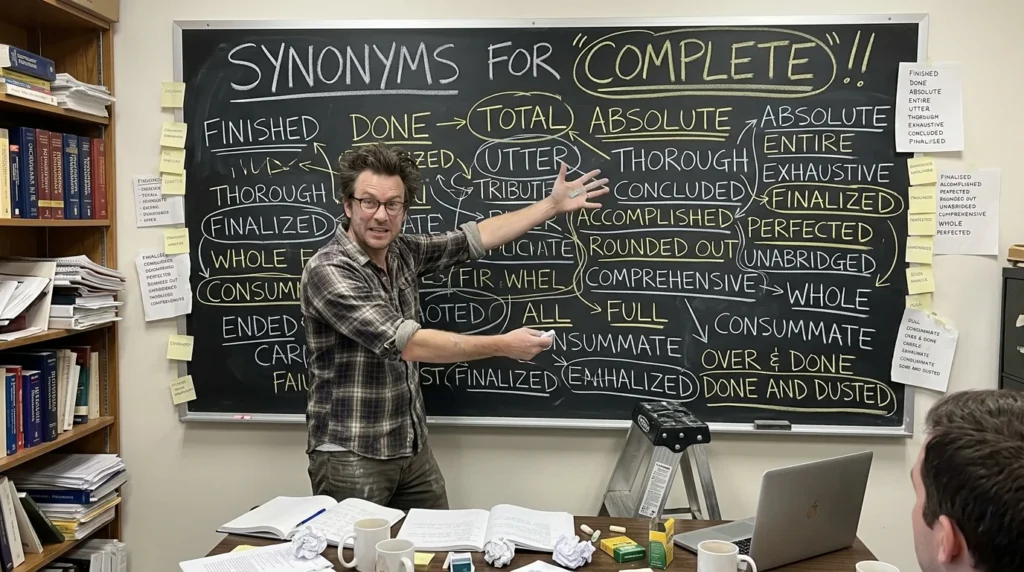
Some of the best synonyms for complete are finished, entire, whole, full, accomplished, finalized, comprehensive, thorough, finished, concluded, fulfilled, and total. Use finished for a task that has ended, entire for something considered as a whole, comprehensive for broad coverage, and thorough for detailed work. The best choice depends on the sentence and intended meaning.
What Does “Complete” Mean?
The word complete has several related meanings. It can function as an adjective or a verb.
As an adjective, it can mean:
Finished: A task or process has reached its end.
Whole: Nothing is missing from something.
Comprehensive: Something covers all the necessary parts or details.
Total: Something includes every part or member of a group.
As a verb, complete means to finish something or supply what is needed to make it whole.
Examples:
She submitted the complete report.
The project is complete.
He completed the assignment before the deadline.
Please complete the application form.
The collection is now complete.
Because “complete” has several meanings, not every synonym works in every sentence. The best replacement depends on whether you mean finished, whole, fully covered, accomplished, or made whole.

52+ Synonyms for Complete
The following words and phrases offer useful alternatives in different contexts. Some are close synonyms, while others apply only to particular meanings of “complete.”
| Synonym | Meaning | Best context |
|---|---|---|
| Finished | Brought to an end | Tasks and projects |
| Entire | Including every part | Objects, periods, and groups |
| Whole | Not divided or missing parts | Objects and quantities |
| Full | Containing or including as much as expected | Capacity and amounts |
| Total | Including everything | Amounts and quantities |
| Comprehensive | Covering a wide range of relevant details | Reports and reviews |
| Thorough | Detailed and careful | Research and examinations |
| Finalized | Settled or made final | Plans and documents |
| Concluded | Brought to an end | Meetings and processes |
| Accomplished | Successfully achieved | Goals and tasks |
| Fulfilled | Completed or satisfied a requirement | Duties and obligations |
| Executed | Carried out or performed | Plans and instructions |
| Achieved | Successfully reached a goal | Targets and objectives |
| Final | Coming at the end of a process | Versions and decisions |
| Exhaustive | Covering all relevant possibilities or details | Research and lists |
| All-inclusive | Including all relevant parts or items | Packages and plans |
| Inclusive | Including specified people or things | Policies and groups |
| Unabridged | Not shortened or condensed | Books and texts |
| Unabridged | Presented without omissions or cuts | Full-length publications |
| Undiminished | Not reduced in amount or strength | Resources and intensity |
| Intact | Whole and undamaged | Objects and structures |
| Perfect | Free from flaws or defects | Quality and performance |
| Flawless | Without noticeable mistakes or defects | Work and performance |
| Finished off | Brought to a final state | Informal speech |
| Closed | Brought to an end or settled | Cases and accounts |
| Settled | Resolved or finalized | Disputes and arrangements |
| Resolved | Successfully settled | Problems and issues |
| Accomplished | Successfully brought about | Goals and achievements |
| Fulfilled | Met a need, condition, or obligation | Requirements and promises |
| Discharged | Carried out a duty or obligation | Duties and responsibilities |
| Implemented | Put a plan or decision into effect | Policies and projects |
| Carried out | Performed or executed | Tasks and instructions |
| Performed | Done or carried out | Duties and procedures |
| Delivered | Produced or provided the expected result | Projects and services |
| Realized | Made an objective or plan a reality | Goals and ambitions |
| Attained | Successfully reached | Goals and standards |
| Perfected | Improved until no further changes seem necessary | Skills and techniques |
| Mature | Fully developed | Ideas and processes |
| Developed | Brought to a more advanced state | Systems and plans |
| Fully developed | Advanced through all necessary stages | Products and concepts |
| Finished product | The final version of something | Manufacturing and creative work |
| Fully formed | Developed into a complete structure or idea | Concepts and plans |
| Self-contained | Complete within itself | Units and systems |
| Standalone | Able to function independently | Products and documents |
| Definitive | Authoritative or final in its field | Guides and decisions |
| Conclusive | Providing a decisive result or ending | Evidence and investigations |
| All | The entire amount or number | Quantities and groups |
| Wholehearted | Complete in sincerity or commitment | Support and dedication |
| Absolute | Total or unrestricted | Authority and certainty |
| Utter | Complete, often with strong emphasis | Failure or confusion |
| Unqualified | Complete and without conditions | Approval or support |
| Unconditional | Not limited by conditions | Support and acceptance |
| Full-fledged | Fully developed or established | Roles and organizations |
| Integrated | Combined into a functioning whole | Systems and plans |
Important distinction: Words such as perfect, implemented, mature, and conclusive are not universal synonyms for “complete.” They describe particular qualities or stages. Use them only when the context supports their meaning.
Best Synonyms for Complete
1. Finished
Finished is one of the closest alternatives when “complete” means that a task or activity has ended.
Example:
I have completed my homework.
Alternative:
I have finished my homework.
Use “finished” in everyday conversations, instructions, and informal writing. It is direct and natural when the main idea is that no more work remains.
2. Entire
Entire means the whole of something, with no part excluded.
Example:
She read the complete book in two days.
Alternative:
She read the entire book in two days.
Use “entire” when describing a whole book, day, building, group, or period.
3. Whole
Whole emphasizes that something remains together as one unit rather than being divided or incomplete.
Example:
We spent the complete afternoon outdoors.
Alternative:
We spent the whole afternoon outdoors.
“Whole” is common in everyday English and works particularly well with periods, objects, and quantities.
4. Full
Full can mean containing all the expected parts or reaching the intended capacity.
Example:
Please provide the complete details.
Alternative:
Please provide the full details.
Use “full” for details, names, reports, accounts, schedules, and amounts. It does not always mean that a task has been finished.
5. Comprehensive
Comprehensive means covering a broad range of relevant topics, details, or requirements.
Example:
The team prepared a complete guide to the software.
Alternative:
The team prepared a comprehensive guide to the software.
This word is useful in academic, professional, and technical writing. It emphasizes coverage rather than simply saying that something has ended.
6. Thorough
Thorough describes work that is careful, detailed, and attentive to relevant points.
Example:
The inspector conducted a complete examination.
Alternative:
The inspector conducted a thorough examination.
Use “thorough” when you want to emphasize careful investigation or attention to detail. A thorough examination can be comprehensive, but the words emphasize different qualities.
7. Finalized
Finalized means that a plan, document, decision, or arrangement has been settled and is no longer expected to change significantly.
Example:
We completed the project schedule yesterday.
Alternative:
We finalized the project schedule yesterday.
Use “finalized” when the final version or decision has been approved. It does not necessarily mean that the entire project has been carried out.
8. Accomplished
Accomplished emphasizes successful achievement, often after effort or planning.
Example:
The team completed its main objective.
Alternative:
The team accomplished its main objective.
It is especially useful when the focus is on reaching a goal rather than simply ending a task.
9. Fulfilled
Fulfilled means that a requirement, obligation, promise, need, or expectation has been satisfied.
Example:
She completed all the requirements for the program.
Alternative:
She fulfilled all the requirements for the program.
Use “fulfilled” for obligations, promises, conditions, responsibilities, and expectations.
10. Exhaustive
Exhaustive describes something that covers all relevant possibilities or details.
Example:
The researchers conducted a complete search of the records.
Alternative:
The researchers conducted an exhaustive search of the records.
Use it when emphasizing the breadth or depth of a search, review, or investigation. It can sound stronger than “comprehensive.”
Synonyms for Complete Meaning “Finished”
When “complete” means that an activity or process has ended, useful alternatives include:
Finished
Concluded
Finalized
Accomplished
Fulfilled
Completed
Carried out
Performed
Executed
Wrapped up
Examples
Complete the assignment → Finish the assignment
Complete the meeting → Conclude the meeting
Complete the project plan → Finalize the project plan
Complete the objective → Accomplish the objective
Complete a duty → Fulfill a duty
Complete a task → Carry out a task
These words emphasize different aspects of finishing. “Conclude” focuses on bringing something to an end, while “accomplish” highlights successful achievement.
Synonyms for Complete Meaning “Whole”
When “complete” means that nothing is missing, consider:
Entire
Whole
Full
Intact
Total
All-inclusive
Undivided
Unabridged
Unbroken
Self-contained
Examples
The complete collection is on display.
→ The entire collection is on display.
The package arrived complete.
→ The package arrived intact, if you mean that it was undamaged and all expected parts were present.
I need the complete text.
→ I need the full text.
Be careful with “intact”: it usually emphasizes being undamaged or preserved, not necessarily containing every required part.
Synonyms for Complete Meaning “Comprehensive”
When “complete” means covering all necessary information or relevant areas, use:
Comprehensive
Thorough
Exhaustive
All-inclusive
Detailed
Extensive
Wide-ranging
Far-reaching
Full
All-encompassing
Examples
The report provides a complete overview of the issue.
→ The report provides a comprehensive overview of the issue.
The team conducted a complete investigation.
→ The team conducted a thorough investigation.
The guide includes a complete list of options.
→ The guide includes an exhaustive list of options, if all relevant options are covered.
“Detailed” emphasizes the amount of information, while “comprehensive” emphasizes the range of coverage.
Synonyms for Complete in Formal Writing
Formal writing often benefits from choosing a word that identifies exactly what has been completed or covered.
Useful alternatives include:
Finalized
Concluded
Comprehensive
Thorough
Exhaustive
Fulfilled
Accomplished
Conclusive
Entire
Fully developed
Examples
Original:
The committee completed its review.
Alternative:
The committee concluded its review.
Original:
The report provides complete information.
Alternative:
The report provides comprehensive information.
Original:
The application is complete.
Alternative:
The application is fully completed.
In the last example, “complete” may actually be the more natural choice. Formal writing does not require replacing simple words with longer ones.
Synonyms for Complete in Academic Writing
Academic writing requires accuracy about what a study, review, or analysis actually covers.
Useful alternatives include:
Comprehensive
Thorough
Exhaustive
Entire
Full
Concluded
Finalized
Conclusive
Fully developed
All-inclusive
Examples
The researchers completed a review of previous studies.
→ The researchers concluded a review of previous studies.
More naturally:
The researchers completed their review of previous studies.
The paper offers a complete analysis of the findings.
→ The paper offers a comprehensive analysis of the findings.
Avoid calling a review “exhaustive” unless it genuinely attempts to cover all relevant material within its defined scope.
Synonyms for Complete in Professional Writing
Professional communication often uses “complete” to describe projects, reports, forms, processes, and requirements.
Depending on the context, consider:
Finished
Finalized
Delivered
Fulfilled
Accomplished
Executed
Implemented
Concluded
Comprehensive
Fully developed
Examples
Original:
The team completed the project on time.
Alternative:
The team finished the project on time.
Original:
We completed the final version of the proposal.
Alternative:
We finalized the proposal.
Original:
The company completed the new policy rollout.
Alternative:
The company implemented the new policy.
The last alternative works when “complete” means putting the policy into operation, rather than merely finishing the document.
Synonyms for Complete in a Resume
On a resume, the best alternative depends on the action you performed and the result you achieved.
Useful verbs include:
Completed
Delivered
Executed
Finalized
Accomplished
Implemented
Achieved
Fulfilled
Developed
Launched
Examples
Instead of:
Completed a customer service training program.
You could write:
Finished a customer service training program.
Or, if you successfully met its requirements:
Fulfilled all requirements for the customer service training program.
Instead of:
Completed a new reporting system.
You might write:
Implemented a new reporting system.
Use “implemented” only if you put the system into use. If you simply built it, “developed” may be more accurate.
For stronger resume writing, describe what you did and the result whenever possible rather than replacing “completed” with a more elaborate verb.
Synonyms for Complete When Describing a Task
Useful alternatives include:
Finished
Accomplished
Fulfilled
Carried out
Performed
Executed
Concluded
Wrapped up
Finalized
Achieved
Examples:
Complete the assignment → Finish the assignment
Complete the task successfully → Accomplish the task
Complete the procedure → Carry out the procedure
Complete the scheduled work → Perform the scheduled work
Complete the final steps → Finish the final steps
Choose the verb that reflects whether you ended a task, achieved a goal, or performed a procedure.
Synonyms for Complete When Describing a Document
When discussing documents, forms, reports, or written materials, consider:
Full
Entire
Comprehensive
Finalized
Finished
Unabridged
Thorough
All-inclusive
Definitive
Fully filled out
Examples:
Complete report → comprehensive report
Complete book → entire book or unabridged book
Complete form → fully filled-out form
Complete proposal → finalized proposal, if it has been settled
Complete guide → comprehensive guide
An unabridged book has not been shortened. A definitive guide is intended to be authoritative. Neither word should be used merely to mean “finished.”
Synonyms for Complete When Describing a Set or Collection
When referring to all members or items in a set, useful alternatives include:
Entire
Whole
Full
Total
All-inclusive
Intact
Complete set
Full collection
Examples:
She bought the complete set of books.
→ She bought the entire set of books.
We now have the complete collection.
→ We now have the full collection.
The package contains the complete set of parts.
→ The package contains all the required parts.
The last version is especially clear when the main concern is whether anything is missing.
Synonyms for Complete in Everyday Conversation
In casual speech, simple words and phrases are usually the most natural.
Try:
Finished
Done
All done
Whole
Full
Entire
Wrapped up
Taken care of
All set
Over
Examples:
Are you complete with your homework?
A more natural sentence is:
Are you finished with your homework?
Or:
Are you done with your homework?
“Done” is very common in everyday conversation, while “finished” is also suitable for formal and informal contexts.
Stronger or More Specific Alternatives to Complete
Sometimes a more specific word can communicate more than “complete.”
Exhaustive: Covers all relevant details or possibilities.
Comprehensive: Covers a broad range of necessary information.
Unabridged: Has not been shortened.
All-inclusive: Includes all relevant components or services.
Conclusive: Settles a question or provides a decisive result.
Finalized: Settled as the final version.
Fulfilled: Meets a requirement or obligation.
Accomplished: Successfully achieves an objective.
Intact: Remains whole and undamaged.
Definitive: Serves as authoritative or final.
Examples
Complete investigation → exhaustive investigation, if all relevant avenues were explored.
Complete guide → comprehensive guide, if it covers the subject broadly.
Complete edition → unabridged edition, if no content has been removed.
Complete agreement → finalized agreement, if its terms have been settled.
Complete evidence → Consider conclusive evidence only if the evidence decisively establishes the point.
10 Sentence Transformations Using Synonyms for Complete
1. Complete an assignment
Original:
She completed the assignment before dinner.
Alternative:
She finished the assignment before dinner.
2. Complete a report
Original:
The team prepared a complete report.
Alternative:
The team prepared a comprehensive report.
3. Complete a project
Original:
We completed the project last week.
Alternative:
We finished the project last week.
4. Complete a form
Original:
Please complete the form before submitting it.
Alternative:
Please fill out the form before submitting it.
5. Complete a review
Original:
The committee completed its review.
Alternative:
The committee concluded its review.
6. Complete a goal
Original:
She completed her main goal.
Alternative:
She achieved her main goal.
7. Complete a requirement
Original:
He completed all the program requirements.
Alternative:
He fulfilled all the program requirements.
8. Complete a collection
Original:
They own the complete collection.
Alternative:
They own the entire collection.
9. Complete a guide
Original:
The website offers a complete guide to gardening.
Alternative:
The website offers a comprehensive guide to gardening.
10. Complete a plan
Original:
The manager completed the plan.
Alternative:
The manager finalized the plan.
This works best if the manager settled the plan’s details. If the manager carried it out, “implemented the plan” may be more accurate.
Best Synonyms for Complete by Context
| Context | Best alternatives |
|---|---|
| General use | Finished, whole, full |
| Tasks | Finished, done, accomplished |
| Projects | Finished, finalized, delivered |
| Reports | Comprehensive, thorough, finalized |
| Books | Entire, full, unabridged |
| Forms | Filled out, fully completed |
| Research | Thorough, comprehensive, exhaustive |
| Requirements | Fulfilled, satisfied, met |
| Goals | Achieved, accomplished, attained |
| Plans | Finalized, settled, fully developed |
| Sets and collections | Entire, whole, full |
| Professional writing | Finalized, delivered, accomplished |
| Academic writing | Comprehensive, thorough, exhaustive |
| Everyday conversation | Done, finished, all set |
| Procedures | Performed, carried out, executed |
| Systems | Integrated, fully developed, operational |
| Evidence | Conclusive, sufficient, comprehensive, depending on meaning |
| Quality | Perfect, flawless, exceptional, only when warranted |
Complete vs. Finished
Complete and finished often overlap, but they can emphasize different things.
Complete emphasizes that all necessary parts or steps are present.
Finished emphasizes that the work has ended.
Compare:
The application is complete.
This means all required sections or information are present.
The application is finished.
This means the person has finished working on it, though the wording may be less precise about whether every required field is filled in.
Complete vs. Entire
Complete can mean that nothing necessary is missing, while entire means the whole of something.
Compare:
The complete report is ready.
This emphasizes that the report has all its required content.
The entire report is ready.
This emphasizes the report as a whole rather than just a section.
Both can be correct, but the focus differs.
Complete vs. Comprehensive
Comprehensive emphasizes breadth and coverage.
The complete guide includes the main topics.
The comprehensive guide covers the main topics in depth.
A complete guide may contain everything required for its purpose. A comprehensive guide suggests broad coverage and substantial detail.
Complete vs. Thorough
Thorough emphasizes carefulness and attention to detail.
The inspector completed the examination.
The inspector conducted a thorough examination.
The first states that the examination ended. The second emphasizes how carefully it was carried out.
An examination can be complete without being thorough, and a thorough examination may still have a limited scope.
Complete vs. Total
Total emphasizes the whole amount, number, or degree.
The complete cost was $500.
This may sound less natural than:
The total cost was $500.
Use “total” when referring to sums, quantities, numbers, or the combined amount of several parts.
Complete vs. Accomplished
Accomplished emphasizes successful achievement, while complete can simply mean finished.
She completed the task.
This means she finished it.
She accomplished the task.
This suggests she successfully achieved what was required.
The two can overlap, but “accomplished” often emphasizes success more strongly.
Complete vs. Fulfilled
Fulfilled is most natural when someone meets an obligation, condition, need, or promise.
He completed his responsibilities.
He fulfilled his responsibilities.
The second emphasizes meeting the expectations associated with those responsibilities.
Use “fulfilled” for promises, duties, requirements, expectations, and obligations.
Common Mistakes When Using Synonyms for Complete
1. Using “comprehensive” to mean finished
“Comprehensive” means broad in coverage, not necessarily finished.
A comprehensive report may still be a draft.
If you mean that the work has ended, use finished or finalized.
2. Using “perfect” as a direct synonym
“Perfect” means free from flaws or defects, which is a stronger claim than “complete.”
A report can be complete but still contain errors.
3. Using “entire” when you mean finished
“Entire” means the whole of something.
Instead of:
I entire my homework.
Use:
I finish my homework.
4. Using “accomplished” for every completed task
“Accomplished” often suggests successful achievement. For ordinary tasks, “finished” or “completed” may sound more natural.
5. Confusing “fulfilled” with “finished”
You can finish a document, but you usually fulfill a promise or requirement.
Use the verb that matches the object.
6. Calling a review “exhaustive” without justification
“Exhaustive” implies extensive coverage of all relevant possibilities or details within the intended scope. Do not use it simply because a review was long.
7. Using “finalized” when the work has only started
“Finalized” means settled or made final. It does not mean that the task has been initiated or that implementation is complete.
8. Using “implemented” when you mean “written”
You can write or finalize a plan without implementing it. Implementation means putting a plan, policy, or system into effect.
9. Replacing “complete” with an overly formal phrase
“Complete the form” is clear and natural. Replacing it with “fulfill the requirements of the form” would usually be awkward.
10. Replacing the original word unnecessarily
“Complete” is a versatile, precise word. If it expresses the intended meaning clearly, there is no need to replace it just to avoid repetition.
When Should You Keep the Word “Complete”?
You do not always need a synonym. “Complete” is often the best choice in:
Instructions
Forms and applications
Project updates
Academic writing
Technical documentation
Everyday communication
Reports and professional documents
For example:
Please complete the application by Friday.
This is clear, concise, and natural. Replacing “complete” with “accomplish” or “fulfill” would change the meaning or make the instruction less natural.
Keep “complete” when you want to communicate that all required parts are present or that the necessary steps have been finished. Choose an alternative when it conveys a more specific idea.
How to Choose the Right Synonym for Complete
Ask yourself what “complete” means in your sentence.
Does it mean that a task has ended?
Use finished, done, concluded, or wrapped up.
Does it mean that something includes every part?
Use entire, whole, full, or all-inclusive.
Does it mean that information covers all relevant details?
Use comprehensive, thorough, or exhaustive, depending on the intended scope.
Does it mean that a goal was successfully reached?
Use accomplished, achieved, or attained.
Does it mean that an obligation has been met?
Use fulfilled, satisfied, or met.
Does it mean that a plan or document has been settled?
Use finalized or settled.
Does it mean that something remains whole and undamaged?
Use intact.
Does it mean that a result settles a question?
Use conclusive, but only when the result provides a decisive answer.
The best synonym is the one that preserves your intended meaning while making the sentence more precise.
True Synonyms vs. Related Alternatives
| Word | Relationship to “Complete” | Interchangeability |
|---|---|---|
| Finished | Close synonym for ending a task | Usually interchangeable |
| Entire | Synonym for the whole of something | Context-dependent |
| Whole | Emphasizes unity or no missing parts | Often interchangeable |
| Full | Emphasizes inclusion or capacity | Context-dependent |
| Comprehensive | Emphasizes broad coverage | Best for information and analysis |
| Thorough | Emphasizes careful detail | Best for work and investigation |
| Finalized | Means settled as a final version | Best for plans and documents |
| Accomplished | Emphasizes successful achievement | Best for goals and objectives |
| Fulfilled | Means a duty or requirement was satisfied | Best for obligations and expectations |
| Exhaustive | Emphasizes covering all relevant possibilities | Best for research and lists |
| Intact | Emphasizes being whole and undamaged | Not a general replacement |
| Perfect | Means free from flaws | Not a general replacement |
| Total | Emphasizes the whole amount | Best for quantities and sums |
| Implemented | Means put into effect | Best for plans and systems |
| Conclusive | Means decisive or settling an issue | Best for evidence and findings |
| Unabridged | Means not shortened | Best for books and texts |
| Definitive | Means authoritative or final | Best for guides and decisions |