
Quick Answer
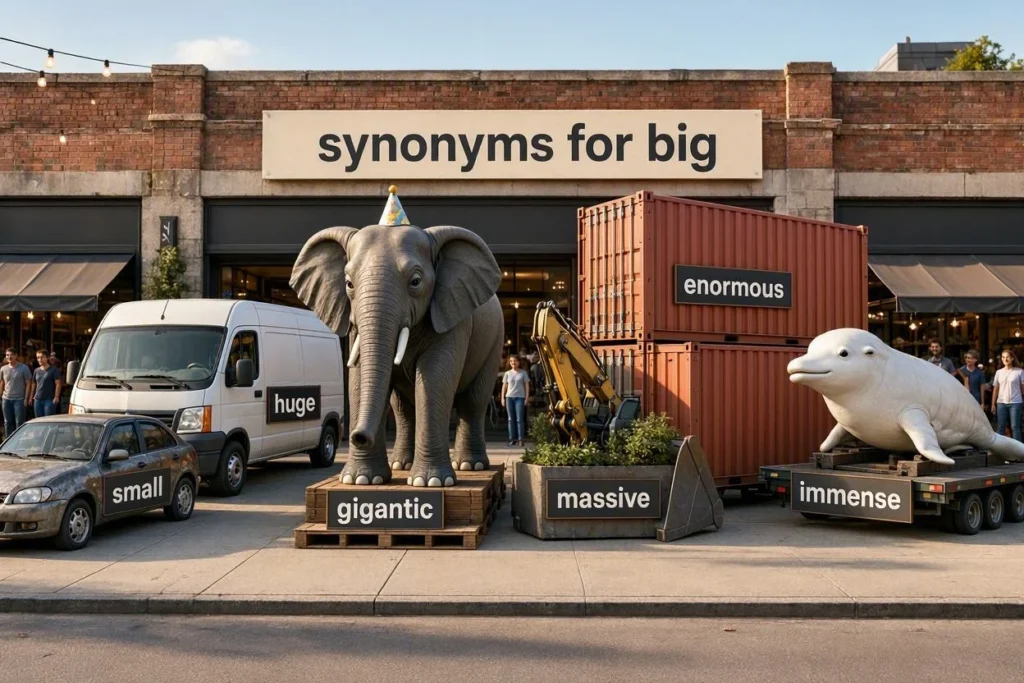
The best synonyms for big depend on the meaning and context. For physical size, use large, huge, enormous, massive, immense, or gigantic. For importance, use significant, major, substantial, or important. For quantities, considerable, substantial, or extensive may be more precise.
Quick List: Synonyms for Big
- Large
- Huge
- Enormous
- Massive
- Immense
- Gigantic
- Giant
- Colossal
- Tremendous
- Vast
- Enormous
- Substantial
- Considerable
- Sizeable
- Sizable
- Extensive
- Major
- Significant
- Important
- Great
- Grand
- Mammoth
- Monumental
- Astronomical
- Expansive
- Spacious
- Hefty
- Bulky
- Oversized
- Towering
- Mighty
- Encompassing
- Extensive
- Abundant
- Generous
What Does Big Mean?
Big is a common adjective with several meanings. It can describe physical size, quantity, importance, intensity, influence, age, or significance.
For example:
They live in a big house.
Here, big refers to physical size.
She made a big decision.
Here, big means important or significant.
The company experienced a big increase in sales.
Here, big describes the size or degree of an increase.
Because the word has so many uses, the best synonym depends on what big means in the sentence.
Closest Synonyms for Big
Large
Large is the closest general synonym for big when talking about physical size or quantity.
They bought a large house.
It is neutral, natural, and suitable for formal and informal writing.
Huge
Huge means very large in size, amount, or degree.
A huge crowd gathered outside.
It is stronger than large and is common in everyday language.
Enormous
Enormous describes something extremely large.
The project required an enormous amount of time.
It emphasizes size or quantity more strongly than large.
Massive
Massive suggests great physical size, weight, scale, or impact.
The building has massive stone walls.
It is particularly useful when something feels substantial or imposing.
Immense
Immense means extremely large or great in size, amount, or degree.
The ocean has immense depth.
It works well in descriptive, formal, and literary writing.
Gigantic
Gigantic means extraordinarily large.
A gigantic statue stood at the entrance.
It is vivid and emphasizes physical size.
Vast
Vast usually describes something covering a large area or involving a very large amount.
They explored a vast desert.
It works especially well with areas, spaces, quantities, and subjects.
Tremendous
Tremendous can mean very large, powerful, impressive, or intense.
The team made tremendous progress.
Unlike gigantic, it does not necessarily describe physical size.
Stronger Synonyms for Big
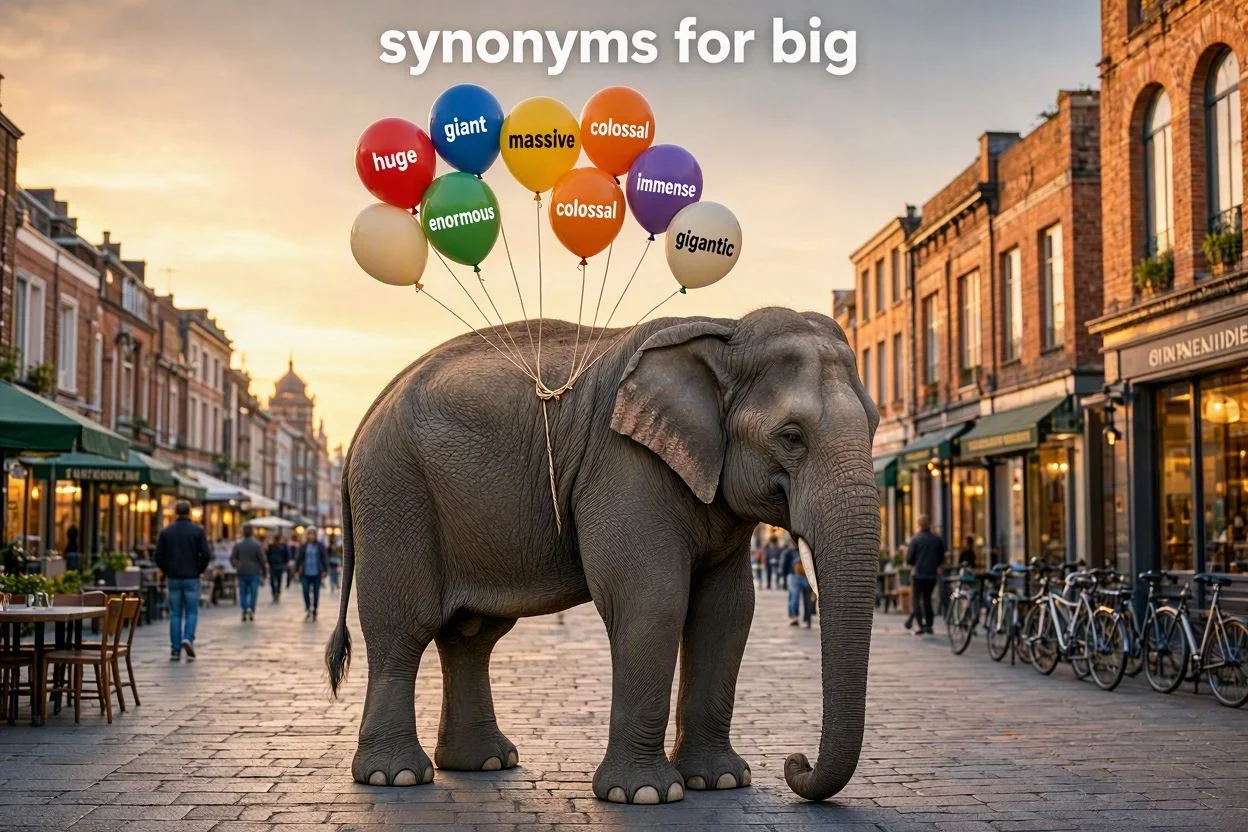
When big does not seem strong enough, these alternatives can emphasize extreme size.
| Word | Meaning | Example |
|---|---|---|
| Huge | Very large | A huge building |
| Enormous | Extremely large | An enormous crowd |
| Massive | Very large and substantial | A massive structure |
| Immense | Extremely great in size or degree | Immense pressure |
| Gigantic | Exceptionally large | A gigantic animal |
| Colossal | Extremely large or important | A colossal mistake |
| Mammoth | Exceptionally large or demanding | A mammoth project |
| Vast | Very large in area or amount | A vast landscape |
| Monumental | Extremely significant or important | A monumental achievement |
| Astronomical | Extremely large, especially numbers or costs | Astronomical expenses |
When to use stronger words
Choose the word based on what you want to emphasize.
- Huge → strong but conversational
- Enormous → extreme size or amount
- Massive → size, weight, or scale
- Immense → exceptional size or degree
- Gigantic → dramatic physical size
- Colossal → extreme scale or significance
- Mammoth → unusually large task, project, or effort
- Astronomical → extremely high numbers, costs, or amounts
Synonyms for Big Meaning Large in Size
When big refers specifically to physical dimensions, these words are useful:
- Large
- Huge
- Enormous
- Massive
- Immense
- Gigantic
- Giant
- Colossal
- Oversized
- Sizable
- Bulky
- Hefty
- Towering
- Expansive
- Spacious
- Mammoth
Examples
They bought a large sofa.
A massive truck blocked the road.
The museum has a vast interior.
She carried an oversized suitcase.
A towering building dominated the skyline.
These words are not always interchangeable. Bulky emphasizes awkward size, towering emphasizes height, and spacious emphasizes available room.
Synonyms for Big House
When describing a large house, choose a word that reflects the type of size you mean.
- Large
- Huge
- Spacious
- Expansive
- Grand
- Imposing
- Palatial
- Magnificent
- Roomy
- Substantial
Examples
They moved into a spacious house.
The family owns a grand home.
The mansion has an expansive interior.
They purchased a palatial residence.
Spacious focuses on available room, while grand suggests impressive appearance or scale. Palatial suggests a very luxurious and palace-like property.
Synonyms for Big Person
The appropriate synonym depends on what aspect of the person you want to describe.
For physical size
- Large
- Tall
- Big
- Hefty
- Broad
- Muscular
- Stocky
- Robust
For height
- Tall
- Towering
- Long-limbed
- Stately
For body build
- Broad
- Hefty
- Stocky
- Muscular
- Burly
- Sturdy
Be careful with these words because they describe different physical characteristics. Tall refers to height, hefty often suggests considerable weight, and muscular refers to developed muscles.
Synonyms for Big Amount
When big describes a quantity, alternatives such as substantial, considerable, extensive, significant, and large are often more precise.
Examples
The company received a large amount of funding.
The company received a substantial amount of funding.
The project requires a considerable amount of money.
They experienced a significant increase in demand.
Best choices
Substantial → a large amount that is meaningful or significant.
Considerable → an amount large enough to deserve attention.
Extensive → covering a broad amount, area, or range.
Significant → important or noticeably large.
Synonyms for Big Increase
When big describes an increase, use words that communicate scale or significance.
- Significant
- Substantial
- Considerable
- Major
- Dramatic
- Sharp
- Steep
- Pronounced
- Marked
- Notable
- Large
Examples
Sales experienced a significant increase.
The company reported a substantial increase in revenue.
There was a dramatic increase in demand.
The product saw a sharp increase in sales.
The best word depends on the nature of the increase. Sharp often suggests a rapid change, while substantial emphasizes the size of the change.
Synonyms for Big Decision
When big means important or consequential, physical-size synonyms do not work.
Useful alternatives include:
- Important
- Major
- Significant
- Critical
- Crucial
- Serious
- Consequential
- Pivotal
- Momentous
- Life-changing
Examples
She made a major decision about her career.
It was a pivotal decision for the organization.
They faced a critical decision.
Moving abroad was a life-changing decision.
Major is a natural general alternative. Pivotal emphasizes that the decision could significantly affect what happens next.
Synonyms for Big Problem
When big means serious or difficult, consider:
- Serious
- Major
- Significant
- Severe
- Critical
- Substantial
- Difficult
- Complex
- Pressing
- Formidable
Examples
The company faces a major problem.
They are dealing with a serious issue.
The project has a significant challenge.
The organization faces a critical problem.
Severe and critical are stronger than big and should be used when the circumstances justify that intensity.
Synonyms for Big Success
When big means highly successful or impressive, consider:
- Major
- Significant
- Outstanding
- Remarkable
- Tremendous
- Exceptional
- Spectacular
- Phenomenal
- Monumental
- Historic
Examples
The product was a major success.
The campaign achieved remarkable success.
It was a phenomenal success.
The discovery was a historic achievement.
Synonyms for Big Impact
When big describes the strength or importance of an effect, use:
- Significant
- Major
- Substantial
- Powerful
- Profound
- Considerable
- Far-reaching
- Dramatic
- Lasting
- Transformative
Examples
The policy had a significant impact.
The decision had far-reaching consequences.
The discovery had a profound impact on the field.
Profound suggests deep or meaningful impact, while far-reaching emphasizes effects that extend across many areas.
Formal and Professional Synonyms for Big
The word big is perfectly acceptable in everyday speech, but professional writing often benefits from more specific alternatives.
Useful choices include:
- Significant
- Substantial
- Considerable
- Major
- Extensive
- Notable
- Meaningful
- Pronounced
- Extensive
- Comprehensive
- Large-scale
Examples
Casual:
The company made a big investment.
Professional:
The company made a substantial investment.
Casual:
There was a big change in policy.
Professional:
There was a significant change in policy.
Casual:
The company has a big operation.
Professional:
The company operates on a large scale.
Academic Synonyms for Big
Academic writing often requires precision rather than simply choosing a stronger adjective.
Useful alternatives include:
- Significant
- Substantial
- Considerable
- Extensive
- Major
- Large-scale
- Pronounced
- Marked
- Comprehensive
- Widespread
Examples
The study identified a significant difference between the groups.
The policy resulted in a substantial reduction in costs.
Researchers observed a marked change in behavior.
The program produced widespread effects.
Avoid replacing big with an impressive-sounding word unless the alternative accurately describes the evidence or situation.
Synonyms for Big in Creative Writing
Creative writing gives you more freedom to use vivid and descriptive alternatives.
- Gigantic
- Colossal
- Towering
- Mammoth
- Immense
- Majestic
- Monumental
- Vast
- Grand
- Mighty
- Expansive
- Tremendous
Example
Instead of:
A big mountain stood before them.
You could write:
A towering mountain stood before them.
Or:
A colossal mountain rose above the valley.
The more specific word creates a clearer mental image.
Big vs Large
Big and large are often interchangeable when describing physical size.
They live in a big house.
They live in a large house.
The main difference is tone. Big is more conversational, while large is slightly more neutral and formal.
Large is often preferable in professional, technical, and academic writing.
Big vs Huge
Both describe something larger than average, but huge is stronger.
They bought a big house.
They bought a huge house.
The second sentence suggests considerably greater size.
Use big for general description and huge when the size is particularly noticeable.
Big vs Enormous
Enormous suggests extremely large size or quantity.
The company has a big customer base.
The company has an enormous customer base.
The second version emphasizes an exceptionally large number of customers.
Big vs Massive
Massive often suggests physical weight, substance, scale, or structural size.
A big wall surrounded the property.
A massive wall surrounded the property.
The second sentence creates a stronger impression of solidity and scale.
Big vs Immense
Immense means extremely large or great in size, amount, or degree.
They faced a big challenge.
They faced an immense challenge.
Immense sounds more formal and emphasizes an exceptional degree.
Big vs Vast
Vast is especially useful for areas, spaces, ranges, and quantities.
They crossed a big desert.
They crossed a vast desert.
The second sentence sounds more descriptive and emphasizes the enormous area.
Big vs Significant
These words overlap when big means important or influential, but they are not identical.
It was a big change.
It was a significant change.
Significant emphasizes importance, consequence, or noticeable effect rather than physical size.
Big vs Major
Major means important, serious, or substantial in scale.
The company announced a big change.
The company announced a major change.
Major is usually more appropriate in formal and professional contexts when big means important.
How to Choose the Right Synonym for Big
Ask yourself what big means in your sentence.
Is it about physical size?
Use:
large, huge, enormous, massive, immense, gigantic, or colossal.
Is it about area or space?
Use:
vast, expansive, extensive, spacious, or large-scale.
Is it about quantity?
Use:
substantial, considerable, extensive, significant, or abundant.
Is it about importance?
Use:
major, significant, important, crucial, pivotal, or momentous.
Is it about intensity?
Use:
strong, powerful, intense, tremendous, or dramatic.
Is it about success or achievement?
Use:
major, remarkable, outstanding, exceptional, phenomenal, or monumental.
Is it about a problem or challenge?
Use:
serious, major, substantial, severe, critical, or formidable.
Sentence Transformations: Better Alternatives to Big
1. Big house
Original:
They live in a big house.
Better Alternative:
They live in a spacious house.
Why: Spacious emphasizes the amount of usable space.
2. Big increase
Original:
The company reported a big increase in sales.
Better Alternative:
The company reported a substantial increase in sales.
Why: Substantial is more precise for professional writing.
3. Big decision
Original:
She made a big decision.
Better Alternative:
She made a major decision.
Why: Major communicates importance rather than physical size.
4. Big problem
Original:
The team has a big problem.
Better Alternative:
The team has a serious problem.
Why: Serious communicates the severity of the problem.
5. Big amount
Original:
They spent a big amount of money.
Better Alternative:
They spent a substantial amount of money.
Why: Substantial amount is more natural and polished.
6. Big impact
Original:
The invention had a big impact.
Better Alternative:
The invention had a profound impact.
Why: Profound emphasizes a deep and meaningful effect.
7. Big success
Original:
The campaign was a big success.
Better Alternative:
The campaign was a major success.
Why: Major is a natural professional alternative.
8. Big difference
Original:
There is a big difference between the two products.
Better Alternative:
There is a significant difference between the two products.
Why: Significant is more precise when discussing noticeable differences.
9. Big challenge
Original:
The project presents a big challenge.
Better Alternative:
The project presents a formidable challenge.
Why: Formidable suggests that the challenge is difficult to overcome.
10. Big opportunity
Original:
This is a big opportunity for the company.
Better Alternative:
This is a significant opportunity for the company.
Why: Significant works well in professional communication and emphasizes importance.
Common Mistakes When Using Synonyms for Big
1. Using every synonym as if it means exactly the same thing
Huge, vast, massive, spacious, and significant do not have identical meanings.
Choose based on the specific quality you want to describe.
2. Using physical-size words for importance
❌ The company made a gigantic decision.
✓ The company made a major decision.
Gigantic normally refers to physical size.
3. Overusing extremely strong words
Using colossal, gigantic, or enormous for ordinary things can make your writing sound exaggerated.
The meeting was a colossal event.
This may be inappropriate if the meeting was simply large.
4. Confusing vast with huge
Vast usually describes something spread over a large area, range, or amount.
A vast landscape
sounds natural.
A vast chair
does not.
5. Using spacious for objects
Spacious normally describes places or areas that have plenty of room.
A spacious apartment
is natural.
A spacious smartphone
is usually not.
6. Using significant when you only mean physically large
The significant building stood near the river.
This sounds like the building is important rather than physically large.
Use large, enormous, massive, or another size-related word if physical dimensions are the focus.
7. Using formal alternatives in casual conversation
Words such as substantial, considerable, and significant can sound unnecessarily formal in ordinary speech.
That’s a big dog.
is often more natural than:
That’s a substantial dog.
When Not to Replace Big
Big is not a bad word. It is one of the most common and flexible adjectives in English.
Keep big when:
- You are writing casually.
- The exact type of size is not important.
- The sentence sounds natural with big.
- You want a simple, conversational tone.
- A stronger synonym would exaggerate the meaning.
For example:
That’s a big dog.
We had a big problem.
She made a big mistake.
All three are natural.
Replacing every instance of big with a more advanced synonym can make writing sound unnatural. The goal is precision, not complexity.
Key Takeaways
- Large is the closest general synonym for big when describing physical size.
- Use huge, enormous, massive, immense, or gigantic when you need to emphasize extreme size.
- Choose substantial, considerable, or extensive when big refers to an amount, quantity, or scale.
- When big means important, use major, significant, crucial, pivotal, or consequential.
- The best alternative depends on meaning, context, tone, intensity, and grammar, not simply on finding a stronger word.