
Quick Answer
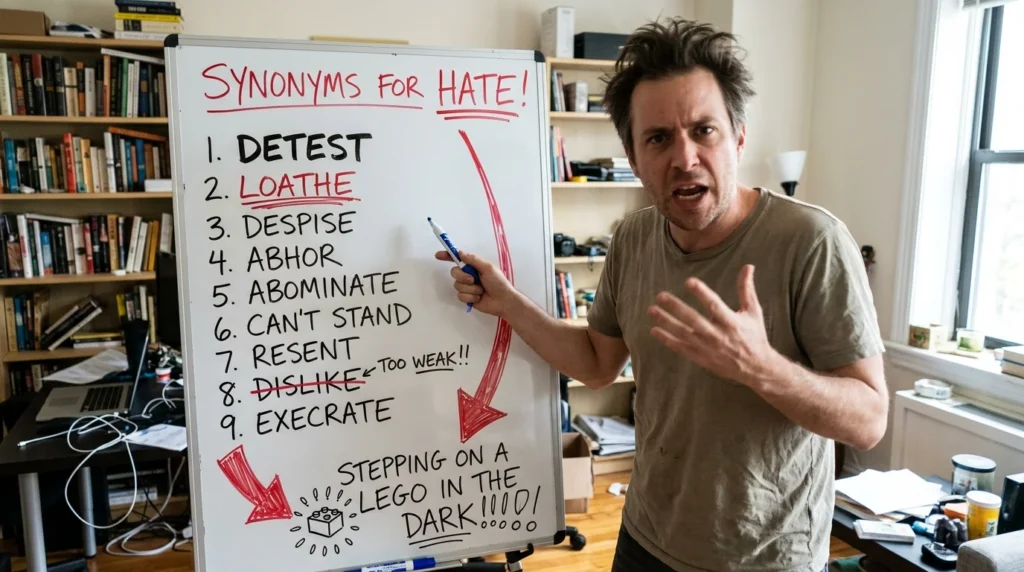
Some of the best synonyms for hate are detest, despise, loathe, abhor, dislike, resent, abominate, disdain, deplore, and disfavor. Use detest for intense dislike, despise for contempt, resent for bitterness, and dislike for a milder feeling. The best choice depends on the strength and nature of the emotion.
What Does “Hate” Mean?
Hate is a verb and noun that expresses intense dislike, deep hostility, or strong aversion toward a person, thing, activity, idea, or situation.
As a verb:
I hate waiting in long lines.
She hates dishonesty.
He hates being interrupted.
They hate the way the company treats its employees.
As a noun:
There was no love or hate between them.
The speech was filled with anger and hate.
The organization works to reduce hate and discrimination.
The word can express anything from everyday frustration to deep hostility. In casual conversation, someone might say, “I hate doing laundry,” without expressing a serious emotional feeling. In other contexts, hate can describe intense animosity toward a person or group.
Because “hate” has several meanings and levels of intensity, choosing a more precise synonym can help communicate your intended emotion.

40+ Synonyms for Hate
The following alternatives differ in intensity, tone, and meaning. Not every word can replace “hate” naturally in every sentence.
| Synonym | Meaning | Best context |
|---|---|---|
| Detest | Dislike intensely | General and formal writing |
| Despise | Regard with contempt | Strong personal or moral disapproval |
| Loathe | Feel intense aversion toward | Emotional and expressive writing |
| Abhor | Regard with intense disgust or hatred | Formal and moral contexts |
| Abominate | Hate or detest intensely | Formal or literary writing |
| Dislike | Feel negatively toward something | Everyday conversation |
| Resent | Feel bitterness about a perceived wrong | Personal relationships and unfair treatment |
| Disdain | Regard something or someone as unworthy | Formal and critical writing |
| Deplore | Strongly disapprove of something | Formal and public statements |
| Disfavor | Regard with less approval or support | Formal writing |
| Reject | Refuse to accept something | Decisions, beliefs, and proposals |
| Oppose | Act or express oneself against something | Politics, ideas, and decisions |
| Despise deeply | Feel profound contempt | Emphatic expression |
| Abhor deeply | Feel intense moral or emotional aversion | Formal or emphatic writing |
| Disapprove of | Consider something wrong or unsuitable | Polite and formal contexts |
| Be repulsed by | Feel strong disgust or aversion | Emotional or descriptive writing |
| Be disgusted by | Feel strong revulsion | Situations involving disgust |
| Be revolted by | Experience intense disgust | Strong descriptive writing |
| Be sick of | Be tired of or irritated by something | Informal conversation |
| Be fed up with | Be frustrated after enduring something | Casual conversation |
| Can’t stand | Find something extremely unpleasant | Everyday speech |
| Can’t bear | Find something very difficult to tolerate | Emotional writing |
| Have an aversion to | Strongly dislike or avoid something | Formal writing |
| Feel antipathy toward | Feel a strong dislike | Formal or literary writing |
| Feel animosity toward | Feel hostility or ill will | Serious conflict |
| Feel hostility toward | Feel antagonism or opposition | Formal and descriptive writing |
| Bear a grudge against | Continue to feel resentment | Personal conflict |
| Hold in contempt | Regard someone or something as unworthy of respect | Formal criticism |
| Look down on | Regard someone as inferior | Everyday conversation |
| Be hostile toward | Act or feel antagonistic | Conflict and relationships |
| Be antagonistic toward | Oppose or act against someone | Formal writing |
| Be intolerant of | Be unwilling to accept certain behavior or differences | Social and formal contexts |
| Abuse | Treat someone harmfully or cruelly | Conduct, not a direct synonym |
| Condemn | Express strong disapproval of something | Public or formal criticism |
| Denounce | Publicly criticize or reject something | Speeches, reports, and public statements |
| Detest intensely | Emphasize extreme dislike | Expressive writing |
| Hate passionately | Feel or express intense hatred | Emotional writing |
| Feel repugnance toward | Experience strong disgust or aversion | Formal or literary writing |
| Find repulsive | Regard something as deeply unpleasant | Descriptive writing |
| Find intolerable | Consider something impossible or extremely difficult to endure | Formal and everyday writing |
| Have no use for | Dislike or have little respect for someone or something | Informal conversation |
Important: Some entries are phrases or related expressions rather than exact synonyms. For example, oppose means to resist or disagree with something, while resent means to feel bitterness about it. Choose the word that preserves your intended meaning.
Best Synonyms for Hate
1. Detest
Detest is one of the closest synonyms for “hate.” It expresses very strong dislike and works in both everyday and formal writing.
Example:
I hate dishonesty.
Alternative:
I detest dishonesty.
The alternative sounds forceful and emphasizes how strongly the speaker dislikes dishonesty.
Best for: Strong personal preferences, moral disapproval, and formal writing.
Watch out: “Detest” is stronger than ordinary “dislike,” so it may sound excessive for a minor inconvenience.
2. Despise
Despise means to regard someone or something with contempt. It often suggests that the speaker considers the target unworthy of respect.
Example:
She hates people who exploit others.
Alternative:
She despises people who exploit others.
Best for: Moral criticism, serious personal conflict, and strong expressions of contempt.
Watch out: “Despise” often implies a judgment about worth or character, not just an unpleasant feeling.
3. Loathe
Loathe communicates deep, intense aversion. It is often emotional and expressive.
Example:
He hates public humiliation.
Alternative:
He loathes public humiliation.
Best for: Strong personal feelings, creative writing, and expressive descriptions.
Watch out: “Loathe” may sound dramatic in a casual or professional sentence about a small inconvenience.
4. Abhor
Abhor means to regard something with intense disgust or moral aversion. It is often used for actions, practices, or ideas considered deeply wrong.
Example:
They hate cruelty toward animals.
Alternative:
They abhor cruelty toward animals.
Best for: Formal writing, ethical discussions, and strong moral objections.
Watch out: “Abhor” sounds more formal than “hate” and is less common in everyday conversation.
5. Dislike
Dislike is a milder, more neutral alternative to “hate.” It communicates a negative feeling without necessarily suggesting intense hostility.
Example:
I hate crowded places.
Milder alternative:
I dislike crowded places.
Best for: Everyday conversation, polite communication, and professional writing.
Watch out: “Dislike” may weaken the meaning if you intend to express deep hatred.
6. Resent
Resent means to feel bitterness or anger because of something you consider unfair, insulting, or undeserved.
Example:
He hates being treated unfairly.
Alternative:
He resents being treated unfairly.
Best for: Personal relationships, workplace conflicts, unfair treatment, and lingering frustration.
Watch out: Resentment usually has a reason behind it. It is not simply another word for hating something.
7. Disdain
Disdain means to regard someone or something as unworthy of respect or consideration.
Example:
She hates dishonest business practices.
Alternative:
She regards dishonest business practices with disdain.
Best for: Formal writing, criticism, and situations involving contempt.
Watch out: “Disdain” often emphasizes a judgment of superiority or unworthiness rather than pure emotional hatred.
8. Abominate
Abominate means to hate or detest something intensely. It is a strong, relatively formal word.
Example:
He hates corruption.
Alternative:
He abominates corruption.
Best for: Formal, literary, or emphatic writing.
Watch out: “Abominate” is uncommon in everyday conversation and can sound overly elaborate.
9. Deplore
Deplore means to strongly disapprove of something or express regret about it.
Example:
The organization hates the use of violence against civilians.
Alternative:
The organization deplores the use of violence against civilians.
Best for: Official statements, public criticism, and formal discussions of harmful behavior.
Watch out: “Deplore” usually expresses strong disapproval rather than personal hatred. It can also carry a sense of regret.
10. Can’t Stand
Can’t stand is an informal expression meaning that someone finds a person, activity, or situation extremely unpleasant.
Example:
I hate getting stuck in traffic.
Alternative:
I can’t stand getting stuck in traffic.
Best for: Casual conversation, text messages, and informal writing.
Watch out: It is conversational and may not suit academic or highly formal writing.
11. Be Repulsed By
Be repulsed by expresses a strong feeling of disgust or aversion.
Example:
She hates cruelty.
Alternative:
She is repulsed by cruelty.
Best for: Describing strong emotional reactions to disturbing, offensive, or disgusting behavior.
Watch out: It focuses on disgust or revulsion rather than every possible meaning of “hate.”
12. Have an Aversion To
Have an aversion to means to strongly dislike or want to avoid something.
Example:
He hates taking unnecessary risks.
Alternative:
He has an aversion to taking unnecessary risks.
Best for: Formal writing, personal preferences, and descriptions of behavior.
Watch out: This phrase can sound clinical or formal compared with the direct word “hate.”
Synonyms for Hate by Intensity
Not every synonym expresses the same degree of dislike. Choosing the right strength helps your writing sound natural.
Mild Dislike
Use these when you want to express a negative preference without strong hostility.
Dislike
Not care for
Be unenthusiastic about
Be put off by
Have little affection for
Find unpleasant
Example:
I hate this type of music.
Milder alternatives:
I dislike this type of music.
I’m not particularly fond of this type of music.
Strong Dislike
Use these when you want to express an intense negative feeling.
Detest
Loathe
Abhor
Despise
Abominate
Can’t stand
Be repulsed by
Example:
She hates dishonesty.
Stronger alternatives:
She detests dishonesty.
She abhors dishonesty.
Hatred With Contempt
These words emphasize that someone or something is considered unworthy of respect.
Despise
Disdain
Hold in contempt
Look down on
Scorn
Example:
He hates people who cheat others.
Alternative:
He holds people who cheat others in contempt.
Note: “Scorn” and “disdain” focus on contempt and can sometimes involve dismissive behavior, not just a feeling of hatred.
Hatred With Anger or Bitterness
Use these when negative feelings are connected to a perceived wrong.
Resent
Bear a grudge against
Feel animosity toward
Feel hostility toward
Be bitter about
Example:
She hates her colleague for taking credit for her work.
More precise alternative:
She resents her colleague for taking credit for her work.
This version emphasizes the perceived unfairness behind the feeling.
Synonyms for Hate in Formal Writing
Formal writing often benefits from words that explain the nature of the negative feeling more precisely.
Useful alternatives include:
Detest
Abhor
Deplore
Disapprove of
Condemn
Feel antipathy toward
Regard with disdain
Hold in contempt
Express hostility toward
Examples
Original:
The report says the community hates corruption.
Alternative:
The report indicates that the community strongly opposes corruption.
Or:
The report describes widespread public opposition to corruption.
The second alternatives may be more appropriate in formal writing because they communicate opposition without assuming that everyone feels personal hatred.
Tip: In formal writing, use a precise term instead of choosing the strongest word automatically.
Synonyms for Hate in Academic Writing
Academic writing usually requires neutral, precise language. The best alternative depends on whether you are describing an emotion, a belief, a social attitude, or opposition to a practice.
Useful choices include:
Dislike
Antipathy
Hostility
Aversion
Resentment
Opposition
Disapproval
Negative attitudes toward
Strongly reject
Express hostility toward
Examples
Original:
Participants said they hate the new policy.
More neutral:
Participants expressed strong opposition to the new policy.
Original:
The character hates the ruling class.
More analytical:
The character expresses deep hostility toward the ruling class.
Tip: Do not replace “hate” with “hostility” or “opposition” if you specifically need to describe a person’s internal emotion. These words can describe broader attitudes or actions.
Synonyms for Hate in Professional Communication
In workplace writing, direct expressions of hatred can sound overly emotional. It is often better to describe the specific concern.
Consider these alternatives:
Strongly oppose
Disapprove of
Have concerns about
Object to
Be dissatisfied with
Resent
Find unacceptable
Disagree strongly with
Examples
Original:
I hate the new scheduling system.
More professional:
I have serious concerns about the new scheduling system.
Or:
I find the new scheduling system ineffective.
Original:
The team hates the proposed changes.
More professional:
The team strongly opposes the proposed changes.
Tip: Professional writing is usually clearer when it identifies the problem instead of relying on a strong emotional label.
Synonyms for Hate in Everyday Conversation
In casual speech, natural phrases often work better than formal words.
Try:
Dislike
Can’t stand
Can’t bear
Be sick of
Be fed up with
Not be a fan of
Not care for
Be annoyed by
Be tired of
Examples
I hate waking up early.
You could say:
I can’t stand waking up early.
Or:
I’m not a fan of waking up early.
Or:
I’m tired of waking up early.
These expressions differ slightly. “I’m tired of” often suggests repeated frustration, while “I’m not a fan of” is a softer way to express dislike.
Synonyms for Hate When Describing a Person
When you say you hate someone, you might mean that you dislike them, resent them, feel hostility toward them, or hold them in contempt. The right word depends on the reason for the feeling.
Useful alternatives include:
Dislike
Detest
Despise
Loathe
Resent
Feel antipathy toward
Feel animosity toward
Hold in contempt
Be hostile toward
Examples
Original:
He hates his former business partner.
Depending on the situation, you could write:
He dislikes his former business partner.
He resents his former business partner for breaking their agreement.
He despises his former business partner.
He feels deep animosity toward his former business partner.
Each version communicates a different emotional reason or intensity.
Synonyms for Hate When Describing an Activity
When “hate” refers to an activity, it often means that you strongly dislike doing it rather than feeling actual hostility.
Useful alternatives include:
Dislike
Can’t stand
Can’t bear
Be reluctant to
Dread
Be fed up with
Not enjoy
Be averse to
Examples
Original:
I hate exercising in hot weather.
Alternatives:
I dislike exercising in hot weather.
I can’t stand exercising in hot weather.
I dread exercising in hot weather.
Important: “Dread” means to anticipate something with fear or apprehension. It works when you dislike the prospect of an activity, not simply when you dislike the activity itself.
Synonyms for Hate When Describing an Idea or Belief
When “hate” refers to a policy, belief, practice, or proposal, you may mean that you reject it, disagree with it, or consider it morally wrong.
Useful alternatives include:
Oppose
Reject
Disapprove of
Condemn
Denounce
Deplore
Object to
Strongly disagree with
Examples
Original:
They hate the proposed law.
Alternatives:
They oppose the proposed law.
They strongly object to the proposed law.
They condemn the proposed law.
The best choice depends on whether the people are simply against the law, disagree with it, or publicly criticize it.
Synonyms for Hate in Creative Writing
Creative writing often benefits from precise verbs that reveal a character’s emotions and motivations.
Consider:
Loathe
Despise
Abhor
Detest
Scorn
Resent
Abominate
Feel revulsion toward
Hold in contempt
Feel bitter toward
Example
Basic sentence:
She hated him.
More specific alternatives:
She despised him for his cruelty.
She resented him for betraying her trust.
She loathed the memory of their final argument.
She held him in contempt for his dishonesty.
These sentences give readers more information about the nature of the character’s feelings.
Hate vs. Detest
Hate is a broad word for intense dislike or hostility. Detest also expresses intense dislike but often sounds slightly more deliberate or formal.
Compare:
I hate dishonesty.
I detest dishonesty.
Both sentences are natural. “Detest” can sound more emphatic, but the difference is not absolute.
Use “detest” when you want a strong alternative without changing the basic meaning too much.
Hate vs. Despise
Despise adds a sense of contempt. It suggests that the person or thing is considered unworthy of respect.
Compare:
He hates corruption.
He despises corruption.
The second can communicate a more judgmental attitude toward corruption.
Use “despise” when contempt or moral condemnation is part of the intended meaning.
Hate vs. Loathe
Loathe expresses deep aversion and often has a more emotional or expressive tone.
Compare:
She hates being humiliated.
She loathes being humiliated.
Both are correct. “Loathe” makes the feeling sound especially intense.
Use “loathe” when you want to emphasize strong personal aversion.
Hate vs. Abhor
Abhor often expresses intense disgust or moral revulsion.
Compare:
They hate cruelty.
They abhor cruelty.
The second sounds more formal and may communicate a strong moral reaction.
Use “abhor” when the feeling involves profound disgust or ethical disapproval.
Hate vs. Dislike
Dislike is considerably milder than “hate” in many contexts.
Compare:
I hate spicy food.
I dislike spicy food.
The first suggests a stronger negative feeling. The second sounds more neutral and measured.
Use “dislike” when you want to express a preference without exaggerating your reaction.
Hate vs. Resent
Resent emphasizes bitterness about something perceived as unfair, insulting, or undeserved.
Compare:
She hates her manager.
She resents her manager for taking credit for her work.
The second sentence explains the source of the feeling and is more specific.
Use “resent” when the emotion is connected to a perceived wrong.
Hate vs. Disdain
Disdain emphasizes contempt or a feeling that something is unworthy of respect.
Compare:
He hates their dishonest methods.
He regards their dishonest methods with disdain.
The second focuses more on contempt than on hatred itself.
Use “disdain” when the judgment of unworthiness is central to the meaning.
Hate vs. Oppose
Oppose means to disagree with, resist, or work against something. It does not necessarily imply personal hatred.
Compare:
She hates the new policy.
She opposes the new policy.
The second is more neutral and focuses on disagreement or resistance.
Use “oppose” for proposals, policies, plans, decisions, or actions when you mean disagreement rather than an emotional feeling.
Stronger Synonyms for Hate
If you want to express intense dislike, consider:
Loathe
Detest
Despise
Abhor
Abominate
Scorn
Feel deep animosity toward
Hold in contempt
Be repulsed by
Examples
Hate dishonesty → Detest dishonesty
Hate cruelty → Abhor cruelty
Hate someone’s behavior → Despise someone’s behavior
Hate a disturbing experience → Be repulsed by the experience
Choose a stronger word only when it accurately reflects the intended emotion.
Softer Synonyms for Hate
If you want to express dislike without sounding too harsh, consider:
Dislike
Not care for
Not be fond of
Not be a fan of
Be uncomfortable with
Be dissatisfied with
Find unpleasant
Have reservations about
Examples
Strong:
I hate your suggestion.
Softer:
I have some reservations about your suggestion.
Or:
I’m not sure your suggestion is the best option.
These alternatives can be especially useful in professional conversations, disagreements, and polite feedback.
10 Sentence Transformations Using Synonyms for Hate
1. Strong Dislike
Original:
I hate dishonesty.
Alternative:
I detest dishonesty.
Why: “Detest” preserves the sense of intense dislike.
2. Contempt
Original:
She hates people who exploit others.
Alternative:
She despises people who exploit others.
Why: “Despises” adds a sense of contempt.
3. Deep Aversion
Original:
He hates being humiliated.
Alternative:
He loathes being humiliated.
Why: “Loathes” emphasizes deep personal aversion.
4. Moral Disgust
Original:
They hate cruelty toward animals.
Alternative:
They abhor cruelty toward animals.
Why: “Abhor” is particularly suitable for strong moral aversion.
5. Mild Preference
Original:
I hate crowded restaurants.
Alternative:
I dislike crowded restaurants.
Why: “Dislike” expresses a milder, more neutral preference.
6. Bitterness About Unfairness
Original:
She hates being excluded from important decisions.
Alternative:
She resents being excluded from important decisions.
Why: “Resents” highlights the sense of unfairness.
7. Professional Disagreement
Original:
I hate the proposed changes.
Alternative:
I strongly oppose the proposed changes.
Why: “Oppose” communicates disagreement without implying personal hatred.
8. Everyday Frustration
Original:
He hates waiting in traffic.
Alternative:
He can’t stand waiting in traffic.
Why: “Can’t stand” sounds natural in casual conversation.
9. Strong Disgust
Original:
She hates the smell of spoiled food.
Alternative:
She is repulsed by the smell of spoiled food.
Why: “Repulsed by” emphasizes disgust.
10. Polite Feedback
Original:
I hate this approach.
Alternative:
I have serious concerns about this approach.
Why: The alternative is more constructive and appropriate in many professional situations.
Best Synonyms for Hate by Context
| Context | Best alternatives |
|---|---|
| General use | Detest, dislike, loathe |
| Strong emotional dislike | Loathe, detest, abhor |
| Contempt | Despise, disdain, hold in contempt |
| Moral disapproval | Abhor, deplore, condemn |
| Bitterness about unfairness | Resent, bear a grudge against |
| Casual conversation | Can’t stand, be sick of, be fed up with |
| Formal writing | Detest, abhor, feel antipathy toward |
| Academic writing | Antipathy, aversion, hostility, opposition |
| Professional communication | Strongly oppose, disapprove of, have concerns about |
| Creative writing | Loathe, despise, scorn, resent |
| Disgust | Be repulsed by, be revolted by |
| Disagreement | Oppose, reject, object to |
| Mild dislike | Dislike, not care for, not be fond of |
| Long-standing conflict | Feel animosity toward, bear a grudge against |
Common Mistakes When Using Synonyms for Hate
1. Using “despise” when you only mean “dislike”
“Despise” suggests contempt, which is stronger than a simple negative preference.
If you merely dislike a food, activity, or style, “dislike” is usually more natural.
2. Using “resent” without a reason for bitterness
“Resent” usually implies that someone feels wronged or treated unfairly.
I resent being ignored during the meeting.
This suggests that the speaker sees the treatment as unfair. If you simply dislike being ignored, another expression may be more accurate.
3. Using “abhor” in casual conversation
“Abhor” is correct but often sounds formal.
In everyday conversation, “I hate that behavior” or “I can’t stand that behavior” may sound more natural.
4. Confusing “oppose” with “hate”
You can oppose a policy without hating it. Opposition describes resistance or disagreement, not necessarily an emotional reaction.
5. Confusing “deplore” with personal hatred
“Deplore” commonly expresses strong disapproval or regret. It does not always mean the speaker personally hates the subject.
6. Using “disdain” when you mean fear or anger
“Disdain” emphasizes contempt or a lack of respect. It does not simply mean being afraid of someone or angry with them.
7. Making every negative feeling sound extreme
Words such as “abominate,” “loathe,” and “abhor” are powerful. Using them for minor annoyances can make your writing sound exaggerated.
8. Treating “can’t stand” as formal language
“Can’t stand” is common in conversation, but “strongly dislike” or “find unacceptable” may be more appropriate in formal documents.
9. Using “condemn” to describe a private feeling
“Condemn” usually means to express strong disapproval, often publicly or explicitly. It is not a direct replacement for every use of “hate.”
10. Replacing “hate” when it is already clear
“Hate” is a common, direct word. If it accurately communicates the feeling and suits the tone, a more elaborate synonym may not improve the sentence.
When Should You Keep the Word “Hate”?
You do not always need to replace “hate.”
The word is often appropriate in:
Casual conversations
Personal opinions
Dialogue and fiction
Emotional writing
Everyday descriptions of strong dislike
Direct statements about preferences
For example:
I hate getting up early.
This sounds natural in everyday English. Replacing it with “I have an intense aversion to waking up early” would sound unnecessarily formal.
Similarly:
The character hates injustice.
is a clear and effective sentence. Use “abhors injustice” if you specifically want a more formal or morally emphatic tone, but do not change the word simply for variety.
How to Choose the Right Synonym for Hate
Ask yourself what kind of negative feeling you want to express.
Do you mean general dislike?
Use dislike, not care for, or not be fond of.
Do you mean intense dislike?
Use detest, loathe, or abhor.
Do you mean contempt?
Use despise, disdain, or hold in contempt.
Do you mean bitterness about unfair treatment?
Use resent or bear a grudge against.
Do you mean moral disapproval?
Use abhor, deplore, or condemn, depending on the sentence.
Do you mean disagreement with a policy or proposal?
Use oppose, reject, or object to.
Do you mean disgust?
Use be repulsed by or be revolted by.
Do you want an informal expression?
Use can’t stand, be sick of, or be fed up with.
The best synonym is the one that expresses the right emotion and intensity—not necessarily the strongest or most sophisticated word.
True Synonyms vs. Related Alternatives
| Word or phrase | Relationship to “hate” | Interchangeability |
|---|---|---|
| Detest | Close synonym for intense dislike | Usually interchangeable |
| Loathe | Close synonym emphasizing aversion | Often interchangeable |
| Abhor | Close synonym emphasizing disgust or moral aversion | Context-dependent |
| Despise | Related synonym emphasizing contempt | Context-dependent |
| Dislike | Milder alternative | Interchangeable only when the intensity fits |
| Resent | Bitterness about a perceived wrong | Not always interchangeable |
| Disdain | Contempt or low regard | Context-dependent |
| Abominate | Strong synonym for intense hatred | Usually interchangeable in suitable formal contexts |
| Deplore | Strong disapproval or regret | Not a direct replacement in every sentence |
| Oppose | Disagreement or resistance | Not interchangeable for emotional hatred |
| Reject | Refusal to accept something | Not a direct synonym |
| Condemn | Express strong disapproval | Context-dependent |
| Can’t stand | Informal expression of strong dislike | Usually suitable in casual contexts |
| Be repulsed by | Strong disgust or aversion | Context-dependent |
| Bear a grudge against | Ongoing resentment | Not interchangeable in most contexts |
| Be fed up with | Frustration after repeated experience | Not a direct synonym |