

Quick Answer
Some of the best synonyms for family are relatives, kin, household, loved ones, clan, lineage, descendants, ancestors, family members, relations, and kindred. Use relatives for people related to you, household for people living together, loved ones for people close to your heart, and lineage for family ancestry.
What Does “Family” Mean?
The word family generally refers to a group of people connected by birth, marriage, adoption, or other close relationships. It can also describe people who share a household, ancestry, responsibilities, or a strong emotional bond.
For example:
My family lives in Texas.
She comes from a large family.
We invited our family to the celebration.
His family has lived in the town for generations.
My friends have become like family to me.
The meaning changes slightly depending on the context. In one sentence, “family” may refer to parents and children. In another, it may include grandparents, cousins, aunts, uncles, and other relatives. It can also describe a chosen family made up of people who provide love, support, and belonging.
Because the word has several meanings, the best synonym depends on the relationship or group you want to describe.
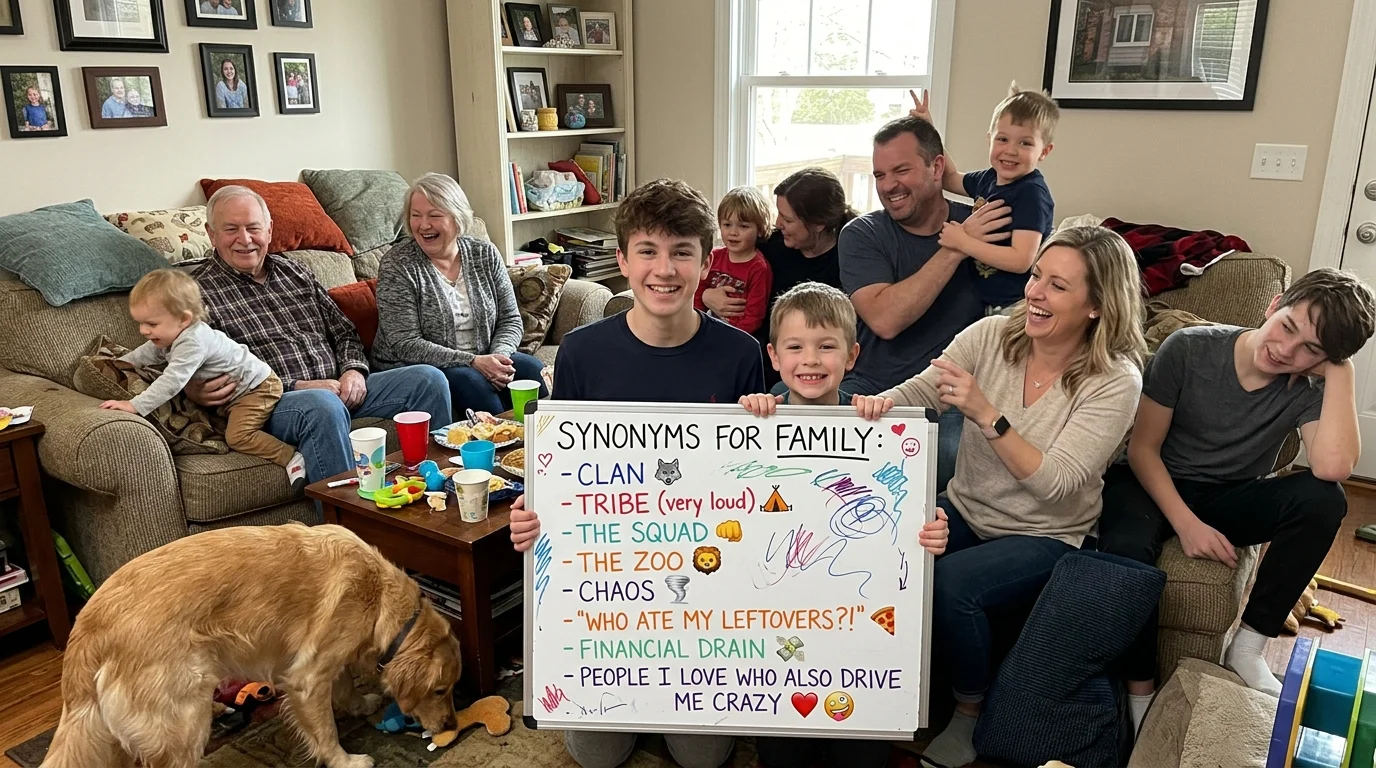
42+ Synonyms for Family
The following words and phrases offer alternatives to “family,” although some are contextual alternatives rather than exact synonyms.
| Synonym | Meaning | Best context |
|---|---|---|
| Relatives | People connected by birth, marriage, or adoption | General use |
| Kin | People related to someone | Traditional or literary writing |
| Relations | People connected through family ties | General or formal use |
| Household | People living together in one home | Housing, statistics, everyday use |
| Loved ones | People who are deeply cared for | Personal and emotional writing |
| Family members | Individual people belonging to a family | Clear, neutral writing |
| Clan | A group connected by ancestry or family ties | Cultural or historical contexts |
| Kindred | Relatives or people with a shared connection | Literary or formal writing |
| Lineage | A line of descent from ancestors | Genealogy and history |
| Ancestry | Family origins and descent | Genealogy and heritage |
| Descendants | People who come from a particular ancestor | Historical or genealogical writing |
| Ancestors | People from whom someone is descended | History and heritage |
| Housemates | People who share a home | Living arrangements, not necessarily family |
| Immediate family | Closest family members, often parents, children, and siblings | Personal or official contexts |
| Extended family | Relatives beyond the immediate family | General use |
| Kinfolk | Family members or relatives | Informal or regional English |
| Blood relatives | People related by biological descent | Biological relationships |
| Family circle | A person’s close family group | Personal writing |
| Family unit | A family considered as a single group | Social science or formal writing |
| Domestic unit | People organized around a shared home | Academic or administrative writing |
| Household members | People who live in the same household | Official and statistical contexts |
| Tribe | A social group that may share ancestry, culture, or identity | Cultural contexts; not a general replacement |
| Dynasty | A succession of rulers or influential family members | History and royalty |
| House | A family, especially a prominent or royal one | Royalty and history |
| Family tree | A diagram or record of family relationships | Genealogy |
| Genealogy | The study or record of family descent | Family history |
| Heritage | Traditions, history, or identity passed down through generations | Culture and ancestry |
| Roots | A person’s origins or ancestral background | Informal and personal writing |
| Descendants and ancestors | People across generations of a family line | Genealogy |
| Progeny | A person’s children or descendants | Formal or scientific writing |
| Offspring | Children or young produced by a parent | Biological or scientific contexts |
| Parents and children | The adult-child relationship within a family | Specific family structures |
| Siblings | Brothers and sisters | Specific family relationships |
| In-laws | Relatives connected through marriage | Marriage and family relationships |
| Cousins | Relatives who share a common ancestor, typically a grandparent or more distant ancestor | Specific relationships |
| Family network | Relatives and their connections | Social and professional contexts |
| Support system | People who provide practical or emotional help | Personal and emotional contexts |
| Chosen family | People treated as family despite not necessarily being related | Personal and inclusive writing |
| Circle of loved ones | People who are emotionally close | Warm, expressive writing |
| Household family | Family members who live together | Descriptive contexts |
| Family lineage | A person’s line of descent | Ancestry and genealogy |
| Family branch | A subgroup descended from a particular ancestor | Family history |
Important: These alternatives are not all interchangeable. For example, household refers to people living together, while lineage refers to descent through generations. Choose the word that matches your intended meaning.
Best Synonyms for Family
1. Relatives
Relatives is one of the closest alternatives to “family” when referring to people connected through birth, marriage, or adoption.
Example:
We invited our family to the wedding.
Alternative:
We invited our relatives to the wedding.
Best for: Everyday conversation, invitations, family gatherings, and general descriptions.
Watch out: “Relatives” may sound more focused on the relationship itself than on emotional closeness. Friends who feel like family are not usually called relatives.
2. Kin
Kin is a concise word meaning people who are related to someone. It can sound traditional, literary, or formal depending on the sentence.
Example:
He returned to his family after many years.
Alternative:
He returned to his kin after many years.
Best for: Literature, historical writing, cultural discussions, and descriptions of ancestry.
Watch out: “Kin” is less common in everyday American English than “family” or “relatives.”
3. Household
Household refers to the people who live together in one home. They may be related, but they do not have to be.
Example:
Her family includes four people.
Alternative, if they all live together:
Her household includes four people.
Best for: Housing, census data, household budgets, official forms, and living arrangements.
Watch out: A household can include roommates or unrelated people, so it does not always mean family.
4. Loved Ones
Loved ones emphasizes affection and emotional connection rather than a formal relationship.
Example:
He spent the holidays with his family.
Alternative:
He spent the holidays with his loved ones.
Best for: Personal messages, celebrations, sympathy messages, speeches, and emotional writing.
Watch out: Loved ones may include friends, partners, or other close people who are not relatives.
5. Family Members
Family members is a clear, neutral phrase for individuals who belong to a family.
Example:
All family members attended the reunion.
Alternative:
All members of the family attended the reunion.
Best for: Professional writing, school communications, official notices, and situations where clarity matters.
Watch out: This is a phrase-level alternative rather than a shorter synonym. It is often more useful for precision than for variety.
6. Clan
A clan is a group of people connected through ancestry, kinship, or a shared family identity. In some cultures, clans have important social and historical roles.
Example:
The family has lived in the region for centuries.
Alternative, if the group has a shared ancestral identity:
The clan has lived in the region for centuries.
Best for: Historical writing, genealogy, cultural traditions, and descriptions of extended kinship groups.
Watch out: A clan is not simply another word for every modern family. It can have specific cultural meanings.
7. Kindred
Kindred refers to relatives or people connected through family ties. It may also describe people who share similar qualities or interests.
Example:
She gathered with her family for the celebration.
Alternative:
She gathered with her kindred for the celebration.
Best for: Literary writing, historical settings, and expressive descriptions.
Watch out: “Kindred” can sound old-fashioned. In expressions such as “kindred spirits,” it refers to people with similar feelings or interests, not necessarily relatives.
8. Lineage
Lineage refers to a line of descent from an ancestor or group of ancestors.
Example:
The family traces its history back several generations.
Alternative:
The family traces its lineage back several generations.
Best for: Genealogy, ancestry research, history, and discussions of inherited descent.
Watch out: Lineage describes a family line, not the group of relatives who gather for dinner or live in a home.
9. Ancestry
Ancestry refers to a person’s family origins or the ancestors from whom they descend.
Example:
She researched her family’s history.
Alternative:
She researched her ancestry.
Best for: Family trees, heritage, genealogy, and cultural background.
Watch out: Ancestry is about origins and descent, not a direct substitute for “family” in every sentence.
10. Extended Family
Extended family refers to relatives beyond the immediate family, such as grandparents, aunts, uncles, and cousins.
Example:
Our family gathers every summer.
Alternative, if many generations and branches attend:
Our extended family gathers every summer.
Best for: Family reunions, holidays, cultural traditions, and discussions of larger family networks.
Watch out: “Extended family” is more specific than “family.” It should not replace the word when you mean only parents and children.
11. Immediate Family
Immediate family usually refers to a person’s closest family members, often parents, children, and siblings. The exact definition can vary by context.
Example:
Only close family members attended the ceremony.
Alternative:
Only her immediate family attended the ceremony.
Best for: Weddings, funerals, personal announcements, and official policies.
Watch out: The precise meaning may differ across institutions and legal or administrative settings.
12. Kinfolk
Kinfolk is an informal or regional term for relatives and family members.
Example:
He visited his family in the countryside.
Alternative:
He visited his kinfolk in the countryside.
Best for: Informal conversation, regional storytelling, and warm descriptions of family gatherings.
Watch out: It may sound folksy or old-fashioned in formal writing.
Synonyms for Family in Different Contexts
Synonyms for Family in Formal Writing
In formal writing, choose words that communicate the exact relationship or group you mean.
Useful alternatives include:
Relatives
Family members
Household members
Immediate family
Extended family
Kin
Lineage, when referring to descent
Example:
Family members must complete the registration form.
This is clearer than using an unusual alternative simply to avoid repeating “family.”
Synonyms for Family in Academic Writing
Academic writing may distinguish between a household, a kinship group, and a family unit.
Useful terms include:
Household
Family unit
Kinship group
Family members
Extended family
Relatives
Domestic unit
Example:
The study examined how family influences children’s development.
Depending on the study’s scope, this could become:
The study examined how the household environment influences children’s development.
However, this changes the focus from family relationships to the home environment. Use the alternative only if it reflects the research accurately.
Synonyms for Family in Professional Writing
In workplace, administrative, or service-related writing, clear phrases are often preferable.
Useful choices include:
Family members
Household members
Immediate family
Dependents, when referring to people financially supported by someone
Relatives
Loved ones, for warmer communication
Example:
Employees may add family members to the benefits plan.
A more specific version might be:
Employees may add eligible dependents to the benefits plan.
Watch out: “Dependents” has a financial or administrative meaning. It does not include every relative.
Synonyms for Family in an Essay
The best alternative depends on what your essay discusses.
Use relatives for people connected by family ties.
Use household for people living together.
Use kinship group for social or cultural relationships.
Use lineage for ancestry.
Use loved ones for emotional connection.
Use extended family for relatives beyond the immediate family.
Example:
Family plays an important role in shaping identity.
If the essay focuses on emotional relationships, you might write:
Relationships with loved ones can play an important role in shaping identity.
If it focuses on shared living arrangements, “household” may be more precise.
Synonyms for Family in Casual Conversation
Everyday alternatives include:
Relatives
Loved ones
Kin
Family members
The folks, in some informal contexts
My people, when referring affectionately to a close group
Kinfolk
Examples:
I’m visiting my family this weekend.
I’m visiting my relatives this weekend.
I’m spending the weekend with my loved ones.
The best option depends on whether you mean relatives specifically or people you feel close to.
Synonyms for Family Meaning “People You Love”
When you want to emphasize affection and belonging, consider:
Loved ones
Close family
Family circle
Chosen family
Support system
Circle of loved ones
My people, in informal speech
Examples:
She is surrounded by her loved ones.
Her chosen family supported her through a difficult time.
He spent the evening with his family circle.
These expressions emphasize emotional connection, but they are not all exact synonyms. A support system may include friends, coworkers, or professionals as well as family.
Synonyms for Family Meaning “Relatives”
When referring specifically to people related to you, use:
Relatives
Kin
Relations
Kinfolk
Extended family
Blood relatives, when biological relationship matters
In-laws, for relatives connected through marriage
Examples:
Many of my relatives live nearby.
I am visiting my kin.
We invited our extended family to the reunion.
Choose blood relatives only when you specifically mean biological relationships. Adoption and marriage can create family relationships that are equally valid without being biological.
Synonyms for Family Meaning “Household”
If you mean people who live in the same home, use:
Household
Household members
Domestic unit
People living together
Household group
Example:
The family has three people living in the house.
Alternative:
The household has three members.
The distinction matters because a household may include unrelated roommates, while a family can live in separate homes.
Synonyms for Family Meaning “Ancestry”
If your focus is where a family comes from or how its generations are connected, consider:
Lineage
Ancestry
Descent
Family tree
Genealogy
Roots
Heritage
Family line
Examples:
She researched her ancestry.
The historical record documents his lineage.
He is proud of his family’s heritage.
They created a family tree.
These words describe different aspects of family history. Genealogy is the study or record of family descent, while heritage often includes cultural traditions and history as well as ancestry.
Synonyms for Family in Emotional or Creative Writing
For warm, expressive writing, the following phrases may work well:
Loved ones
Chosen family
Family circle
Close-knit family
Circle of loved ones
Kindred
People closest to me
Those I hold dear
Example:
Family is always there when you need support.
More expressive:
The people we hold dear can give us a sense of belonging and support.
The alternative should match your message. “Those I hold dear” sounds more poetic than the everyday word “family.”
Family vs. Relatives
Family is broader and can emphasize belonging, relationships, or a shared household. Relatives specifically refers to people connected through family relationships.
Compare:
I spend every holiday with my family.
This may include relatives and people who feel like family.
I spend every holiday with my relatives.
This more specifically refers to people related to you.
Use “relatives” when the family relationship itself is important. Keep “family” when you mean the group as a whole or want to emphasize belonging.
Family vs. Household
Family describes a relationship group. Household describes people who live together.
For example:
Their family includes grandparents, parents, and children.
Their household includes five people.
The family may include relatives who live elsewhere. A household may also include roommates or other people who are not related.
Family vs. Kin
Kin is a shorter, more traditional word for relatives or family relations.
She visited her family.
She visited her kin.
Both can be understood, but the second sentence sounds more literary or old-fashioned in everyday American English.
Use kin when the tone fits; otherwise, family or relatives is usually more natural.
Family vs. Clan
A clan is often a larger group linked by ancestry or a shared cultural identity. It can carry specific cultural, historical, or social meanings.
The family gathered for the holiday.
The clan gathered for the ceremony.
The second sentence may suggest a broader ancestral group or a culturally significant gathering. Do not use “clan” as a universal replacement for “family.”
Family vs. Lineage
Family refers to people and relationships. Lineage refers to a line of descent.
Compare:
She comes from a large family.
She comes from a long lineage of artists.
The first describes a group of relatives. The second emphasizes generations of ancestry and inherited tradition.
Family vs. Loved Ones
Loved ones emphasizes affection rather than biological, legal, or household relationships.
He invited his family to the celebration.
He invited his loved ones to the celebration.
The second can include close friends or a partner who is not a relative.
Use loved ones when emotional connection matters more than the exact relationship.
Family vs. Chosen Family
A chosen family is a group of people who provide family-like love, care, and support, whether or not they are related by birth, marriage, or adoption.
She relies on her family for support.
She relies on her chosen family for support.
The second emphasizes relationships built through trust and mutual care rather than conventional family ties.
10 Sentence Transformations Using Synonyms for Family
Here are examples of how to choose a more precise alternative to “family.”
1. Family gathering
Original:
We had a large family gathering.
Alternative:
We had a large relatives’ gathering.
A more natural option is often:
We had a large extended-family gathering.
2. Family living together
Original:
The family has four people living in the house.
Alternative:
The household has four members.
Why: “Household” focuses on the people living together.
3. Family relationships
Original:
She invited her family to dinner.
Alternative:
She invited her relatives to dinner.
Why: This emphasizes people connected through family relationships.
4. Family ancestry
Original:
He researched his family’s history.
Alternative:
He researched his ancestry.
Why: “Ancestry” focuses on family origins and descent.
5. Family descendants
Original:
The family has lived there for generations.
Alternative:
The descendants of the original settlers have lived there for generations.
Why: “Descendants” is appropriate when referring to people who came after a particular ancestor or group.
6. Family support
Original:
Her family supported her during the difficult time.
Alternative:
Her loved ones supported her during the difficult time.
Why: This emphasizes emotional care and can include close friends.
7. Family heritage
Original:
He is proud of his family’s history and traditions.
Alternative:
He is proud of his family heritage.
Why: “Heritage” emphasizes traditions, history, and cultural background.
8. Family line
Original:
The family traces its roots back several centuries.
Alternative:
The family traces its lineage back several centuries.
Why: “Lineage” focuses on descent across generations.
9. Family beyond parents and children
Original:
Her family came together for the reunion.
Alternative:
Her extended family came together for the reunion.
Why: This clarifies that the gathering includes relatives beyond the immediate family.
10. Family-like friendships
Original:
My family has always supported me.
Alternative, if referring to close friends:
My chosen family has always supported me.
Why: “Chosen family” describes meaningful relationships that are not necessarily based on biological or legal ties.
Best Synonyms for Family by Context
| Context | Best alternatives |
|---|---|
| General use | Relatives, family members, kin |
| Emotional writing | Loved ones, chosen family, family circle |
| Formal writing | Family members, relatives, household members |
| Academic writing | Household, kinship group, family unit |
| Family gathering | Relatives, extended family, kinfolk |
| Household | Household members, domestic unit |
| Ancestry | Lineage, ancestry, family line |
| Family history | Genealogy, family tree, heritage |
| Biological relationships | Blood relatives, ancestors, descendants |
| Marriage | In-laws, relatives by marriage |
| Children and parents | Immediate family, parents and children |
| Larger family group | Extended family, clan, kin group |
| Casual conversation | Relatives, loved ones, kinfolk |
| Workplace benefits | Eligible dependents, family members |
| Creative writing | Kindred, loved ones, those I hold dear |
Common Mistakes When Using Synonyms for Family
1. Using “household” when you mean relatives
A household is based on shared living arrangements, not necessarily family relationships.
Instead of:
My household is visiting for the reunion.
If you mean relatives, write:
My family is visiting for the reunion.
2. Using “lineage” to mean the people in a family
“Lineage” describes descent across generations rather than a group of relatives in everyday life.
Instead of:
My lineage came over for dinner.
Write:
My family came over for dinner.
3. Using “loved ones” when the exact relationship matters
“Loved ones” may include friends or partners who are not relatives.
If a policy applies specifically to legal or biological relatives, use the exact term required by that context.
4. Treating “clan” and “tribe” as universal synonyms
These words may carry specific cultural meanings. They should not be used casually as replacements for every type of family.
5. Using “descendants” to mean all relatives
Descendants are people who come after a particular ancestor. They do not include that person’s ancestors, siblings, or every collateral relative.
6. Using “dependents” to mean family members generally
Dependents are people who rely on someone for financial or other support, particularly in administrative contexts. Not every relative is a dependent.
7. Using “kin” in casual writing when it sounds unnatural
“Kin” is valid English, but “family” or “relatives” will often sound more natural in modern American conversation.
8. Replacing “family” just to avoid repetition
“Family” is a common, clear, and meaningful word. Replacing every instance with an unusual alternative can make your writing awkward.
9. Assuming all families share the same structure
Families may include biological relatives, adoptive relatives, step-relatives, spouses, partners, and chosen family. Use wording that reflects the people and relationships you mean.
When Should You Keep the Word “Family”?
You do not always need to replace “family.” It is often the most natural and inclusive choice when discussing:
Parents and children
Relatives as a group
Family traditions
Emotional support and belonging
Family celebrations
Family life
Family relationships
Chosen or adoptive family, when the context makes this clear
For example:
Family is important to many people.
This sentence is simple and natural. Replacing “family” with “kinship group” would make it more technical without necessarily making it better.
Use a synonym when it adds useful information, such as whether you mean relatives, household members, ancestry, or loved ones.
How to Choose the Right Synonym for Family
Ask yourself what aspect of family you want to emphasize.
Do you mean people related to you?
Use relatives, kin, or family members.
Do you mean people living in the same home?
Use household or household members.
Do you mean people you love and trust?
Use loved ones, chosen family, or family circle.
Do you mean relatives beyond parents and children?
Use extended family.
Do you mean your ancestors and origins?
Use ancestry, lineage, or family line.
Do you mean people who came after an ancestor?
Use descendants.
Do you mean a traditional or culturally significant ancestral group?
Use clan or kinship group only when the context supports it.
Do you mean people who depend on someone financially?
Use dependents when that is the precise meaning.
The best synonym is the one that preserves your intended meaning and fits the tone of the sentence.
True Synonyms vs. Related Alternatives
| Word or phrase | Relationship to “family” | Interchangeable? | Best use |
|---|---|---|---|
| Relatives | Close synonym | Often | People connected by family ties |
| Kin | Close, traditional synonym | Usually, depending on tone | Relatives or family relations |
| Family members | Phrase-level equivalent | Usually | Clear, neutral descriptions |
| Household | Related term | Context-dependent | People living together |
| Loved ones | Emotional alternative | Sometimes | People who matter deeply |
| Clan | Specific type of kinship group | No, not generally | Shared ancestry or cultural identity |
| Lineage | Related to family descent | No | A line of ancestry |
| Ancestry | Related concept | No | Origins and descent |
| Descendants | Narrower term | No | People descended from an ancestor |
| Ancestors | Narrower term | No | Earlier generations |
| Extended family | Specific family group | Context-dependent | Relatives beyond the immediate family |
| Immediate family | Specific family group | Context-dependent | Closest family members |
| Kinfolk | Informal or regional synonym | Usually, depending on tone | Relatives |
| Chosen family | Context-specific alternative | Sometimes | Family-like bonds not based on legal or biological ties |
| Housemates | Related living arrangement | No | People sharing a home |
| Support system | Related social concept | No | People who provide help |
| Heritage | Related cultural concept | No | Traditions and history passed down |
| Genealogy | Related field or record | No | Family descent and family history |
| Dependents | Administrative category | No | People financially or otherwise dependent on someone |
| Offspring | Biological or generational term | No | Children or young produced by a parent |