
Quick Answer
Some of the best synonyms for critical are crucial, essential, vital, important, significant, serious, severe, decisive, indispensable, analytical, evaluative, and judgmental. Use crucial for something extremely important, severe for a serious condition, analytical for careful examination, and judgmental for a person who tends to find fault.
What Does “Critical” Mean?
The word critical has several meanings, and the best synonym depends on how it is used.
1. Extremely important
When “critical” means essential to success or the outcome of a situation, synonyms include crucial, vital, essential, and indispensable.
Communication is critical to a successful team.
Alternative:
Communication is essential to a successful team.
2. Serious or dangerous
When “critical” describes a dangerous condition, serious problem, or urgent situation, alternatives include serious, severe, grave, and life-threatening.
The patient is in critical condition.
Alternative:
The patient is in serious condition.
The precise wording depends on the medical context; these expressions do not always have identical meanings.
3. Expressing criticism or disapproval
When “critical” means expressing negative opinions or finding faults, alternatives include disapproving, judgmental, fault-finding, and condemnatory.
She was critical of his decision.
Alternative:
She was disapproving of his decision.
4. Involving careful analysis
When “critical” means examining something carefully, alternatives include analytical, evaluative, discerning, and questioning.
Students need critical thinking skills.
Alternative:
Students need strong analytical thinking skills.
5. Involving a turning point
In some contexts, “critical” describes a decisive moment or stage when an outcome may change.
The project has reached a critical stage.
Alternative:
The project has reached a decisive stage.
Understanding these meanings helps you choose a synonym that preserves the intended message.
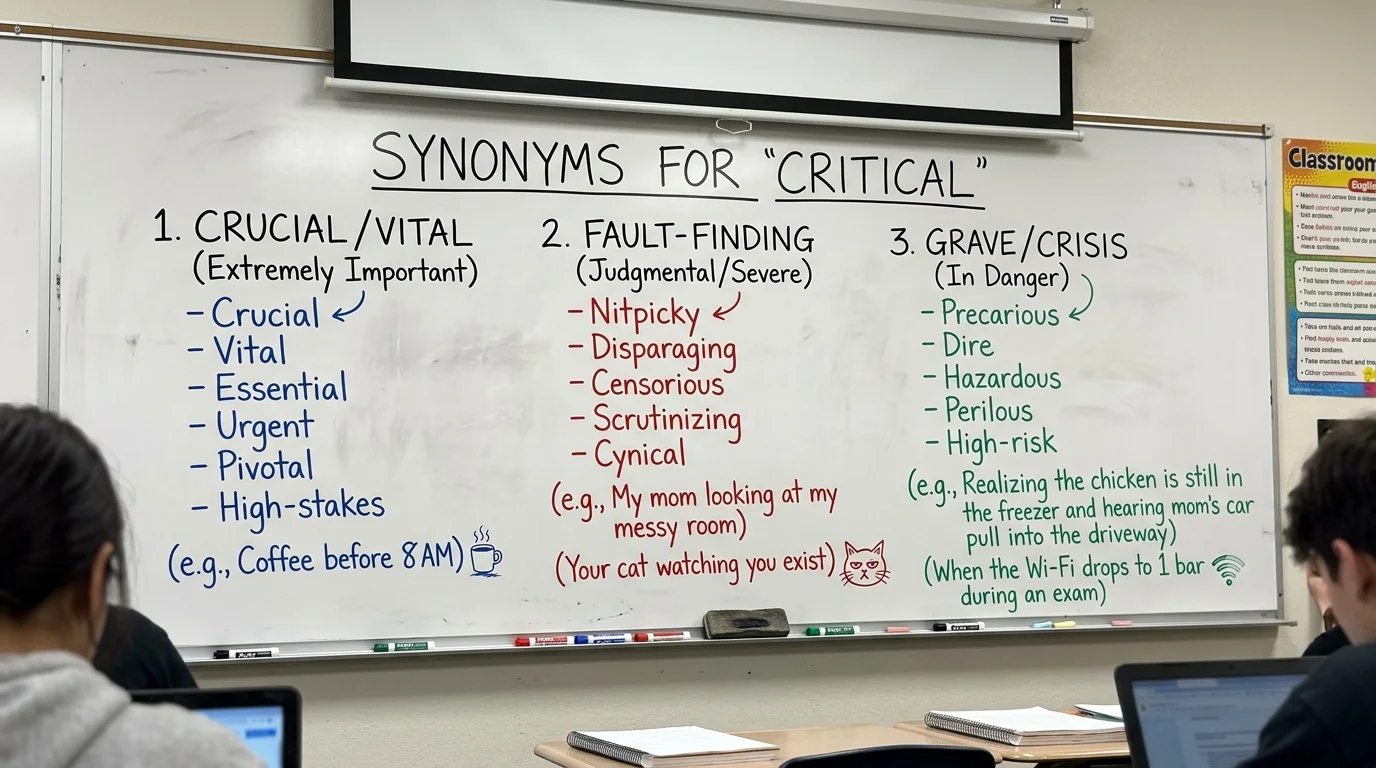
44+ Synonyms for Critical
The following table groups useful alternatives by their main meanings.
| Synonym | Meaning | Best context |
|---|---|---|
| Crucial | Extremely important to an outcome | Decisions, success, projects |
| Essential | Absolutely necessary | Requirements, processes |
| Vital | Necessary for life or success | Health, safety, important functions |
| Important | Having considerable value or influence | General use |
| Significant | Having notable meaning or effect | Academic and professional writing |
| Indispensable | Impossible or very difficult to do without | Resources, people, tools |
| Fundamental | Forming a necessary foundation | Principles, education, systems |
| Necessary | Needed for a purpose | Instructions, requirements |
| Key | Especially important to an outcome | Business, everyday writing |
| Pivotal | Having a major influence on what happens next | Turning points, decisions |
| Decisive | Determining the final result | Actions, moments, choices |
| Urgent | Requiring immediate attention | Problems, requests, tasks |
| Serious | Important, concerning, or potentially harmful | Problems, conditions |
| Severe | Very intense or extreme | Symptoms, weather, consequences |
| Grave | Very serious and potentially dangerous | Warnings, situations |
| Dire | Extremely serious or alarming | Circumstances, consequences |
| Alarming | Causing worry or fear | Reports, developments |
| Dangerous | Likely to cause harm | Conditions, situations |
| Life-threatening | Potentially causing death | Medical and safety contexts |
| Analytical | Involving systematic examination | Thinking, reasoning |
| Evaluative | Involving assessment or judgment | Research, reviews |
| Discerning | Showing good judgment and insight | People, decisions |
| Questioning | Examining or challenging assumptions | Discussion, inquiry |
| Skeptical | Doubting whether something is true | Claims, evidence |
| Judgmental | Inclined to judge or criticize others | Personal behavior |
| Disapproving | Expressing a negative opinion | Reactions, comments |
| Fault-finding | Focused on identifying mistakes | Behavior, reviews |
| Condemnatory | Expressing strong disapproval | Statements, commentary |
| Negative | Expressing unfavorable views | Feedback, reactions |
| Harsh | Severe or unkind in judgment | Comments, criticism |
| Censorious | Strongly inclined to criticize | Formal or literary writing |
| Disparaging | Showing disrespect or belittlement | Remarks, reviews |
| Constructive | Intended to help improve something | Feedback, criticism |
| Insightful | Showing a deep understanding | Analysis, observations |
| Rigorous | Thorough and exacting | Testing, analysis, evaluation |
| Thorough | Complete and detailed | Reviews, examinations |
| Decisive | Having the power to settle an issue | Turning points, evidence |
| Pivotal | Crucial to a major change or outcome | Events, decisions |
| High-priority | Deserving special attention | Tasks, workplace planning |
| Central | At the core of an issue | Themes, arguments |
| Paramount | More important than anything else | Formal writing, priorities |
| Momentous | Very important because of its consequences | Events, decisions |
| Imperative | Absolutely necessary or urgent | Instructions, formal writing |
| Consequential | Having important results | Actions, choices |
| Make-or-break | Determining success or failure | Informal writing, decisions |
Some entries are near synonyms or context-specific alternatives rather than exact replacements. For example, constructive describes helpful criticism, while skeptical describes doubt; neither simply means “critical” in every sense.
Best Synonyms for Critical
1. Crucial
Crucial is one of the closest synonyms for “critical” when something is extremely important to success or the outcome of a situation.
Example:
Planning is critical to the success of the event.
Alternative:
Planning is crucial to the success of the event.
Best for: Important decisions, projects, goals, and outcomes.
Watch out: “Crucial” emphasizes importance, not necessarily danger or criticism.
2. Essential
Essential describes something absolutely necessary for a purpose or result.
Example:
Clean water is critical for survival.
Alternative:
Clean water is essential for survival.
Best for: Requirements, resources, basic needs, and necessary conditions.
Watch out: Something can be important without being essential. Use “essential” when the necessity is clear.
3. Vital
Vital emphasizes importance to life, health, functioning, or success.
Example:
Accurate information is critical to the investigation.
Alternative:
Accurate information is vital to the investigation.
Best for: Health, safety, essential processes, and important resources.
Watch out: “Vital” can sound more urgent or forceful than “important.”
4. Significant
Significant describes something meaningful, noteworthy, or influential.
Example:
The research revealed a critical difference between the groups.
Alternative:
The research revealed a significant difference between the groups.
Best for: Academic writing, research, data, and professional reports.
Watch out: In statistics, “significant” can have a specific technical meaning. Do not use it to mean “statistically significant” unless the evidence supports that interpretation.
5. Important
Important is a broad, natural alternative when “critical” means having considerable value or influence.
Example:
This is a critical step in the process.
Alternative:
This is an important step in the process.
Best for: Everyday communication, general writing, and explanations.
Watch out: “Important” is usually less emphatic than “critical.”
6. Indispensable
Indispensable describes something that cannot reasonably be done without.
Example:
Her experience is critical to the project.
Alternative:
Her experience is indispensable to the project.
Best for: Essential team members, resources, skills, and tools.
Watch out: This word is stronger than “important” and may overstate the point if something can be replaced.
7. Pivotal
Pivotal describes something that has a major influence on what happens next.
Example:
The final meeting was a critical moment in the negotiations.
Alternative:
The final meeting was a pivotal moment in the negotiations.
Best for: Turning points, major decisions, historical events, and strategic developments.
Watch out: “Pivotal” usually suggests a turning point or significant influence, not simply that something matters.
8. Urgent
Urgent describes something that requires immediate attention or action.
Example:
The team must address this critical issue.
Alternative, if immediate action is required:
The team must address this urgent issue.
Best for: Deadlines, emergencies, requests, and time-sensitive problems.
Watch out: An issue can be critical without requiring immediate action. Importance and urgency are related but different.
9. Serious
Serious describes something significant, concerning, or potentially harmful.
Example:
The company is facing a critical problem.
Alternative:
The company is facing a serious problem.
Best for: Problems, risks, health conditions, and consequences.
Watch out: “Serious” does not always communicate the same level of urgency or danger as “critical.”
10. Severe
Severe emphasizes intensity, harshness, or an extreme degree.
Example:
The region experienced critical weather conditions.
Depending on the conditions, a more precise sentence might be:
The region experienced severe weather.
Best for: Weather, symptoms, injuries, penalties, and intense problems.
Watch out: “Severe” describes intensity. It does not simply mean important.
11. Analytical
Analytical describes careful, systematic examination of information or a problem.
Example:
Critical thinking helps students evaluate evidence.
Alternative:
Analytical thinking helps students evaluate evidence.
Best for: Education, research, reasoning, and problem-solving.
Watch out: Critical thinking can include evaluating assumptions and questioning evidence, while analytical thinking focuses more broadly on examining parts and relationships.
12. Judgmental
Judgmental describes someone who tends to form negative opinions about other people or their behavior.
Example:
He was critical of her appearance.
Alternative, if he was unfairly judging her:
He was judgmental about her appearance.
Best for: Personal behavior, social interactions, and descriptions of disapproval.
Watch out: “Judgmental” often has a negative connotation. It is not a neutral substitute for every kind of criticism.
Synonyms for Critical Meaning “Very Important”
When “critical” means necessary or extremely important, use:
Crucial
Essential
Vital
Indispensable
Significant
Fundamental
Pivotal
Paramount
Key
Central
Decisive
Imperative
Consequential
High-priority
Examples
Critical decision → Crucial decision
Critical resource → Essential resource
Critical role → Vital role
Critical moment → Pivotal moment
Critical requirement → Essential requirement
Critical factor → Key factor
Critical issue → High-priority issue, if it requires special attention
These alternatives help specify why something matters.
Synonyms for Critical Meaning “Serious or Dangerous”
When “critical” describes a serious problem or condition, consider:
Serious
Severe
Grave
Dire
Dangerous
Alarming
Life-threatening
Acute, in appropriate medical contexts
Urgent, when immediate action is needed
Examples
Critical condition → Serious condition
Critical injury → Severe injury, if the degree of injury supports that wording
Critical risk → Serious risk
Critical situation → Grave situation
Critical shortage → Severe shortage
Critical warning → Urgent warning, if it requires immediate attention
Important distinction: In medical settings, “critical condition” can have a specific meaning. Avoid replacing it with a different term if the exact clinical status matters.
Synonyms for Critical Meaning “Expressing Criticism”
When “critical” means finding fault or expressing disapproval, useful alternatives include:
Disapproving
Judgmental
Fault-finding
Negative
Harsh
Condemnatory
Censorious
Disparaging
Unfavorable
Skeptical, when the emphasis is on doubt
Examples
Critical comments → Disapproving comments
Critical attitude → Judgmental attitude
Critical review → Unfavorable review, if the review gives a negative assessment
Critical remarks → Harsh remarks, if the comments are severe or unkind
Critical response → Skeptical response, if the response expresses doubt
These words differ in tone. “Disapproving” communicates a negative opinion, “harsh” emphasizes severity, and “skeptical” focuses on doubt rather than disapproval.
Synonyms for Critical Thinking
The phrase critical thinking refers to evaluating information, evidence, assumptions, and arguments carefully before reaching a conclusion.
Related expressions include:
Analytical thinking
Careful reasoning
Logical reasoning
Evaluative thinking
Independent thinking
Reflective thinking
Evidence-based reasoning
Systematic analysis
Sound judgment
Reasoned evaluation
Examples
Critical thinking skills → Analytical reasoning skills
Critical evaluation → Careful evaluation
Critical analysis → Systematic analysis
Critical examination → Thorough examination
Watch out: These expressions overlap but are not identical. Critical thinking often involves questioning assumptions and weighing evidence, while logical reasoning focuses on whether conclusions follow from premises.
Synonyms for Critical in Formal Writing
Formal writing benefits from choosing a word that expresses the intended meaning precisely.
Useful alternatives include:
Crucial
Essential
Significant
Indispensable
Pivotal
Paramount
Imperative
Consequential
Evaluative
Analytical
Examples
Original:
This is a critical component of the framework.
Alternative:
This is an essential component of the framework.
Original:
The report identifies a critical issue.
Alternative:
The report identifies a significant issue.
Original:
The researcher offers a critical assessment.
Alternative:
The researcher offers an evaluative assessment.
Choose according to the meaning. “Essential” emphasizes necessity, “significant” emphasizes importance, and “evaluative” emphasizes assessment.
Synonyms for Critical in Academic Writing
Academic writing often uses “critical” to describe importance, evaluation, or analysis.
Depending on the sentence, useful alternatives include:
Significant
Crucial
Essential
Analytical
Evaluative
Rigorous
Thorough
Evidence-based
Pivotal
Fundamental
Examples
Critical analysis of the evidence is necessary.
Possible alternative:
Rigorous analysis of the evidence is necessary.
The study plays a critical role in understanding the issue.
Possible alternative:
The study plays a significant role in understanding the issue.
Students need critical thinking skills.
Possible alternative:
Students need analytical reasoning skills.
Do not replace “critical” automatically. In academic writing, it may have a specific meaning tied to evaluation or analysis.
Synonyms for Critical in Professional Writing
In workplace communication, the best alternative depends on whether you mean importance, urgency, risk, or evaluation.
Useful choices include:
Essential
High-priority
Crucial
Significant
Urgent
Key
Strategic
Indispensable
Decisive
Serious
Examples
Critical task → High-priority task
Critical information → Essential information
Critical deadline → Urgent deadline, if immediate action is needed
Critical business function → Essential business function
Critical decision → Decisive decision, if it determines the outcome
“High-priority” is especially useful when organizing tasks, but it is not always interchangeable with “critical.”
Synonyms for Critical in an Essay
When writing an essay, choose a synonym that reflects the point you are making.
Original:
Education plays a critical role in economic development.
Alternative:
Education plays a significant role in economic development.
Original:
The author provides a critical analysis of the policy.
Alternative:
The author provides a thorough evaluation of the policy.
Original:
This is a critical moment in the story.
Alternative:
This is a pivotal moment in the story.
The right replacement depends on whether you mean importance, evaluation, or a turning point.
Critical vs. Crucial
Critical and crucial are close synonyms when describing something very important.
Critical can suggest importance, urgency, danger, or a decisive condition.
Crucial mainly emphasizes that something is essential to an outcome.
Examples:
Accurate data is critical to the project.
Accurate data is crucial to the project.
Both are natural. However, “critical condition” often implies serious danger, while “crucial condition” usually emphasizes importance to a result.
Critical vs. Essential
Essential means absolutely necessary. Critical can mean necessary, but it can also describe something serious, analytical, or disapproving.
Compare:
Sleep is essential for good health.
Sleep is critical for good health.
Both can work, though “essential” focuses directly on necessity.
You would not normally replace “critical comments” with “essential comments” if you mean negative feedback.
Critical vs. Important
Important is broader and usually less emphatic than “critical.”
This is an important step.
This is a critical step.
The second sentence suggests that the step may be necessary to avoid failure or achieve a particular result.
Use “important” for general significance and “critical” when the stakes or consequences are especially high.
Critical vs. Significant
Significant emphasizes meaning, importance, or a noticeable effect. Critical can add a stronger sense of necessity, urgency, or risk.
The change had a significant effect.
This means the effect was notable or meaningful.
The change had a critical effect.
This suggests the effect was decisive or extremely important, though it may sound less natural depending on the context.
In research, remember that “statistically significant” has a specific technical meaning.
Critical vs. Severe
Severe describes intensity or degree. Critical often describes importance, urgency, or a very serious state.
Compare:
The patient is in critical condition.
The patient has severe symptoms.
These sentences describe different things. The first refers to the patient’s overall condition; the second describes the intensity of symptoms.
Use “severe” when you mean extreme intensity, not merely importance.
Critical vs. Analytical
Analytical emphasizes systematic examination. Critical can include analysis, but critical thinking also involves questioning assumptions and evaluating evidence.
She used critical thinking to assess the proposal.
She used analytical thinking to assess the proposal.
Both can work, but “critical thinking” often emphasizes judgment and evaluation, while “analytical thinking” emphasizes examining information and relationships.
Critical vs. Judgmental
Judgmental describes a tendency to judge others, often unfairly or negatively. Critical can mean evaluating something carefully or expressing disapproval.
He was critical of the proposal.
This may mean he identified flaws in the proposal.
He was judgmental about the person who made it.
This suggests he judged the individual, potentially unfairly.
Use “judgmental” when the criticism is directed at people or their behavior in a disapproving way.
Stronger Synonyms for Critical
If you need a stronger alternative, choose based on the intended meaning.
When critical means very important
Paramount
Indispensable
Imperative
Vital
Crucial
When critical means serious or dangerous
Grave
Dire
Severe
Life-threatening
Alarming
When critical means expressing strong disapproval
Condemnatory
Censorious
Harsh
Disparaging
Examples
Critical requirement → Indispensable requirement
Critical danger → Grave danger
Critical remarks → Condemnatory remarks
Critical need → Imperative need
Choose a strong alternative only when the context justifies the extra intensity.
Softer Synonyms for Critical
If “critical” sounds too strong, consider these alternatives.
When it means important
Important
Relevant
Meaningful
Notable
Key
When it means evaluating something
Analytical
Thoughtful
Reflective
Evaluative
When it means expressing disapproval
Concerned
Questioning
Unconvinced
Disapproving
Examples
Critical feedback → Constructive feedback, if the goal is to help improve something
Critical issue → Important issue, if the issue is not urgent or dangerous
Critical response → Questioning response, if the person is seeking clarification rather than expressing disapproval
These alternatives can reduce the intensity of a sentence without changing its core message.
10 Sentence Transformations Using Synonyms for Critical
1. Critical decision
Original:
The team must make a critical decision.
Alternative:
The team must make a crucial decision.
Why: “Crucial” emphasizes the decision’s importance to the outcome.
2. Critical information
Original:
The report contains critical information.
Alternative:
The report contains essential information.
Why: “Essential” highlights information that is necessary.
3. Critical role
Original:
Technology plays a critical role in education.
Alternative:
Technology plays a significant role in education.
Why: “Significant” emphasizes the importance or influence of technology.
4. Critical situation
Original:
The organization is facing a critical situation.
Alternative:
The organization is facing a serious situation.
Why: “Serious” communicates concern without necessarily implying immediate danger.
5. Critical condition
Original:
The patient remains in critical condition.
Alternative:
The patient remains in serious condition.
Why: This can work in general writing, but medical terminology should be preserved when the exact clinical status matters.
6. Critical thinking
Original:
Students should develop critical thinking skills.
Alternative:
Students should develop analytical reasoning skills.
Why: This highlights systematic reasoning, though it does not capture every aspect of critical thinking.
7. Critical comments
Original:
She made critical comments about the proposal.
Alternative:
She made disapproving comments about the proposal.
Why: “Disapproving” emphasizes a negative opinion.
8. Critical stage
Original:
The project has reached a critical stage.
Alternative:
The project has reached a pivotal stage.
Why: “Pivotal” suggests that what happens next may significantly influence the outcome.
9. Critical problem
Original:
The company must solve this critical problem.
Alternative:
The company must solve this urgent problem.
Why: This works if the problem requires immediate attention. If the problem is important but not time-sensitive, “serious” may be more accurate.
10. Critical analysis
Original:
The researcher conducted a critical analysis of the findings.
Alternative:
The researcher conducted a rigorous evaluation of the findings.
Why: “Rigorous evaluation” emphasizes thorough and careful assessment, though the original may be preferable when discussing a specific academic method.
Best Synonyms for Critical by Context
| Context | Best alternatives |
|---|---|
| Very important | Crucial, essential, vital, indispensable |
| Important to success | Pivotal, decisive, key, fundamental |
| Serious problem | Serious, grave, severe |
| Immediate attention | Urgent, high-priority, pressing |
| Medical condition | Serious, severe, life-threatening, depending on the facts |
| Critical thinking | Analytical, evaluative, reflective |
| Critical analysis | Rigorous, thorough, evaluative |
| Negative comments | Disapproving, harsh, disparaging |
| Unfair judgment | Judgmental, censorious |
| Academic writing | Significant, essential, analytical |
| Professional writing | Crucial, high-priority, key |
| Major historical event | Pivotal, momentous, consequential |
| Necessary requirement | Essential, indispensable, imperative |
| Careful assessment | Analytical, discerning, evaluative |
| Feedback intended to help | Constructive, thoughtful, specific |
Common Mistakes When Using Synonyms for Critical
1. Using “crucial” when you mean dangerous
“Crucial” generally means extremely important. It does not automatically mean dangerous.
Instead of:
The patient is in a crucial condition.
Use the medically appropriate description, such as “critical condition” or “serious condition,” based on the facts.
2. Using “severe” when you mean important
“Severe” describes intensity, harshness, or degree.
This is a severe requirement.
This is usually unnatural if you mean the requirement is essential.
Better:
This is a critical requirement.
Or:
This is an essential requirement.
3. Using “urgent” for every critical issue
A critical issue may be extremely important without requiring immediate action.
Use “urgent” only when timing matters and action is needed soon.
4. Using “judgmental” for objective analysis
A critical analysis can be fair, evidence-based, and constructive. “Judgmental” often suggests unfair or negative personal judgment.
Instead of:
She gave a judgmental analysis of the evidence.
If the analysis was careful and systematic, write:
She gave an analytical evaluation of the evidence.
5. Treating “significant” as a universal replacement
“Significant” means meaningful or notable. It does not always communicate necessity, danger, or urgency.
Choose “essential,” “severe,” or “urgent” when those meanings are intended.
6. Using “constructive” to mean simply positive
Constructive criticism identifies areas for improvement and ideally offers useful guidance. It can still point out serious flaws.
Use “constructive” when the feedback aims to help, not merely when it sounds pleasant.
7. Overusing formal alternatives
Words such as “paramount,” “indispensable,” and “censorious” can sound unnatural in everyday writing.
For simple sentences, “important,” “serious,” or “disapproving” may be clearer.
8. Ignoring the part of speech and phrase
Some alternatives work only in particular structures.
For example:
Critical to success → essential to success
Critical of the decision → disapproving of the decision
Critical condition → serious condition, depending on context
Critical thinking → analytical reasoning, depending on the intended meaning
Always check the complete sentence before making a substitution.
When Should You Keep the Word “Critical”?
You do not need to replace “critical” simply to avoid repetition. It is a versatile word that works well in many contexts.
Keep critical when:
You mean something is extremely important or necessary.
You are describing a specific serious condition.
You are discussing critical thinking or critical analysis.
You mean someone is expressing criticism.
The word is already the most precise option.
A synonym would change the strength or meaning of the sentence.
For example:
Critical thinking helps people evaluate evidence.
This is a well-established expression. Replacing it with “important thinking” would lose the meaning, while “analytical thinking” would change the emphasis slightly.
The goal is not to eliminate “critical.” It is to use a more specific word when doing so improves clarity.
How to Choose the Right Synonym for Critical
Ask yourself what “critical” means in your sentence.
Does it mean extremely important?
Use crucial, essential, vital, indispensable, or paramount.
Does it mean serious or dangerous?
Use serious, severe, grave, dire, or life-threatening, if the facts support the wording.
Does it mean immediate attention is needed?
Use urgent, pressing, or high-priority.
Does it mean careful examination?
Use analytical, evaluative, rigorous, or thorough.
Does it mean expressing disapproval?
Use disapproving, harsh, judgmental, or condemnatory, depending on the tone.
Does it mean a turning point?
Use pivotal, decisive, momentous, or consequential.
Does it mean helpful feedback?
Use constructive when the criticism is intended to help someone improve.
Choose the alternative that communicates your intended meaning most accurately, rather than simply choosing the strongest or most sophisticated word.
True Synonyms vs. Related Alternatives
| Word or phrase | Relationship to “critical” | Interchangeable? | Best use |
|---|---|---|---|
| Crucial | Close synonym for importance | Usually, in importance contexts | Outcomes and decisions |
| Essential | Near synonym for necessity | Often | Requirements and basic needs |
| Vital | Near synonym for importance or necessity | Often | Health, safety, success |
| Important | Broader, less emphatic alternative | Sometimes | General significance |
| Significant | Related synonym emphasizing meaning or effect | Context-dependent | Research and impact |
| Indispensable | Stronger alternative for necessity | Sometimes | Things that cannot be done without |
| Urgent | Related term emphasizing time pressure | No, not generally | Immediate action |
| Severe | Related term emphasizing intensity | No, not generally | Conditions, symptoms, consequences |
| Grave | Near synonym for very serious | Sometimes | Serious risks and situations |
| Analytical | Contextual alternative for careful examination | Sometimes | Thinking and reasoning |
| Evaluative | Contextual alternative emphasizing assessment | Sometimes | Reviews and analysis |
| Judgmental | Related term emphasizing negative personal judgment | No, not generally | Describing a person’s attitude |
| Disapproving | Near synonym for expressing a negative opinion | Sometimes | Reactions and comments |
| Pivotal | Contextual alternative emphasizing a turning point | Sometimes | Events and decisions |
| Constructive | Related term for helpful criticism | No, not generally | Feedback intended to improve |
| High-priority | Contextual alternative emphasizing precedence | Sometimes | Tasks and work planning |