
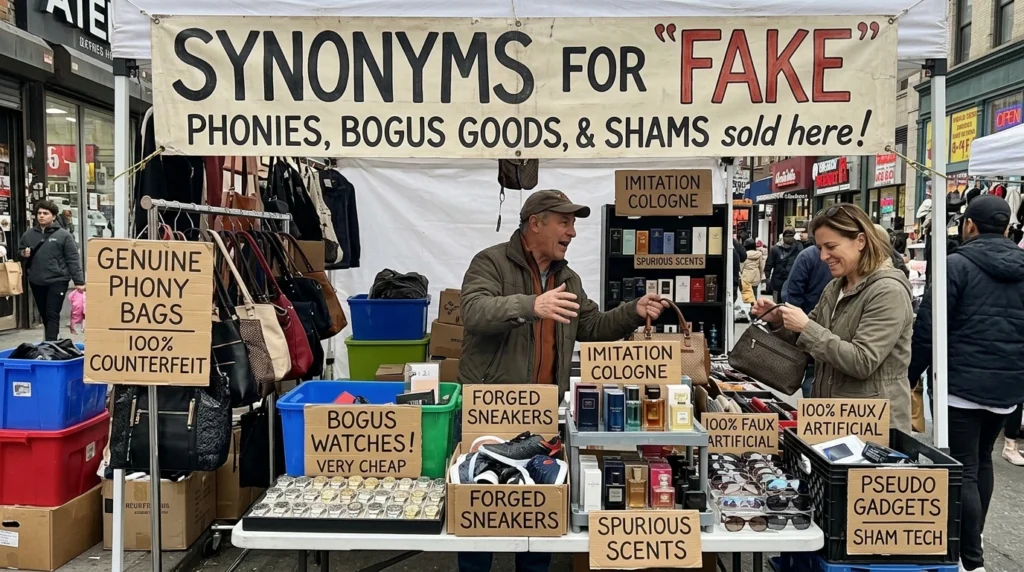
Quick Answer
Some of the best synonyms for fake are false, phony, bogus, counterfeit, fraudulent, artificial, imitation, fabricated, forged, sham, inauthentic, and deceptive. Use false for incorrect claims, phony for something that is not genuine, counterfeit for illegally copied goods or currency, and fraudulent for dishonest conduct.
What Does “Fake” Mean?
The word fake describes something that is not genuine, real, authentic, or what it claims to be. It can refer to physical objects, information, identities, emotions, documents, or behavior.
For example:
She bought a fake designer handbag.
The website published fake news.
He gave a fake name.
Her smile seemed fake.
The document was a fake.
“Fake” can function as an adjective, noun, or verb.
Adjective: They discovered a fake passport.
Noun: The painting turned out to be a fake.
Verb: He tried to fake an injury.
The most appropriate synonym depends on the part of speech and the intended meaning. A counterfeit product, a false statement, and a pretended emotion are all related to fakery, but they are not interchangeable in every sentence.
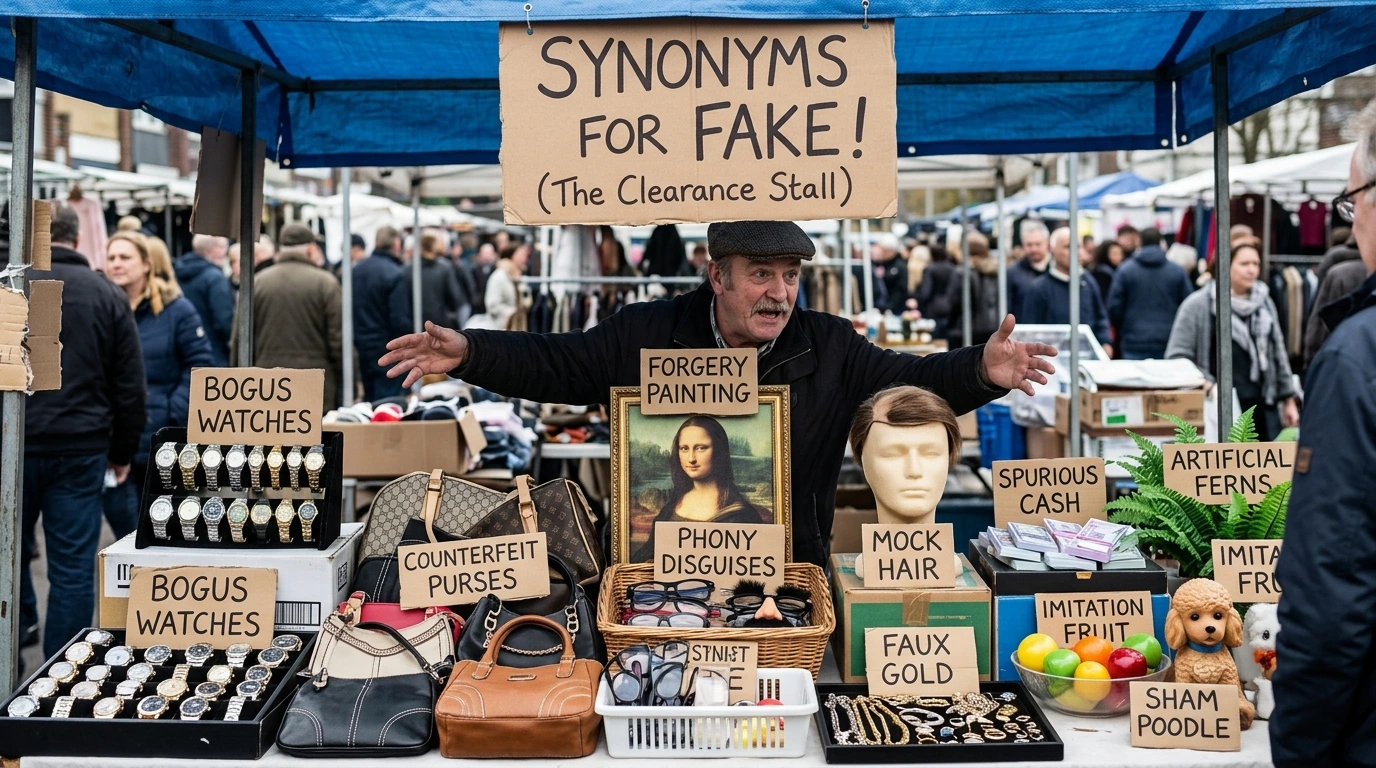
40+ Synonyms for Fake
The following alternatives cover common meanings of “fake,” from ordinary insincerity to deliberate fraud.
| Synonym | Meaning | Best context |
|---|---|---|
| False | Not true or correct | Claims, information, statements |
| Phony | Not genuine; pretending to be real | People, excuses, identities |
| Bogus | False, fake, or invalid | Claims, offers, documents |
| Counterfeit | Made to imitate something genuine, usually illegally | Money, branded products |
| Fraudulent | Involving deception, often for unlawful gain | Transactions, claims, documents |
| Artificial | Made by people rather than occurring naturally | Materials, flavors, environments |
| Imitation | Made to resemble an original | Jewelry, leather, products |
| Fabricated | Invented or deliberately made up | Stories, evidence, excuses |
| Forged | Falsely made or altered to deceive | Signatures, records, documents |
| Inauthentic | Lacking genuineness or authenticity | Behavior, writing, experiences |
| Deceptive | Likely to mislead someone | Advertising, appearances, tactics |
| Sham | Something pretending to be legitimate or genuine | Elections, relationships, promises |
| Spurious | False or not based on valid evidence | Claims, reasoning, results |
| Fictitious | Invented rather than real | Names, characters, businesses |
| Pretend | Imaginary or not real, often in play | Games, imaginary situations |
| Simulated | Imitated or reproduced for practice or study | Training, experiments |
| Synthetic | Made through chemical or industrial processes | Fabrics, materials, substances |
| Misleading | Giving the wrong impression | Headlines, descriptions, statistics |
| Dishonest | Not truthful or fair | People, conduct, explanations |
| Untrue | Contrary to fact | Statements, rumors |
| Unfounded | Lacking adequate evidence or basis | Accusations, fears, claims |
| Invented | Created in the imagination or made up | Stories, excuses, details |
| Concocted | Carefully or creatively made up | Plots, explanations, stories |
| Deceptive-looking | Appearing to suggest something untrue | Visual appearances |
| Insincere | Not expressing genuine feelings or beliefs | Apologies, compliments |
| Affected | Artificial or unnatural in manner | Speech, behavior, style |
| Forced | Not natural or spontaneous | Smiles, laughter, reactions |
| Staged | Arranged to create a particular impression | Photos, events, scenes |
| Rigged | Manipulated unfairly to produce a result | Games, contests, elections |
| Tampered | Improperly altered or interfered with | Records, evidence, equipment |
| Doctored | Altered to mislead or deceive | Images, recordings, documents |
| Altered | Changed from its original form | Images, records, products |
| Copycat | Imitating another person or thing | Designs, behavior, products |
| Knockoff | An imitation, especially of a branded product | Clothing, accessories |
| Look-alike | Someone or something that resembles another | People, products |
| Substitute | Something used in place of another thing | Materials, ingredients |
| Mock | Made as a model, imitation, or practice version | Exams, trials, interviews |
| Pseudo | Apparently or supposedly something, but not genuinely so | Pseudoscience, pseudonym |
| Fallacious | Based on faulty reasoning | Arguments, conclusions |
| Spurious-looking | Appearing questionable or not genuine | Informal descriptions |
| Illegitimate | Not legally or properly authorized | Claims, access, authority |
| Bogus-looking | Appearing suspicious or obviously fake | Informal descriptions |
Important distinction: Some entries are direct or near synonyms, while others describe specific kinds of fakery. For example, artificial does not automatically mean deceptive, and imitation does not necessarily mean illegal or dishonest.
Best Synonyms for Fake
1. False
False is one of the best alternatives when “fake” means incorrect, untrue, or contrary to the facts.
Example:
The article spread fake information.
A more precise version:
The article spread false information.
Best for: Statements, claims, reports, accusations, and information.
Watch out: A false statement is incorrect; it is not necessarily a physical imitation or a deliberate fraud.
2. Phony
Phony is an informal word for something or someone that is not genuine. It can suggest that a person is pretending or trying to deceive others.
Example:
He gave a fake excuse for missing the meeting.
Alternative:
He gave a phony excuse for missing the meeting.
Best for: Excuses, identities, personalities, credentials, and informal conversation.
Tone: Casual and sometimes judgmental.
3. Bogus
Bogus means false, invalid, or not genuine. It is common in conversational English and often describes claims, offers, credentials, or documents.
Example:
She received a fake invoice.
Alternative:
She received a bogus invoice.
Best for: Suspicious offers, false claims, invalid documents, and scams.
Watch out: “Bogus” is informal. In a legal or professional document, fraudulent, invalid, or false may be more appropriate.
4. Counterfeit
Counterfeit refers to something deliberately made to imitate a genuine product, document, or form of currency, usually with the intention of deceiving people.
Example:
The store was selling fake designer watches.
Alternative:
The store was selling counterfeit designer watches.
Best for: Currency, branded goods, luxury products, and certain official documents.
Watch out: A handmade imitation is not necessarily counterfeit. The term often implies unauthorized copying and an intent to deceive.
5. Fraudulent
Fraudulent describes something involving deception, especially when someone intends to gain money, benefits, or another advantage dishonestly.
Example:
The company submitted fake insurance claims.
Alternative:
The company submitted fraudulent insurance claims.
Best for: Transactions, financial claims, business practices, and documents involving suspected fraud.
Tone: Formal and serious.
Watch out: This word can imply serious wrongdoing. Use it only when the context supports that implication.
6. Artificial
Artificial describes something made by humans rather than occurring naturally. It can be a neutral description and does not necessarily mean something is dishonest or inferior.
Example:
The drink contains fake fruit flavoring.
Alternative:
The drink contains artificial fruit flavoring.
Best for: Flavors, materials, flowers, lighting, environments, and substances.
Watch out: Artificial products can be genuine products in their own right. Artificial does not automatically mean fake in the deceptive sense.
7. Imitation
Imitation describes something made to resemble another object or original.
Example:
She bought a fake leather jacket.
Alternative:
She bought an imitation leather jacket.
Best for: Jewelry, leather, artwork, products, materials, and decorative items.
Watch out: An imitation may be openly sold as an imitation. It is not necessarily counterfeit or fraudulent.
8. Fabricated
Fabricated means invented, made up, or deliberately constructed. When used about information, it often suggests that someone created details that are not true.
Example:
The witness told a fake story.
Alternative:
The witness told a fabricated story.
Best for: Stories, evidence, excuses, accusations, and reports.
Watch out: Fabricated can also mean physically manufactured or constructed, so context matters.
9. Forged
Forged describes something falsely created or altered to appear authentic, especially a signature, document, or official record.
Example:
The employee submitted a fake signature.
Alternative:
The employee submitted a forged signature.
Best for: Signatures, contracts, certificates, checks, and records.
Watch out: Forgery generally implies intentional deception. Do not use forged for every inaccurate or altered document.
10. Inauthentic
Inauthentic describes something that lacks genuineness, sincerity, or authenticity.
Example:
His apology sounded fake.
Alternative:
His apology sounded inauthentic.
Best for: Emotions, apologies, relationships, personal branding, behavior, and creative work.
Tone: Neutral to formal.
Watch out: It often describes a lack of sincerity or authenticity rather than a physically copied object.
11. Deceptive
Deceptive describes something that creates a misleading impression or encourages people to believe something incorrect.
Example:
The advertisement made fake promises.
Alternative:
The advertisement made deceptive claims.
Best for: Advertising, appearances, tactics, descriptions, and communication.
Watch out: Something can be deceptive without being completely false. It may leave out important information or create a misleading impression.
12. Sham
A sham is something that pretends to be genuine, legitimate, or meaningful but is not what it claims to be.
Example:
The investigation was a fake attempt to find the truth.
Alternative:
The investigation was a sham.
Best for: Investigations, promises, relationships, procedures, and public displays.
Tone: Strongly critical.
Watch out: Sham is often used as a noun, although it also works as an adjective in phrases such as a sham investigation.
Synonyms for Fake by Context
The best synonym changes according to what you are describing.
Fake Information or News
When something contains incorrect or invented information, consider:
False
Untrue
Fabricated
Misleading
Bogus
Spurious
Unfounded
Deceptive
Examples:
Fake news → false news reports or fabricated stories
Fake accusations → unfounded accusations
Fake statistics → fabricated statistics
Fake claims → false or misleading claims
Use fabricated when information was made up, false when it is untrue, and misleading when it gives the wrong impression.
Fake Products and Brands
When describing goods that imitate genuine products, consider:
Counterfeit
Imitation
Knockoff
Replica
Copycat
Inauthentic
Non-genuine
Examples:
Fake designer bag → counterfeit designer bag if it is falsely presented as genuine
Fake leather → imitation leather or synthetic leather, depending on the material
Fake brand shoes → counterfeit shoes or knockoff shoes, depending on the circumstances
A replica may be a legitimate reproduction, while a counterfeit product typically involves unauthorized imitation intended to deceive.
Fake People or Personalities
When someone is pretending to be different from who they really are, consider:
Phony
Insincere
Dishonest
Inauthentic
Pretentious
Two-faced
Deceptive
Examples:
He seems like a fake person.
You could say:
He seems insincere.
Or:
His behavior seems inauthentic.
Or, in casual conversation:
He seems phony.
Be careful with two-faced: it specifically suggests someone behaves differently toward different people, often by pretending to be friendly while being disloyal.
Fake Smile or Emotions
When a feeling or expression does not seem genuine, use:
Insincere
Forced
Artificial
Inauthentic
Pretended
Feigned
Unconvincing
Examples:
Fake smile → forced smile
Fake laughter → forced laughter
Fake enthusiasm → feigned enthusiasm
Fake apology → insincere apology
Feigned is particularly useful when someone deliberately pretends to feel an emotion or experience a condition.
Fake Documents or Signatures
Depending on the situation, use:
Forged
Fraudulent
Falsified
Fabricated
Altered
Invalid
Unauthenticated
Examples:
Fake signature → forged signature
Fake records → falsified records
Fake certificate → fraudulent certificate, if it is used to deceive
Fake document → forged document, if it was unlawfully created or altered to appear authentic
Not every invalid document is forged. The specific circumstances determine the right term.
Fake Excuses or Stories
Useful alternatives include:
Fabricated
Invented
Made-up
Phony
Bogus
Concocted
Unfounded
Examples:
Fake excuse → made-up excuse
Fake story → fabricated story
Fake explanation → concocted explanation
Fake accusation → unfounded accusation
Fake Online Accounts or Identities
Depending on the circumstances, consider:
Impersonated
Fraudulent
Inauthentic
Bogus
Fictitious
Misleading
Examples:
Fake profile → inauthentic profile or fraudulent profile
Fake identity → false identity
Fake account pretending to be a real person → impersonation account
A fictitious identity is invented; an impersonation account specifically pretends to be someone else.
Synonyms for Fake in Formal Writing
In formal writing, it is usually better to choose a specific word instead of relying on the broad term fake.
| Informal wording | More precise alternative |
|---|---|
| Fake information | False or fabricated information |
| Fake documents | Forged or falsified documents |
| Fake products | Counterfeit or imitation products |
| Fake claims | False or fraudulent claims |
| Fake behavior | Inauthentic or insincere behavior |
| Fake evidence | Fabricated evidence |
| Fake advertising | Deceptive advertising |
| Fake credentials | Falsified credentials |
| Fake statistics | Fabricated statistics |
| Fake identity | False or fictitious identity |
Example:
Informal:
The organization used fake documents.
More precise:
The organization submitted falsified documents.
Choose forged if the documents were falsely created or signed, and falsified if records or information were altered or misrepresented.
Synonyms for Fake in Academic Writing
Academic writing benefits from exact descriptions of evidence, methods, claims, and results.
Useful choices include:
False
Fabricated
Falsified
Misleading
Unfounded
Spurious
Simulated
Artificial
Inauthentic
Examples:
Original:
The researcher used fake data.
More precise:
The researcher used fabricated data if the data were invented.
If genuine data were deliberately changed, falsified data is more accurate.
Original:
The study produced a fake result.
More precise:
The study produced a misleading result if the result gave an incorrect impression.
Or:
The result was spurious if it appeared valid but lacked a sound basis.
In academic work, avoid calling a result fake without explaining whether the issue is fabrication, falsification, error, or weak evidence.
Synonyms for Fake in Professional Writing
For workplace communication, the best alternatives depend on the seriousness and nature of the problem.
Consider:
Inaccurate
False
Invalid
Misleading
Falsified
Fraudulent
Unverified
Inauthentic
Examples:
Fake report → inaccurate report if it contains errors
Fake credentials → falsified credentials if they were deliberately altered or invented
Fake offer → fraudulent offer if it is designed to deceive
Fake information → unverified information if it has not yet been confirmed
Remember that unverified does not mean false. It means the information has not been confirmed.
Synonyms for Fake in Casual Conversation
In everyday speech, these alternatives often sound natural:
Phony
Bogus
Fake-looking
Made-up
Pretend
Knockoff
Fishy
Shady
Examples:
That story sounds fake.
You could say:
That story sounds made-up.
Or:
That story sounds bogus.
Or:
Something about that story seems fishy.
Fishy and shady suggest suspicion rather than proving that something is fake. They are useful when you have doubts but do not know the facts.
Fake vs. False
Fake and false overlap, but they are not identical.
Fake often means not genuine or deliberately made to look real.
False means untrue or incorrect.
Compare:
The shop sold a fake painting.
The painting was not genuine.
The witness gave a false statement.
The statement was untrue.
You can have a fake object, but a claim is usually described as false rather than fake in formal writing.
Fake vs. Phony
Phony is an informal synonym for fake. It often describes people, excuses, claims, or behavior that seem insincere or dishonest.
He gave a fake excuse.
He gave a phony excuse.
Both work, but phony sounds more conversational and can express a stronger personal judgment.
Fake vs. Counterfeit
Counterfeit is narrower and more specific than fake.
A counterfeit product is generally made to imitate a genuine item and is presented in a deceptive or unauthorized way.
The market sold fake designer bags.
The market sold counterfeit designer bags.
The second sentence is more precise if the bags were falsely presented as authentic branded products.
An openly labeled imitation is not necessarily counterfeit.
Fake vs. Fraudulent
Fraudulent describes deception, usually involving dishonesty for personal, financial, or other improper gain.
The company used fake invoices.
The company used fraudulent invoices.
The second version suggests the invoices were part of dishonest conduct.
Not every fake object or incorrect statement is fraudulent. The word is stronger and should match the evidence.
Fake vs. Artificial
Artificial describes something made by people rather than occurring naturally. It does not necessarily imply deception.
The arrangement used fake flowers.
The arrangement used artificial flowers.
The second is often more neutral and appropriate.
Artificial flowers are not pretending to be genuine if they are openly sold as artificial.
Fake vs. Imitation
Imitation emphasizes resemblance to an original rather than necessarily suggesting dishonesty.
She bought a fake leather bag.
She bought an imitation leather bag.
The second version is more neutral. Depending on the material, synthetic leather may be even more precise.
Fake vs. Fabricated
Fabricated usually describes information or stories that have been invented or deliberately made up. It can also mean manufactured or constructed.
The witness gave a fake story.
The witness gave a fabricated story.
The second version emphasizes that the story was invented rather than genuine.
Fake vs. Forged
Forged is used for something falsely made or altered to appear authentic, especially a signature or official document.
The contract had a fake signature.
The contract had a forged signature.
Use forged when the signature was intentionally created or copied without authorization. A misspelled name or accidental error is not necessarily a forgery.
Fake vs. Insincere
Insincere describes feelings, words, or actions that do not reflect genuine beliefs or emotions.
She gave a fake apology.
She gave an insincere apology.
The second sentence focuses on the lack of genuine remorse, not on a physical imitation.
Stronger Synonyms for Fake
If you need a stronger word, choose one that identifies the specific kind of deception.
Fraudulent — involving serious dishonesty
Counterfeit — imitating a genuine product or currency
Forged — falsely created or altered to appear authentic
Fabricated — deliberately invented
Falsified — deliberately changed to misrepresent the truth
Deceptive — designed or likely to mislead
Sham — pretending to be genuine or legitimate
For example:
Fake evidence → fabricated evidence
Fake signature → forged signature
Fake records → falsified records
Fake financial claims → fraudulent claims
Fake investigation → sham investigation
These terms are stronger because they describe a specific problem, not simply because they sound more forceful.
Softer or More Neutral Alternatives to Fake
Sometimes you want to avoid accusing someone of dishonesty when the facts are unclear.
Consider:
Inaccurate
Unverified
Unconfirmed
Imitation
Artificial
Simulated
Non-genuine
Questionable
Examples:
The report contains fake information.
If you only know that the information has not been checked, write:
The report contains unverified information.
If the information is demonstrably incorrect, use false or inaccurate instead.
This distinction helps you avoid making an unsupported accusation.
10 Sentence Transformations Using Synonyms for Fake
1. Fake news
Original: The website published fake news.
Alternative: The website published false reports.
Why: “False reports” focuses on information that is untrue.
2. Fake designer bag
Original: She bought a fake designer bag.
Alternative: She bought a counterfeit designer bag.
Why: “Counterfeit” is more precise when the product falsely imitates a branded original.
3. Fake smile
Original: He gave her a fake smile.
Alternative: He gave her a forced smile.
Why: “Forced” suggests the smile did not happen naturally.
4. Fake excuse
Original: He gave a fake excuse for being late.
Alternative: He gave a made-up excuse for being late.
Why: “Made-up” is natural and conversational.
5. Fake signature
Original: The form contained a fake signature.
Alternative: The form contained a forged signature.
Why: “Forged” is appropriate if the signature was deliberately falsified.
6. Fake data
Original: The researcher used fake data.
Alternative: The researcher used fabricated data.
Why: “Fabricated” indicates that the data were invented rather than collected.
7. Fake apology
Original: She gave a fake apology.
Alternative: She gave an insincere apology.
Why: “Insincere” focuses on the lack of genuine feeling or remorse.
8. Fake product
Original: The store sold fake products.
Alternative: The store sold imitation products.
Why: “Imitation” is appropriate when the products resemble other goods. Use “counterfeit” if they were falsely presented as genuine branded items.
9. Fake advertisement
Original: The company created a fake advertisement.
Alternative: The company created a deceptive advertisement.
Why: “Deceptive” emphasizes the misleading impression the advertisement creates.
10. Fake investigation
Original: The public questioned whether the investigation was fake.
Alternative: The public questioned whether the investigation was a sham.
Why: “Sham” suggests a process that pretends to be legitimate but is not genuine.
Best Synonyms for Fake by Context
| Context | Best alternatives |
|---|---|
| Information | False, fabricated, misleading |
| News | False, fabricated, misleading |
| Products | Counterfeit, imitation, knockoff |
| Designer goods | Counterfeit, knockoff |
| People | Phony, insincere, inauthentic |
| Smile | Forced, insincere |
| Emotions | Feigned, artificial, insincere |
| Excuses | Made-up, fabricated, phony |
| Stories | Invented, fabricated, concocted |
| Documents | Forged, falsified, fraudulent |
| Signatures | Forged |
| Data | Fabricated, falsified |
| Claims | False, bogus, unfounded |
| Advertising | Deceptive, misleading |
| Identity | False, fictitious, fraudulent |
| Online account | Inauthentic, fraudulent, impersonation |
| Scientific result | Spurious, misleading, invalid |
| Natural material | Artificial, synthetic |
| Investigation | Sham, staged |
| Casual conversation | Phony, bogus, made-up |
Common Mistakes When Using Synonyms for Fake
1. Using “counterfeit” for every imitation
A counterfeit item generally involves unauthorized imitation intended to deceive. An openly labeled replica or imitation may not be counterfeit.
2. Using “fraudulent” without enough evidence
“Fraudulent” suggests dishonest conduct and can carry legal implications. If you only know that something is inaccurate, false or incorrect may be safer and more precise.
3. Confusing artificial with fake
Artificial flowers, artificial sweeteners, and synthetic fabrics are real products. The word describes how they are made, not necessarily whether they are deceptive.
4. Using “false” for physical objects
You can describe a false claim or false statement, but a fake watch or counterfeit watch is usually more natural than a “false watch.”
5. Treating “unverified” as “false”
Unverified information has not been confirmed. It may be true or false. Use false only when you have a basis for saying it is incorrect.
6. Using “forged” for any incorrect document
A forged document has been deliberately created or altered to appear authentic. A document containing an ordinary mistake is not necessarily forged.
7. Using “insincere” for counterfeit products
“Insincere” describes a lack of genuine feeling or belief. It is appropriate for apologies, compliments, and behavior—not usually for physical objects.
8. Using “phony” in formal reports
“Phony” is conversational and may sound judgmental. In professional writing, false, inauthentic, counterfeit, or fraudulent may be more precise.
9. Assuming every fake thing is intended to deceive
A pretend toy, simulation, or imitation can be openly understood as not real. Words such as pretend, simulated, artificial, and imitation may be more accurate than fraudulent.
When Should You Keep the Word “Fake”?
You do not always need to replace fake. It is a familiar, flexible word that works well in:
Everyday conversations
Informal messages
Simple explanations
Casual articles
Dialogue and storytelling
General descriptions when the exact type of fakery is not important
For example:
That account looks fake.
This sentence is natural when you are expressing suspicion without knowing the full facts.
A more specific alternative is useful when the context requires precision:
False when a statement is untrue
Counterfeit when a product imitates a genuine branded item deceptively
Fabricated when information was invented
Forged when a signature or document was falsely created or altered
Insincere when an expression of feeling is not genuine
The goal is not to eliminate the word fake. It is to use a more precise alternative when doing so improves clarity.
How to Choose the Right Synonym for Fake
Ask what kind of “fake” you mean.
Is it untrue information?
Use false, untrue, or fabricated.
Is it a copied product presented as genuine?
Use counterfeit.
Is it an imitation that is openly sold as a substitute?
Use imitation, replica, or synthetic, depending on the item.
Is it dishonest or designed to deceive?
Use fraudulent or deceptive, if the facts support that meaning.
Is it an invented story or excuse?
Use made-up, invented, fabricated, or concocted.
Is it a signature or document created to appear authentic?
Use forged or falsified, depending on what was changed.
Is it an emotion that is not genuine?
Use insincere, forced, or feigned.
Is it a process that only pretends to be legitimate?
Use sham.
Are you unsure whether it is actually fake?
Use questionable, suspicious, or unverified when those terms accurately describe what you know.
True Synonyms vs. Related Alternatives
Not every word associated with “fake” can replace it in every sentence.
| Word | Relationship to “fake” | Interchangeability | Best use |
|---|---|---|---|
| Phony | Close synonym | Usually, in informal contexts | Excuses, claims, people |
| Bogus | Close synonym | Usually, in casual contexts | Invalid claims and offers |
| False | Near synonym | Context-dependent | Incorrect information |
| Counterfeit | Narrower synonym | Only for deceptive imitations | Products and currency |
| Fraudulent | Specific related term | Only when deception or fraud is involved | Transactions and claims |
| Artificial | Contextual alternative | Sometimes | Human-made objects or substances |
| Imitation | Contextual alternative | Sometimes | Products resembling originals |
| Fabricated | Near synonym | Best for invented information | Stories, data, evidence |
| Forged | Narrower synonym | Only for falsely created or altered items | Signatures and documents |
| Inauthentic | Near synonym | Often, for sincerity or authenticity | Behavior and expressions |
| Deceptive | Related term | Not always | Misleading conduct or presentation |
| Insincere | Contextual alternative | Only for feelings or intentions | Apologies and compliments |
| Fictitious | Related term | Often, for invented things | Names, characters, identities |
| Simulated | Related term | Only for reproductions or models | Training and experiments |
| Unverified | Related but different | No | Information not yet confirmed |
| Sham | Contextual synonym | Often, for false legitimacy | Investigations and procedures |
| Knockoff | Informal, narrower term | Only for imitative products | Branded goods |
| Misleading | Related term | Sometimes | Claims and presentations |