
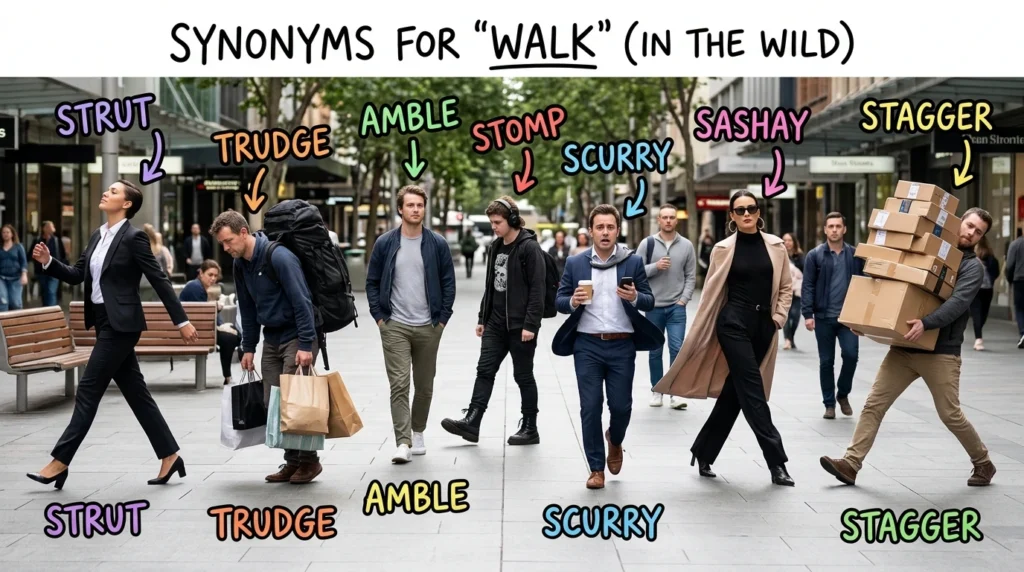
Quick Answer
Some of the best synonyms for walk are stroll, stride, saunter, amble, march, wander, roam, hike, trek, pace, and meander. Use stroll for a relaxed walk, stride for confident steps, march for purposeful movement, wander for moving without a clear destination, and hike for walking outdoors, often on trails.
What Does “Walk” Mean?
Walk is a verb and noun that usually refers to moving on foot at a pace slower than running. It can also describe a short journey, a regular activity, or the way someone moves.
For example:
She walks to school every morning.
We went for a walk after dinner.
He walked confidently into the room.
They walked through the forest.
The tired traveler continued to walk toward the village.
The word is simple and versatile, but more specific alternatives can help you describe a person’s speed, purpose, attitude, or surroundings.
For instance, someone who walks slowly through a garden might stroll, while someone walking with long, confident steps might stride. A person moving without a clear direction might wander, while someone walking long distances over rough terrain might trek.
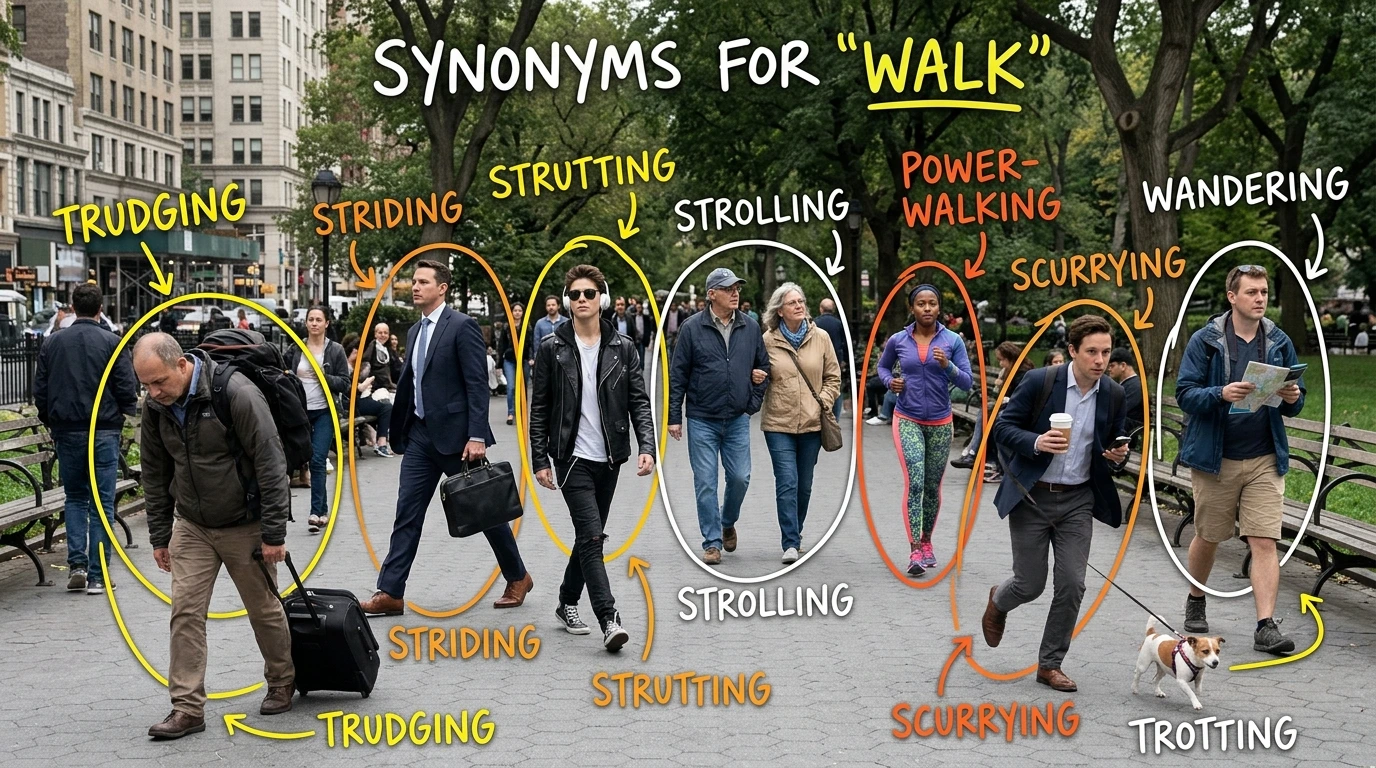
47+ Synonyms for Walk
Here are useful alternatives to “walk,” along with their meanings and best contexts.
| Synonym | Meaning | Best context |
|---|---|---|
| Stroll | Walk slowly and casually | Parks, streets, leisure |
| Stride | Walk with long, confident steps | Confident or purposeful movement |
| Saunter | Walk slowly in a relaxed, often casual way | Informal scenes, storytelling |
| Amble | Walk at a leisurely pace | Relaxed movement |
| Wander | Walk without a fixed destination | Exploring, uncertainty |
| Roam | Move around an area freely | Open spaces, travel |
| March | Walk with regular, purposeful steps | Groups, determination |
| Hike | Walk a long distance outdoors, often on trails | Nature, exercise |
| Trek | Make a long or difficult journey on foot | Travel, adventure |
| Meander | Follow a winding route or move without a direct path | Rivers, paths, relaxed walking |
| Pace | Walk back and forth repeatedly | Nervousness, impatience |
| Shuffle | Walk with short steps, often dragging the feet | Tiredness, discomfort |
| Trudge | Walk slowly and heavily with effort | Fatigue, difficult conditions |
| Plod | Walk slowly with heavy, steady steps | Tiredness, determination |
| Tiptoe | Walk quietly on the tips of the toes | Avoiding noise |
| Stomp | Walk with heavy, forceful steps | Anger, frustration |
| Tramp | Walk a long distance, often heavily or laboriously | Long journeys |
| Tread | Step or walk on a surface | Careful movement, surfaces |
| Amble along | Continue walking leisurely | Relaxed movement |
| Proceed | Move forward or continue | Formal instructions |
| Advance | Move forward, often toward a goal | Military, strategic, formal |
| Traverse | Travel across or through an area | Geography, technical writing |
| Cross | Move from one side to another | Streets, bridges, spaces |
| Tour | Travel around a place to see it | Sightseeing |
| Explore | Travel through an area to learn about it | Discovery, travel |
| Promenade | Walk in a public place for leisure or display | Formal or leisurely outings |
| Perambulate | Walk around, especially in a formal or leisurely manner | Formal or humorous writing |
| Foot it | Travel on foot | Informal speech |
| Step | Move by lifting and placing a foot | Individual movements |
| Strut | Walk proudly or confidently, sometimes arrogantly | Personality, attitude |
| Swagger | Walk with exaggerated confidence | Attitude, character description |
| Limp | Walk unevenly because of pain or injury | Injury, physical movement |
| Hobble | Walk with difficulty, often because of injury | Pain or limited movement |
| Lurch | Move suddenly and unsteadily | Loss of balance |
| Totter | Walk or move unsteadily | Weakness, imbalance |
| Waddle | Walk with short, rocking steps | Penguins, ducks, people |
| Shuffle along | Move with small dragging steps | Fatigue, reluctance |
| File | Walk in a line, one behind another | Organized groups |
| Parade | Walk publicly or formally, often for display | Ceremonies, celebrations |
| Stalk | Walk stealthily or with threatening intent | Suspense, hunting |
| Prowl | Move around quietly while searching or watching | Animals, suspense |
| Sneak | Move quietly to avoid being noticed | Secretive movement |
| Skulk | Move stealthily, often to avoid attention | Suspicious or secretive behavior |
| Escort | Accompany someone while traveling on foot or otherwise | Guidance, protection |
| Accompany | Go somewhere with another person | Everyday and formal use |
Note: Some words describe a specific style of walking, while others describe a journey, direction, or purpose. They are not interchangeable in every sentence.
Best Synonyms for Walk
1. Stroll
Stroll means to walk slowly and casually, usually for pleasure or relaxation.
Example:
We walked through the park after lunch.
A more descriptive version:
We strolled through the park after lunch.
Best for: Parks, beaches, gardens, shopping areas, and relaxed outings.
Tone: Pleasant and leisurely.
Watch out: A stroll usually suggests an unhurried pace, so it is not a good replacement when someone is rushing.
2. Stride
Stride means to walk with long, confident, or purposeful steps.
Example:
She walked into the office confidently.
Alternative:
She strode into the office confidently.
Best for: Describing confidence, determination, authority, or purposeful movement.
Tone: Strong and energetic.
Watch out: A stride generally suggests a particular way of stepping, not simply walking at any pace.
3. Saunter
Saunter means to walk slowly and casually, often with an air of confidence or a lack of urgency.
Example:
He walked toward the café without hurrying.
Alternative:
He sauntered toward the café without hurrying.
Best for: Fiction, character descriptions, relaxed outings, and informal scenes.
Tone: Casual and sometimes playful.
Watch out: Depending on context, saunter can suggest that someone is moving with deliberate nonchalance.
4. Amble
Amble means to walk at a slow, relaxed pace.
Example:
They walked along the country lane.
Alternative:
They ambled along the country lane.
Best for: Peaceful settings, countryside walks, and leisurely movement.
Tone: Gentle and relaxed.
Watch out: Amble emphasizes pace rather than confidence or purpose.
5. Wander
Wander means to move around without a fixed destination or clear direction.
Example:
We walked around the old town for hours.
Alternative:
We wandered around the old town for hours.
Best for: Exploring, sightseeing, daydreaming, and aimless movement.
Tone: Relaxed, curious, or uncertain, depending on context.
Watch out: You can wander mentally or figuratively, too. The word does not necessarily mean walking aimlessly in every use.
6. Roam
Roam means to move freely over a wide area, often without a fixed route.
Example:
The travelers walked through the countryside.
Alternative:
The travelers roamed through the countryside.
Best for: Open spaces, travel, exploration, and animals moving freely.
Tone: Free and expansive.
Watch out: Roam often emphasizes freedom or the size of the area rather than the exact style of walking.
7. March
March means to walk with regular, firm, or purposeful steps.
Example:
The students walked toward the auditorium in an orderly group.
Alternative:
The students marched toward the auditorium in an orderly group.
Best for: Organized groups, demonstrations, military movement, and determined action.
Tone: Strong, disciplined, or forceful.
Watch out: Marching often implies a steady rhythm or firm purpose, so it can sound too intense for an ordinary walk.
8. Hike
Hike means to walk a considerable distance outdoors, often on trails or in natural areas, usually for exercise or recreation.
Example:
We walked through the hills all afternoon.
Alternative:
We hiked through the hills all afternoon.
Best for: Mountains, forests, nature trails, and outdoor recreation.
Tone: Active and outdoorsy.
Watch out: A hike is a type of walk, but not every walk is a hike.
9. Trek
Trek means to make a long or difficult journey, often on foot.
Example:
They walked for hours to reach the remote village.
Alternative:
They trekked for hours to reach the remote village.
Best for: Adventures, long journeys, challenging terrain, and travel writing.
Tone: Adventurous and effortful.
Watch out: Trek emphasizes the journey’s length or difficulty, not merely the act of walking.
10. Meander
Meander means to follow a winding route or move without a direct path.
Example:
We walked through the narrow streets of the village.
Alternative:
We meandered through the narrow streets of the village.
Best for: Winding streets, scenic paths, relaxed exploration, and descriptive writing.
Tone: Slow, indirect, and sometimes picturesque.
Watch out: Rivers and roads can also meander, so the word is not limited to people walking.
11. Pace
Pace means to walk back and forth repeatedly, often because of worry, impatience, or nervousness.
Example:
He walked back and forth while waiting for the results.
Alternative:
He paced while waiting for the results.
Best for: Nervous characters, anxious waiting, frustration, and suspense.
Tone: Restless or tense.
Watch out: Pace can also mean the speed at which someone moves or performs an activity. The intended meaning depends on the sentence.
12. Trudge
Trudge means to walk slowly and heavily, usually because the journey is tiring or difficult.
Example:
They walked through the snow toward home.
Alternative:
They trudged through the snow toward home.
Best for: Bad weather, exhaustion, long journeys, and difficult conditions.
Tone: Weary and effortful.
Watch out: Trudge implies effort or discomfort, so it is not suitable for a pleasant, easy walk.
Synonyms for Walk by Speed and Style
Different walking verbs create different impressions. Use this guide when you want to describe how someone moves.
Slow and Relaxed Walking
Useful alternatives include:
Stroll
Amble
Saunter
Meander
Wander
Promenade
Examples:
She strolled along the beach.
He ambled through the garden.
They sauntered into the café.
We meandered through the village.
These words often work well in descriptive and creative writing because they give the reader a clearer sense of pace and atmosphere.
Fast or Purposeful Walking
Consider:
Stride
March
Hasten
Hurry
Rush
Advance
Examples:
She strode toward the exit.
The soldiers marched across the field.
He hurried to catch the train.
They advanced toward the entrance.
Hurry and rush emphasize speed or urgency, while stride emphasizes the style of the steps.
Heavy or Tired Walking
Useful alternatives include:
Trudge
Plod
Tramp
Shuffle
Drag oneself along
Examples:
He trudged home after a long day.
She plodded up the hill.
They tramped through the muddy field.
He shuffled toward the door.
These choices are useful when describing fatigue, bad weather, or reluctance.
Quiet or Secretive Walking
Use:
Tiptoe
Sneak
Creep
Skulk
Stalk
Prowl
Examples:
She tiptoed past the sleeping baby.
He sneaked out of the room.
The cat stalked its prey.
The stranger prowled around the building.
These verbs differ in meaning. Tiptoe emphasizes quiet steps, sneak suggests avoiding notice, and stalk or prowl can imply watching or pursuing someone or something.
Unsteady Walking
When someone cannot walk steadily, consider:
Limp
Hobble
Totter
Waddle
Lurch
Stagger
Examples:
He limped after injuring his ankle.
She hobbled toward the chair.
The toddler tottered across the room.
The exhausted traveler staggered toward the door.
Choose the word that matches the movement. A limp often involves uneven steps, while a stagger suggests poor balance.
Synonyms for Walk in Formal Writing
In formal writing, the most useful alternative depends on whether you are describing physical movement, travel, or progress.
Consider:
Proceed
Advance
Traverse
Cross
Travel on foot
Move along
Navigate
Examples:
Original:
The participants walked to the next building.
Alternative:
The participants proceeded to the next building.
Original:
The team walked across the terrain.
Alternative:
The team traversed the terrain.
Original:
The visitors walked across the bridge.
Alternative:
The visitors crossed the bridge.
These words can sound more formal, but they do not all mean exactly the same thing. Proceed emphasizes continuing, traverse emphasizes traveling across an area, and cross emphasizes moving from one side to another.
Synonyms for Walk in Academic Writing
Academic writing generally benefits from precision rather than decorative vocabulary.
Useful alternatives include:
Walk
Travel on foot
Traverse
Proceed
Move across
Navigate
Hike
Examples:
Participants walked along the marked route.
could become:
Participants traveled on foot along the marked route.
Or, if the terrain is important:
Participants traversed the marked route.
In research writing, retain walk when it is the clearest and most accurate word. Do not replace it with a more elaborate verb merely to sound academic.
Synonyms for Walk in Creative Writing
Creative writing often benefits from verbs that reveal a character’s mood, physical condition, or intentions.
Try these alternatives:
Sauntered — moved casually and without urgency
Strode — moved with confidence or determination
Trudged — moved with effort or fatigue
Crept — moved slowly and cautiously
Stalked — moved stealthily or with threatening intent
Wandered — moved without a fixed destination
Shuffled — moved with small dragging steps
Lurched — moved suddenly and unsteadily
Tiptoed — moved quietly on the tips of the toes
Marched — moved with firm, purposeful steps
Compare these sentences:
He walked into the room.
He strode into the room.
He crept into the room.
He stumbled into the room.
The basic action is similar, but each verb creates a different impression of the character.
Synonyms for Walk in a Resume or Professional Context
When describing professional duties, walk is usually appropriate for literal movement. For broader responsibilities, you may need a different verb altogether.
Examples:
Walked clients through the process → Guided clients through the process
Walked the team through the report → Presented the report to the team
Walked the site daily → Inspected the site daily, if inspection was the purpose
Walked customers to their seats → Escorted customers to their seats
These are contextual alternatives rather than direct synonyms. Choose the verb that describes what you actually did.
Synonyms for Walk When Describing a Person
The right word can communicate a person’s attitude or physical movement.
| Intended impression | Useful verbs |
|---|---|
| Confident | Stride, swagger |
| Relaxed | Stroll, amble, saunter |
| Nervous | Pace, shuffle |
| Angry | Stomp, march |
| Tired | Trudge, plod, shuffle |
| Careful | Tiptoe, tread |
| Secretive | Sneak, creep, skulk |
| Unsteady | Stagger, totter, lurch |
| Curious | Wander, roam, explore |
| Proud | Strut, parade |
Examples:
She strode into the meeting with confidence.
He paced the hallway nervously.
The child tiptoed past the door.
The exhausted hiker trudged toward camp.
Use these verbs when the manner of walking matters to the scene.
Walk vs. Stroll
Walk is a general term for moving on foot. Stroll specifically suggests a slow, relaxed walk, often for pleasure.
We walked through the park.
This is neutral.
We strolled through the park.
This suggests that we were relaxed and unhurried.
Use stroll when the leisurely pace matters.
Walk vs. Stride
Stride describes walking with long, confident, or purposeful steps.
She walked toward the stage.
She strode toward the stage.
The second sentence suggests confidence or determination. It does not simply mean that she walked faster.
Walk vs. Wander
Walk does not specify a destination or direction. Wander often suggests moving without a fixed route or clear destination.
We walked around the city.
We wandered around the city.
The second sentence suggests informal exploration rather than a planned route.
Walk vs. March
March implies firm, regular, or purposeful steps. It can also describe organized group movement.
They walked toward the building.
They marched toward the building.
The second version suggests determination, discipline, protest, or a more forceful approach.
Walk vs. Hike
A walk can happen almost anywhere and may be short or long. A hike usually refers to walking outdoors for exercise or recreation, often along a trail.
We walked around the neighborhood.
We hiked through the mountains.
The second sentence emphasizes outdoor activity and often a longer or more challenging route.
Walk vs. Trek
A trek usually involves a long or difficult journey, often on foot. It emphasizes distance, effort, or adventure.
They walked to the village.
They trekked to the remote village.
The second sentence suggests that reaching the village required a substantial journey.
Walk vs. Pace
Walk describes movement on foot in general. Pace often means walking back and forth repeatedly, especially while waiting or feeling anxious.
He walked around the room.
This does not necessarily imply anxiety.
He paced around the room.
This often suggests restlessness, worry, or impatience.
Walk vs. Saunter
Saunter suggests relaxed, casual movement and sometimes an air of nonchalance.
He walked into the store.
He sauntered into the store.
The second sentence suggests he was not in a hurry and may have appeared deliberately casual.
10 Sentence Transformations Using Synonyms for Walk
1. Walking for pleasure
Original: She walked through the garden.
Alternative: She strolled through the garden.
Why: “Strolled” emphasizes a relaxed, leisurely pace.
2. Walking confidently
Original: He walked into the office.
Alternative: He strode into the office.
Why: “Strode” suggests confidence or purpose.
3. Walking without a destination
Original: They walked around the old town.
Alternative: They wandered around the old town.
Why: “Wandered” emphasizes informal exploration.
4. Walking in a group
Original: The soldiers walked across the field.
Alternative: The soldiers marched across the field.
Why: “Marched” suggests regular, disciplined steps.
5. Walking through nature
Original: We walked through the forest for hours.
Alternative: We hiked through the forest for hours.
Why: “Hiked” emphasizes outdoor recreation or a longer trail walk.
6. Walking while tired
Original: He walked home through the snow.
Alternative: He trudged home through the snow.
Why: “Trudged” conveys effort and fatigue.
7. Walking nervously
Original: She walked back and forth before the interview.
Alternative: She paced before the interview.
Why: “Paced” suggests nervousness or impatience.
8. Walking quietly
Original: The child walked past the sleeping dog.
Alternative: The child tiptoed past the sleeping dog.
Why: “Tiptoed” emphasizes quiet movement.
9. Walking unsteadily
Original: He walked toward the chair after the fall.
Alternative: He hobbled toward the chair after the fall.
Why: “Hobbled” suggests difficulty walking, often because of pain or injury.
10. Walking along a winding path
Original: We walked along the winding village streets.
Alternative: We meandered along the winding village streets.
Why: “Meandered” emphasizes a winding route and an unhurried pace.
Best Synonyms for Walk by Context
| Context | Best alternatives |
|---|---|
| Casual walking | Stroll, amble, saunter |
| Confident walking | Stride, strut |
| Slow walking | Amble, stroll, saunter |
| Fast walking | Hurry, hasten, stride |
| Walking without a destination | Wander, roam |
| Walking outdoors | Hike, trek |
| Walking a long distance | Trek, tramp |
| Nervous walking | Pace |
| Tired walking | Trudge, plod, shuffle |
| Angry walking | Stomp, march |
| Quiet walking | Tiptoe, sneak, creep |
| Unsteady walking | Stagger, totter, lurch |
| Formal writing | Proceed, traverse, cross |
| Creative writing | Saunter, stride, trudge, stalk |
| Sightseeing | Tour, explore, wander |
| Organized group movement | March, parade, file |
Common Mistakes When Using Synonyms for Walk
1. Using “stroll” when someone is in a hurry
A stroll is generally relaxed. If someone is rushing to catch a train, hurry or rush is more appropriate.
2. Treating “stride” as a direct synonym for speed
Stride describes long, purposeful, or confident steps. It does not always mean walking quickly.
3. Using “wander” for a planned, direct route
Wander usually suggests a loose or indirect route. If someone follows a clear route to a destination, walk, proceed, or travel on foot may be more accurate.
4. Using “hike” for every walk
A hike usually involves outdoor walking for recreation or exercise, often on a trail. Walking to a nearby store is not normally called hiking.
5. Using “march” for relaxed movement
Marching implies firm, regular, or purposeful steps. It may sound too forceful when describing someone casually walking through a park.
6. Confusing “pace” with ordinary walking
When pace means walking back and forth, it often implies restlessness. Use walk if you simply mean moving around.
7. Using “stagger” when someone is merely tired
Staggering suggests serious difficulty maintaining balance. For ordinary tiredness, trudge, plod, or shuffle may be more accurate.
8. Using “stalk” as a neutral synonym
Stalk often implies stealthy pursuit or threatening intent. It can create a darker impression than the simple word “walk.”
9. Choosing an overly formal word for a simple sentence
“Proceed” and “traverse” can be useful in specific contexts, but they may sound unnatural in casual descriptions.
10. Replacing “walk” just to avoid repetition
“Walk” is often the clearest word. Use a more specific alternative when it adds meaningful information about pace, direction, effort, or attitude.
When Should You Keep the Word “Walk”?
You do not always need to replace walk. It is a clear and natural word for everyday movement.
Keep “walk” when:
The manner of movement is not important.
You want a simple, neutral description.
You are giving directions.
You are writing straightforward instructions.
You do not want to imply a particular emotion or pace.
A more specific verb would add information that is not supported by the context.
For example:
I walk to work every morning.
This sentence is clear and natural. Replacing “walk” with stroll, stride, or march would change the meaning or suggest a different manner of movement.
How to Choose the Right Synonym for Walk
Ask yourself what you want the reader to understand.
Is the person walking slowly for pleasure?
Use stroll, amble, or saunter.
Are they walking confidently or purposefully?
Use stride or strut, depending on the attitude.
Are they moving without a clear destination?
Use wander, roam, or meander.
Are they walking a trail or a long outdoor route?
Use hike or trek.
Are they tired or struggling?
Use trudge, plod, shuffle, or hobble, depending on the movement.
Are they nervous or impatient?
Use pace.
Are they trying to remain quiet?
Use tiptoe, sneak, or creep.
Are they moving unsteadily?
Use stagger, totter, or lurch.
Are you writing formally?
Use proceed, traverse, cross, or travel on foot when the context supports those meanings.
The best synonym is not necessarily the most unusual word. It is the one that describes the movement most accurately.
True Synonyms vs. Related Alternatives
| Word | Relationship to “walk” | Interchangeability | Best use |
|---|---|---|---|
| Stroll | Near synonym | Context-dependent | Relaxed walking |
| Stride | Specific walking style | Not always | Long, confident steps |
| Saunter | Near synonym | Context-dependent | Casual, unhurried walking |
| Amble | Near synonym | Usually, for slow walking | Leisurely movement |
| Wander | Contextual synonym | Sometimes | Moving without a fixed route |
| Roam | Related alternative | Sometimes | Moving freely over an area |
| March | Specific walking style | Only for purposeful steps | Firm, regular movement |
| Hike | Narrower type of walking | Only in outdoor contexts | Trail walking |
| Trek | Related journey term | Only for long or difficult journeys | Extended travel |
| Pace | Specific movement pattern | Only when walking back and forth | Nervous or restless movement |
| Trudge | Specific walking style | Only when movement is effortful | Tired or difficult walking |
| Tiptoe | Specific walking style | Only for quiet steps | Avoiding noise |
| Proceed | Broader movement term | Context-dependent | Continuing or moving forward |
| Traverse | Travel-across term | Context-dependent | Crossing an area |
| Stagger | Specific unsteady movement | Only when balance is affected | Unsteady walking |
| Tour | Activity involving travel | Not directly | Visiting places |
| Explore | Purpose-related alternative | Not directly | Discovering a place |
| Escort | Accompanying action | Not directly | Guiding or accompanying someone |