
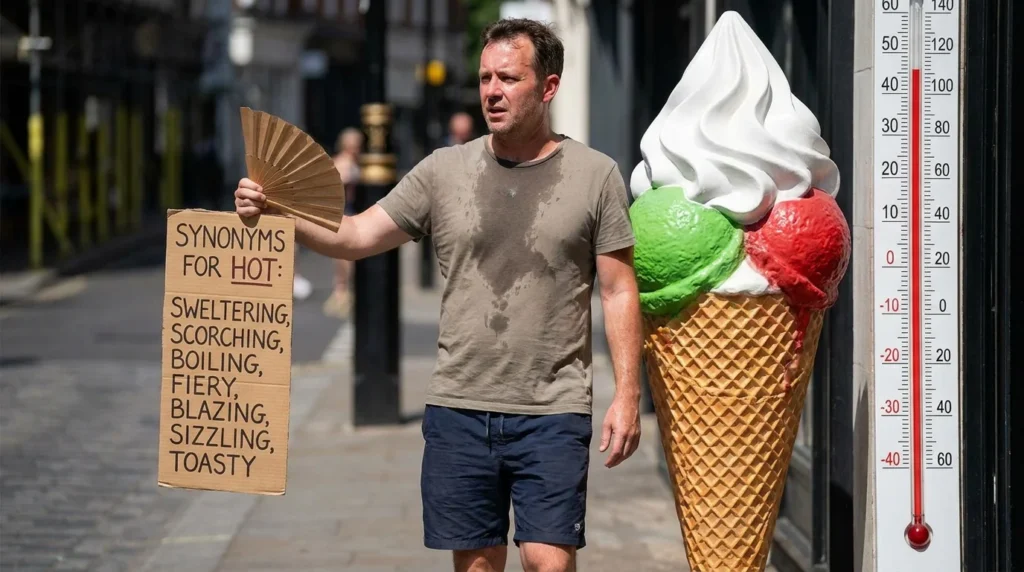
Quick Answer: What Is a Synonym for Hot?
The best synonym for hot depends on its meaning. For high temperature, use warm, heated, scorching, sweltering, boiling, or burning. For spicy food, use spicy, fiery, peppery, or piquant. When describing attractiveness, attractive, gorgeous, stunning, or sexy may fit. For popularity, use trendy, popular, fashionable, or in-demand.
Quick List of Synonyms for Hot
Here are useful alternatives to hot, organized by meaning:
Hot as a High Temperature
- Warm
- Heated
- Burning
- Scorching
- Sweltering
- Boiling
- Blazing
- Fiery
- Sizzling
- Seething
- Torrid
- Sultry
- Broiling
- Stifling
- Oppressive
- Baking
- Blistering
- Smoldering
Hot as Spicy
- Spicy
- Fiery
- Peppery
- Piquant
- Zesty
- Seasoned
- Tongue-burning
- Chili-hot
Hot as Attractive
- Attractive
- Beautiful
- Gorgeous
- Stunning
- Striking
- Alluring
- Appealing
- Sexy
- Good-looking
- Handsome
- Beautiful
Hot as Popular or Trendy
- Popular
- Trendy
- Fashionable
- Stylish
- In-demand
- Sought-after
- Buzzing
- Current
- Hip
- Cutting-edge
Hot as Intense or Exciting
- Intense
- Exciting
- Fierce
- Heated
- Passionate
- Explosive
- Energetic
- Dynamic
- Charged
- Tense
Not every word above can replace hot in every sentence. The meaning and context matter.
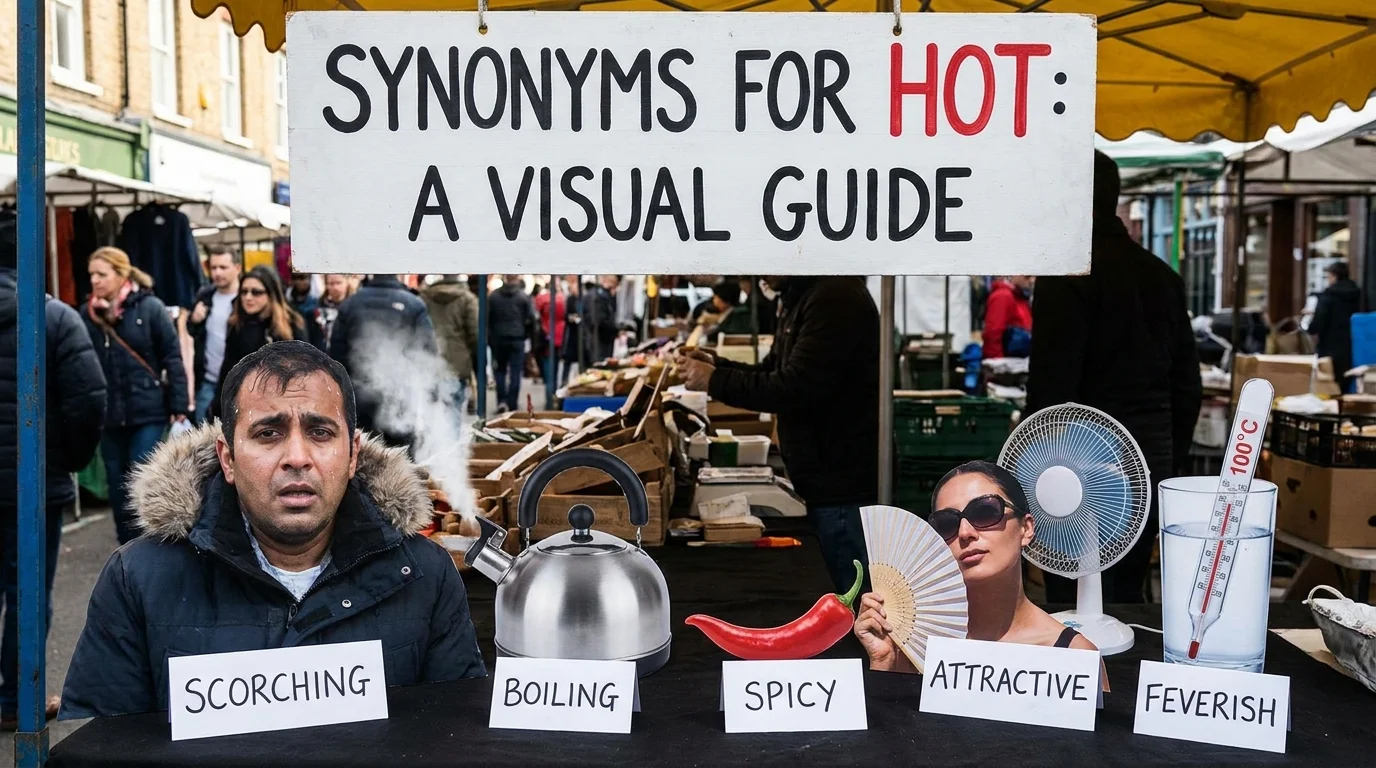
The Closest Synonyms for Hot
Warm
Warm means having a moderately high temperature or a temperature above cool.
The water is warm.
Best for: Weather, food, drinks, objects, and physical temperature.
Watch out: Warm is usually much less intense than hot.
Heated
Heated means made hot or having a high temperature. It can also describe an argument or disagreement that has become intense.
The heated pan was dangerous to touch.
They had a heated discussion.
Best for: Physical temperature and figurative conflict.
Scorching
Scorching describes extremely hot conditions.
It was a scorching afternoon.
Best for: Weather and outdoor temperatures.
Strength: Very strong.
Sweltering
Sweltering means extremely hot and uncomfortable, often because of high heat combined with humidity.
The room became sweltering by noon.
Best for: Weather, rooms, buildings, and uncomfortable conditions.
Boiling
Boiling literally describes liquid at or near its boiling point. Informally, it can also mean extremely hot.
The soup is boiling hot.
It’s boiling outside.
Best for: Food, liquids, weather, and informal descriptions.
Burning
Burning can describe something extremely hot or something that causes a sensation of heat.
The sand was burning hot.
It can also describe strong emotions or urgency:
She felt a burning desire to succeed.
Best for: Extreme heat, sensations, emotions, and figurative writing.
Synonyms for Hot Weather
When hot describes weather, the best alternative depends on how intense or uncomfortable the heat is.
Scorching
Use scorching for extreme heat.
The city experienced a scorching summer day.
Sweltering
Use sweltering when the heat feels oppressive and uncomfortable.
Tourists struggled through the sweltering afternoon.
Sultry
Sultry can describe hot, humid weather and often has a more atmospheric or literary tone.
A sultry evening settled over the city.
It can also describe an alluring person or mood, so context matters.
Blistering
Blistering describes extremely intense heat.
The team played under a blistering sun.
Stifling
Stifling emphasizes uncomfortable heat and a lack of fresh air.
The classroom was stifling.
Torrid
Torrid is a more formal or literary word for very hot conditions.
The region experienced torrid temperatures.
It can also describe intense passion or emotion.
Hot vs. Warm
Hot and warm are related but differ in intensity.
- Warm = pleasantly or moderately high in temperature
- Hot = noticeably high in temperature
- Scorching = extremely hot
- Sweltering = extremely hot and uncomfortable
- Blistering = intensely hot
Compare:
“The tea is warm.”
This suggests a comfortable or moderate temperature.
“The tea is hot.”
This suggests a high temperature and may warn that it could burn you.
“The tea is boiling hot.”
This emphasizes extreme heat.
Choosing the right word helps readers understand the actual intensity.
Synonyms for Hot Food and Drinks
When hot describes food or beverages, the word can refer to temperature or flavor.
For Temperature
Use:
- Heated
- Steaming
- Piping hot
- Scalding
- Boiling
- Warm
The soup was steaming.
Be careful—the coffee is scalding.
For Spiciness
Use:
- Spicy
- Fiery
- Peppery
- Piquant
- Chili-hot
- Zesty
This curry is extremely spicy.
The salsa has a fiery flavor.
Spicy vs. Hot
When talking about food, hot can mean two different things.
“The soup is hot.”
This usually means its temperature is high.
“The soup is hot.”
Depending on context, it could also mean the soup contains a lot of chili or spices.
For clarity, steaming or scalding can describe temperature, while spicy or fiery can describe flavor.
Synonyms for Hot as Spicy
Spicy
Spicy is the most direct alternative when hot food creates a strong sensation from chili or other spices.
The restaurant serves spicy noodles.
Fiery
Fiery suggests strong, intense spiciness.
The chef prepared a fiery chili sauce.
It can also describe someone with an intense personality.
Peppery
Peppery describes a flavor resembling pepper or having a sharp, spicy quality.
The sauce has a slightly peppery taste.
Piquant
Piquant means pleasantly sharp, spicy, or stimulating in flavor. It is more formal than spicy.
The dish had a piquant flavor.
Synonyms for Hot as Attractive
In informal English, hot can describe someone who is sexually attractive. Appropriate alternatives depend heavily on tone.
Attractive
Attractive is neutral and broadly appropriate.
She is very attractive.
Good-Looking
Good-looking is casual and commonly used to describe physical appearance.
He is a good-looking actor.
Gorgeous
Gorgeous suggests striking beauty or attractiveness.
She looked gorgeous in the evening dress.
Stunning
Stunning suggests an especially impressive or beautiful appearance.
He looked stunning in the photographs.
Alluring
Alluring suggests attractiveness combined with charm or a quality that draws people in.
Her voice had an alluring quality.
Sexy
Sexy is more direct and explicitly relates to sexual attractiveness.
The character was designed to look sexy.
Watch out: This word may be inappropriate in professional, academic, or formal contexts.
Hot vs. Attractive
Hot is informal and often stronger or more sexually charged.
Attractive is more neutral and versatile.
Compare:
“He is hot.”
This is casual and can imply strong physical or sexual attraction.
“He is attractive.”
This is more neutral and appropriate in a wider range of situations.
For professional writing, attractive is generally safer.
Synonyms for Hot as Popular or Trendy
Hot can also mean highly popular, fashionable, or in demand.
Popular
The new app is extremely popular.
This is the simplest alternative when something has many users or supporters.
Trendy
Trendy describes something currently fashionable or popular.
That neighborhood has become a trendy place to eat.
Fashionable
Fashionable means currently considered stylish or desirable.
The brand sells fashionable clothing.
In-Demand
In-demand describes something that many people want.
Skilled programmers are in demand.
Sought-After
Sought-after means strongly desired.
She is one of the industry’s most sought-after designers.
Buzzing
Buzzing is informal and can describe a place, event, or scene full of excitement and activity.
The downtown district was buzzing that night.
Synonyms for Hot as Exciting or Intense
Sometimes hot describes an intense situation rather than physical temperature.
Useful alternatives include:
- Intense
- Heated
- Fierce
- Passionate
- Explosive
- Charged
- Exciting
- Tense
- Energetic
- Dynamic
Heated
The debate became heated.
This suggests strong disagreement or emotion.
Fierce
The two teams had a fierce competition.
This emphasizes intensity and determination.
Passionate
She gave a passionate speech.
This emphasizes strong emotion and enthusiasm.
Explosive
The situation became explosive.
This suggests that tension or emotion could suddenly become much stronger.
Charged
The atmosphere was emotionally charged.
This suggests strong emotion or tension.
Formal and Professional Synonyms for Hot
The best formal replacement depends on what hot means.
| Alternative | Meaning | Tone | Best Context | Can Replace “Hot”? |
|---|---|---|---|---|
| Heated | High temperature or intense | Neutral/formal | Objects, discussions | Often |
| Scorching | Extremely hot | Neutral | Weather | Usually |
| Sweltering | Extremely hot and uncomfortable | Formal/neutral | Weather, rooms | Usually |
| Torrid | Extremely hot or intense | Formal/literary | Weather, writing | Sometimes |
| Intense | Very strong | Formal/neutral | Emotions, situations | Context-dependent |
| Popular | Widely liked or used | Neutral | Products, trends | Context-dependent |
| In-demand | Highly wanted | Professional | Skills, products | Context-dependent |
| Attractive | Pleasant-looking | Neutral | People, designs | Context-dependent |
| Spicy | Strongly flavored with spices | Neutral | Food | Yes, for flavor |
| Heated | Emotionally intense | Formal/neutral | Arguments | Sometimes |
Academic Alternatives to Hot
Academic writing usually benefits from more precise language.
Instead of:
“The region had hot temperatures.”
Consider:
“The region experienced high temperatures.”
Or:
“The region experienced extreme heat.”
For research or scientific writing, high temperature, elevated temperature, extreme heat, or a specific temperature measurement is often more precise than hot.
Instead of:
“The experiment used a hot solution.”
A more precise sentence might be:
“The experiment used a heated solution maintained at a high temperature.”
The more technical the context, the more useful precise measurements become.
Creative Writing Synonyms for Hot
Creative writing often benefits from words that create a stronger sensory image.
Consider:
- Scorching
- Blazing
- Sizzling
- Sweltering
- Blistering
- Fiery
- Torrid
- Stifling
- Baking
- Smoldering
Compare:
“It was a hot day.”
with:
“A scorching sun beat down on the empty road.”
The second sentence gives the reader a stronger sensory impression.
Sizzling
Sizzling is vivid and often suggests intense heat.
The sizzling pavement shimmered in the afternoon sun.
It can also describe food:
The steak arrived sizzling on a hot plate.
Blazing
Blazing suggests powerful heat, brightness, or fire.
The blazing sun made the road seem endless.
Baking
Baking is informal and vivid.
We were baking inside the car.
It is especially useful in conversational or creative writing.
Comparison: Levels of Physical Heat
| Word | Approximate Intensity | Meaning |
|---|---|---|
| Warm | Low | Comfortably above cool |
| Hot | Moderate to high | Clearly high temperature |
| Heated | Moderate to high | Made or becoming hot |
| Very hot | High | Strong heat |
| Scorching | Very high | Extremely hot |
| Blistering | Very high | Intensely hot |
| Sweltering | Very high | Extremely hot and uncomfortable |
| Boiling | Very high | Extremely hot; often informal |
| Burning | Very high | Extremely hot or producing a burning sensation |
These are approximate distinctions, not fixed temperature measurements.
Hot vs. Scorching
Scorching is much stronger than hot.
“It is hot today.”
This describes high temperature.
“It is scorching today.”
This emphasizes extreme heat.
Use scorching when you want to create a stronger impression of intense heat.
Hot vs. Heated
These words overlap, but they are used differently.
Hot is a general adjective.
The pan is hot.
Heated often suggests that something has been deliberately warmed or has become hot.
The heated pan was ready for cooking.
“Heated” also has a figurative meaning:
They had a heated argument.
“Hot argument” is possible in some contexts, but heated argument is much more natural.
Hot vs. Burning
Burning is stronger and often emphasizes the sensation or danger caused by heat.
The coffee is hot.
The coffee is burning hot.
The second sentence strongly emphasizes how hot the coffee feels.
“Burning” can also be figurative:
She had a burning desire to win.
Here, burning does not describe physical temperature.
Hot vs. Sweltering
Sweltering is particularly useful when heat is uncomfortable.
“It was hot in the room.”
This simply describes temperature.
“It was sweltering in the room.”
This suggests oppressive, uncomfortable heat.
Use sweltering when you want to communicate how unpleasant the heat feels.
Hot vs. Fiery
Fiery can describe actual fire, spicy food, strong emotion, or an intense personality.
a fiery sunset
a fiery curry
a fiery speech
a fiery personality
Because it has several figurative uses, fiery can make creative writing more vivid, but it is not a universal replacement for hot.
How to Choose the Right Synonym for Hot
Ask yourself what hot means in your sentence.
If you mean high temperature
Use:
warm → hot → scorching → sweltering
Choose based on intensity.
If you mean spicy
Use:
spicy, fiery, peppery, piquant
If you mean attractive
Use:
attractive, gorgeous, stunning, alluring, sexy
Choose based on tone and audience.
If you mean popular
Use:
popular, trendy, fashionable, in-demand, sought-after
If you mean intense
Use:
heated, fierce, passionate, explosive, charged
This simple distinction prevents many awkward substitutions.
Sentence Transformations: Better Alternatives to Hot
1. Describing extreme weather
Original:
“It was a very hot afternoon.”
Better Alternative:
“It was a scorching afternoon.”
Why: “Scorching” gives a stronger sense of extreme heat.
2. Describing uncomfortable indoor heat
Original:
“The room was very hot.”
Better Alternative:
“The room was sweltering.”
Why: “Sweltering” emphasizes uncomfortable heat.
3. Describing food temperature
Original:
“The soup was hot.”
Better Alternative:
“The soup was steaming.”
Why: “Steaming” gives a more vivid description of very hot food.
4. Describing spicy food
Original:
“This sauce is hot.”
Better Alternative:
“This sauce is spicy.”
Why: “Spicy” removes the ambiguity between temperature and flavor.
5. Describing an attractive person
Original:
“She is hot.”
Better Alternative:
“She is very attractive.”
Why: “Attractive” is more neutral and appropriate for many situations.
6. Describing a popular product
Original:
“That phone is hot right now.”
Better Alternative:
“That phone is extremely popular right now.”
Why: “Popular” makes the intended meaning clear.
7. Describing an argument
Original:
“The discussion became hot.”
Better Alternative:
“The discussion became heated.”
Why: “Heated” is the natural expression for an emotionally intense disagreement.
8. Describing an intense competition
Original:
“The teams had a hot competition.”
Better Alternative:
“The teams had a fierce competition.”
Why: “Fierce” communicates strong competition more naturally.
9. Describing strong attraction
Original:
“The actor was considered hot.”
Better Alternative:
“The actor was considered strikingly attractive.”
Why: The alternative is more descriptive and less informal.
10. Describing a fashionable trend
Original:
“That style is hot this year.”
Better Alternative:
“That style is trendy this year.”
Why: “Trendy” clearly communicates current popularity or fashion.
Common Mistakes When Using Synonyms for Hot
Mistake 1: Using “Warm” for Extreme Heat
Warm is usually much weaker than hot.
“The desert was warm.”
This may seriously understate the temperature.
Use hot, scorching, or blistering when the heat is extreme.
Mistake 2: Confusing Temperature With Spiciness
“The curry is hot.”
This can mean the curry has a high temperature or a spicy flavor.
If you mean flavor, use spicy or fiery.
If you mean temperature, use steaming, heated, or very hot.
Mistake 3: Using “Sexy” in Formal Writing
“Sexy” is informal and directly related to sexual attractiveness.
In professional or neutral contexts, attractive or appealing is usually more appropriate.
Mistake 4: Using “Popular” for Physical Heat
“Popular” cannot replace hot when discussing temperature.
“The water is popular.”
This obviously changes the meaning.
Mistake 5: Assuming “Scorching” Always Means Weather
“Scorching” is strongly associated with intense heat, especially weather, but it can also describe objects or sensations.
Use it where the context supports extreme heat.
Mistake 6: Overusing Dramatic Words
Words such as blazing, blistering, scorching, and burning create strong imagery.
Using them for ordinary warmth can make your writing sound exaggerated.
Mistake 7: Replacing Hot Just to Avoid Repetition
You do not need to replace hot every time it appears.
If the temperature is simply high, hot is often the clearest and most natural word.
When “Hot” Is Better Than a Synonym
Sometimes the original word is exactly right.
Use hot when:
- You need a simple everyday description.
- The temperature is clearly high.
- The context makes the meaning obvious.
- You want conversational language.
- You are describing a common sensation without needing extra intensity.
For example:
“The coffee is hot.”
This is clearer than saying:
“The coffee is scorching.”
unless you specifically want to emphasize extreme heat.
Likewise:
“It’s hot outside.”
is perfectly natural everyday English. Replacing it with “The weather is torrid” may sound unnecessarily formal.
Grammar and Usage of Hot
Hot is primarily an adjective.
Before a noun
a hot day
hot coffee
a hot meal
After a linking verb
The coffee is hot.
The room feels hot.
Comparative form
The comparative is hotter.
Today is hotter than yesterday.
Superlative form
The superlative is hottest.
July was the hottest month.
Because hot ends in a consonant-vowel-consonant pattern, the final consonant is doubled in hotter and hottest.
Common Expressions With Hot
Several common expressions use hot in ways that should not be replaced mechanically.
Hot weather
We had hot weather all week.
Hot water
Turn off the hot water.
Hot coffee
I ordered a hot coffee.
Hot topic
A hot topic is something currently receiving a lot of attention.
Artificial intelligence is a hot topic.
Hot seat
Being in the hot seat means being under pressure or close scrutiny.
The manager was in the hot seat after the decision.
Hot spot
A hot spot can mean a popular place, an area of intense activity, or a location offering wireless internet, depending on context.
Hot button
A hot-button issue is a controversial subject that generates strong opinions.
Immigration remains a hot-button political issue.
These expressions have established meanings, so a direct synonym may not work naturally.