

Quick Answer
Some of the best synonyms for chaos are disorder, confusion, turmoil, mayhem, havoc, commotion, disarray, confusion, pandemonium, anarchy, upheaval, disturbance, bedlam, mess, and disorganization. The best choice depends on the situation. Use disorder for general lack of organization, confusion for uncertainty, mayhem for wild disorder, and havoc for widespread damage.
What Does “Chaos” Mean?
Chaos is a noun that generally refers to a state of complete or extreme disorder, confusion, unpredictability, or lack of organization.
For example:
The office was in chaos after the computer system crashed.
This means the office became extremely disorganized and difficult to manage.
Chaos can describe many different situations, including:
- Physical disorder
- Confusion
- Crowded situations
- Emotional turmoil
- Political instability
- Social unrest
- Disorganized workplaces
- Uncontrolled events
- Natural disasters
- Confusing situations
- A breakdown of normal systems
For example:
The storm caused chaos across the city.
Here, “chaos” describes widespread disruption.
Her thoughts were in chaos.
Here, it describes mental or emotional confusion.
The classroom descended into chaos.
Here, it describes a loss of order and control.
Because chaos is a broad word, the best synonym depends on the specific type of disorder you want to describe.
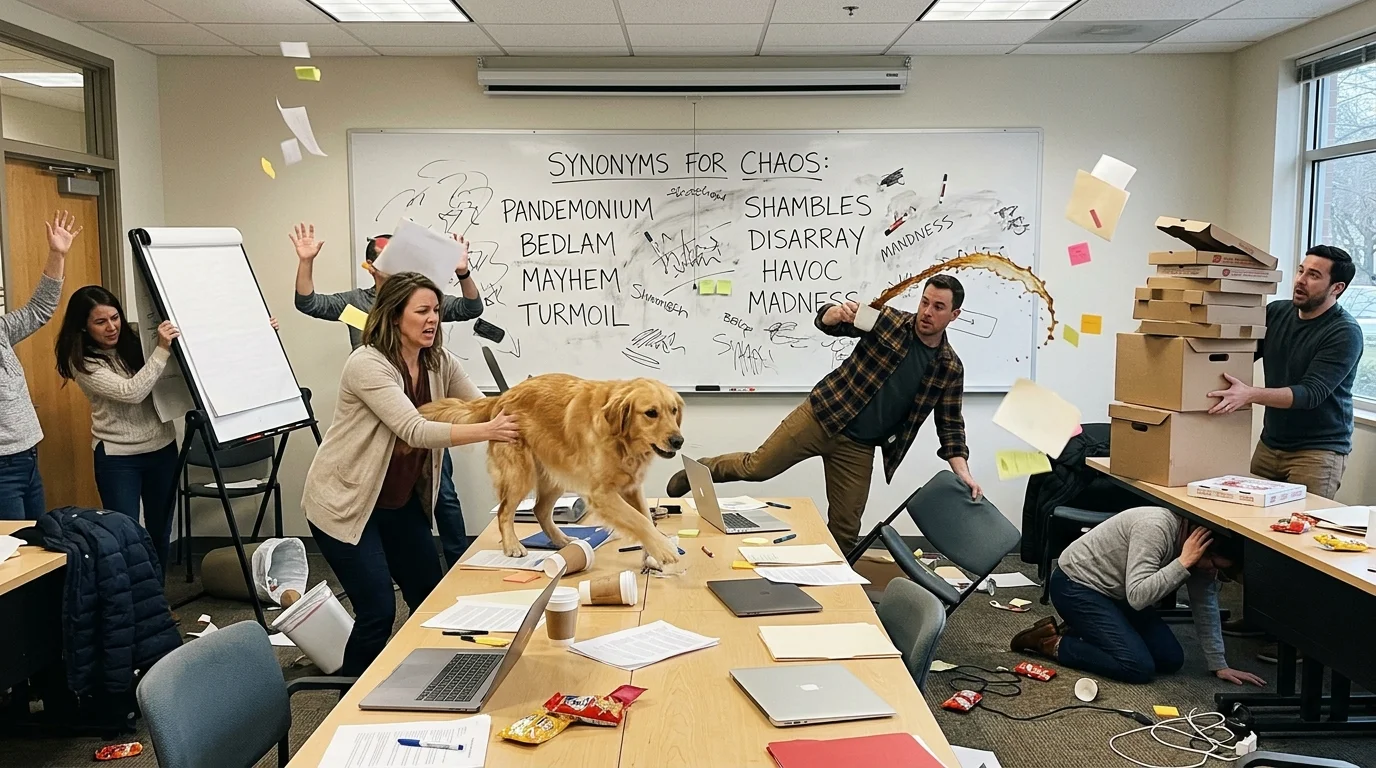
40+ Synonyms for Chaos
| Synonym | Meaning | Best Context |
|---|---|---|
| Disorder | Lack of order or organization | General |
| Confusion | Lack of clarity or understanding | Mental/social |
| Disarray | A state of untidiness or poor organization | Physical/general |
| Turmoil | Severe disturbance or uncertainty | Emotional/social |
| Mayhem | Violent, uncontrolled disorder | Crowds/emergencies |
| Havoc | Widespread damage or destruction | Disasters/conflict |
| Commotion | Noisy disturbance or agitation | Crowds/events |
| Pandemonium | Wild and noisy confusion | Crowds/emergencies |
| Bedlam | Extreme confusion and noise | Crowds/places |
| Anarchy | Lack of government, authority, or order | Political/social |
| Upheaval | Major disruption or sudden change | Society/business |
| Disturbance | Something that interrupts peace or order | General |
| Disruption | Interruption of normal activity | Business/systems |
| Disorganization | Lack of effective organization | Work/systems |
| Mess | Untidy or confused state | Informal/general |
| Muddle | Confused or disorganized situation | Informal |
| Clutter | Collection of things in an untidy arrangement | Physical |
| Jumble | Confused mixture or arrangement | Objects/ideas |
| Distraction | Something that prevents concentration | Mental/work |
| Unrest | Social or political disturbance | Politics/society |
| Instability | Lack of steadiness or predictability | Politics/economics |
| Confoundedness | State of being confused | Formal/rare |
| Frenzy | Wild excitement or agitation | Crowds/emotions |
| Furor | Intense public excitement or anger | Public reaction |
| Fracas | Noisy quarrel or disturbance | Conflict |
| Clamor | Loud, confused noise | Crowds/protests |
| Ruckus | Noisy disturbance | Informal |
| Row | Noisy argument or disturbance | British/informal |
| Free-for-all | Situation without effective rules or control | Informal |
| Disarray | Lack of order or neatness | General |
| Disorganization | Poor arrangement or coordination | Workplace |
| Dislocation | Disruption of normal structure or activity | Society/economy |
| Dysfunction | Failure to operate normally | Organizations/systems |
| Disintegration | Breakdown into separate or weaker parts | Systems/society |
| Collapse | Sudden failure of a system or structure | Systems/society |
| Breakdown | Failure of an organized system | Systems/processes |
| Turbulence | State of instability or disturbance | Air, politics, events |
| Volatility | Rapid and unpredictable change | Markets/emotions |
| Confusion | Lack of understanding or clarity | General |
| Wildness | Lack of restraint or control | Behavior/events |
| Disorderliness | Lack of neatness or organization | Physical/general |
| Pandemonium | Extreme confusion and noise | Crowds/events |
Best Synonyms for Chaos
Not every synonym for chaos has exactly the same meaning. These are some of the most useful alternatives.
Disorder
Disorder is one of the closest general synonyms for chaos.
It describes a lack of order, organization, or proper arrangement.
The files were in chaos.
can become:
The files were in disorder.
Best for: General writing, physical organization, systems, and formal contexts.
Unlike “chaos,” disorder does not always suggest extreme confusion or uncontrollability.
Confusion
Confusion focuses on a lack of clarity, understanding, or certainty.
The announcement caused chaos among the employees.
could become:
The announcement caused confusion among the employees.
Use confusion when people do not understand what is happening.
Disarray
Disarray describes something that is poorly organized, untidy, or arranged incorrectly.
The office was in chaos.
→
The office was in disarray.
It is particularly useful for describing physical spaces, plans, records, or organizations.
Turmoil
Turmoil describes a state of serious disturbance, uncertainty, or emotional or social instability.
The country was experiencing political chaos.
→
The country was experiencing political turmoil.
It is especially useful for emotional, political, economic, and social situations.
Mayhem
Mayhem suggests extreme, uncontrolled, and often violent disorder.
The crowd descended into chaos.
→
The crowd descended into mayhem.
Mayhem is stronger and more dramatic than ordinary disorder.
Havoc
Havoc emphasizes damage, destruction, or serious disruption caused by an event.
The storm caused chaos throughout the region.
→
The storm caused havoc throughout the region.
The focus is not simply on confusion but on the harmful consequences.
Commotion
Commotion refers to noisy activity, disturbance, or agitation.
There was chaos outside the building.
→
There was a commotion outside the building.
It is often useful for describing crowds, arguments, sudden events, or noisy disturbances.
Pandemonium
Pandemonium describes wild, noisy, uncontrolled confusion.
The stadium was filled with chaos after the final goal.
→
The stadium erupted into pandemonium after the final goal.
It is vivid and expressive and often works particularly well in creative writing.
Anarchy
Anarchy is more specific than chaos. It refers to a situation where there is little or no effective authority, government, or social order.
The country descended into chaos.
could become:
The country descended into anarchy.
Use it carefully because it carries political and social implications.
Upheaval
Upheaval emphasizes major disruption or dramatic change.
The industry was thrown into chaos.
→
The industry was thrown into upheaval.
It works especially well for political, economic, social, and organizational change.
Synonyms for Chaos Meaning “Disorder”
When chaos means a general lack of order, use:
- Disorder
- Disarray
- Disorganization
- Mess
- Muddle
- Jumble
- Untidiness
- Disorderliness
- Clutter
- Confusion
Examples
The room was in chaos.
→ The room was in disarray.
The paperwork was in chaos.
→ The paperwork was in disorder.
The files were in chaos.
→ The files were in a mess.
Disorder is generally more formal, while mess is more conversational.
Synonyms for Chaos Meaning “Confusion”
When the main idea is uncertainty or lack of understanding, consider:
- Confusion
- Bewilderment
- Uncertainty
- Muddle
- Disorientation
- Perplexity
- Confoundedness
- Ambiguity
Examples
The new rules created chaos.
If people did not understand the rules:
The new rules created confusion.
If people were deeply uncertain:
The new rules created uncertainty.
The best word depends on the specific problem.
Synonyms for Chaos Meaning “Violent Disorder”
When chaos involves violence, fighting, or uncontrolled behavior, stronger words may be appropriate:
- Mayhem
- Pandemonium
- Bedlam
- Frenzy
- Fracas
- Ruckus
- Riot
- Turmoil
- Free-for-all
For example:
The protest descended into chaos.
If there was violence:
The protest descended into mayhem.
If there was mainly loud activity:
The protest created a commotion.
Choose the word based on what actually happened.
Synonyms for Chaos Meaning “Damage”
When chaos emphasizes destruction or harmful consequences, use:
- Havoc
- Destruction
- Devastation
- Damage
- Ruin
- Wreckage
- Disruption
Examples:
The hurricane caused chaos along the coast.
→ The hurricane caused havoc along the coast.
The explosion left chaos behind.
→ The explosion left destruction behind.
Havoc is often the closest choice when an event causes widespread damage.
Synonyms for Chaos in a Workplace
Workplace chaos can refer to poor organization, confusion, pressure, or operational problems.
Useful alternatives include:
- Disorganization
- Disorder
- Confusion
- Disarray
- Dysfunction
- Disruption
- Turmoil
- Upheaval
- Instability
- Mismanagement
Examples
The office was in chaos after the manager resigned.
Possible alternatives:
The office was in disarray after the manager resigned.
The office was experiencing turmoil after the manager resigned.
The company was suffering from organizational dysfunction.
Each version emphasizes something different.
Synonyms for Chaos in Business
Business chaos can involve unpredictable conditions, poor management, market changes, or operational failure.
Useful words include:
- Disruption
- Turmoil
- Instability
- Upheaval
- Volatility
- Dysfunction
- Disorder
- Uncertainty
- Breakdown
- Disorganization
Examples
The company was thrown into chaos after the merger.
→
The company was thrown into turmoil after the merger.
Or:
The merger caused significant disruption.
Or:
The organization experienced major upheaval.
Synonyms for Chaos in Politics
Political chaos can describe instability, conflict, protests, government failure, or uncertainty.
Useful alternatives include:
- Turmoil
- Unrest
- Instability
- Upheaval
- Anarchy
- Disorder
- Crisis
- Conflict
- Political instability
Examples
The country descended into chaos.
Depending on the situation:
The country descended into political turmoil.
The country experienced widespread unrest.
The government faced severe instability.
Use anarchy only when the situation genuinely involves a breakdown of authority or law and order.
Synonyms for Chaos in Society
For social disorder or widespread disruption, consider:
- Social unrest
- Turmoil
- Upheaval
- Disorder
- Instability
- Conflict
- Unrest
- Disruption
- Anarchy
Example:
Rapid changes created chaos in the community.
→
Rapid changes created social upheaval in the community.
Synonyms for Chaos in a Crowd
When describing a large crowd that becomes noisy, uncontrolled, or disorderly, use:
- Pandemonium
- Mayhem
- Bedlam
- Commotion
- Frenzy
- Ruckus
- Clamor
- Free-for-all
Examples:
The crowd erupted into chaos.
→ The crowd erupted into pandemonium.
The crowd became chaotic.
→ The crowd descended into mayhem.
Synonyms for Chaos in the Mind
When chaos refers to thoughts or emotions, better alternatives include:
- Confusion
- Turmoil
- Mental clutter
- Disorientation
- Inner conflict
- Emotional turmoil
- Uncertainty
- Distress
- Muddle
Examples:
His mind was filled with chaos.
→
His mind was filled with confusion.
Or:
She was experiencing intense emotional turmoil.
For thoughts, confusion is often more natural than “chaos.”
Synonyms for Chaos in Nature
When describing storms, disasters, or unpredictable natural conditions, consider:
- Turbulence
- Havoc
- Destruction
- Disruption
- Turmoil
- Upheaval
- Unpredictability
- Violence
Examples:
The storm created chaos along the coast.
→
The storm caused havoc along the coast.
The flight experienced chaos during the storm.
→
The flight experienced severe turbulence.
Synonyms for Chaos in Formal Writing
In formal writing, choose a precise word instead of automatically using “chaos.”
Useful alternatives include:
- Disorder
- Disorganization
- Disruption
- Instability
- Turmoil
- Upheaval
- Confusion
- Dysfunction
- Breakdown
- Uncertainty
Example
Less precise:
The organization was in chaos.
More precise:
The organization was experiencing significant disorganization.
Or:
The organization was experiencing operational disruption.
The more precise version tells readers what kind of problem exists.
Synonyms for Chaos in Academic Writing
Academic writing benefits from specific descriptions.
Instead of:
The study caused chaos among participants.
You might write:
The study caused confusion among participants.
If procedures stopped working:
The study caused organizational disruption.
If the environment became unstable:
The study created significant uncertainty.
Academic writing should identify the specific problem rather than relying on a dramatic word like “chaos.”
Synonyms for Chaos in Creative Writing
Creative writing allows stronger and more vivid alternatives.
Consider:
- Pandemonium
- Mayhem
- Bedlam
- Frenzy
- Turmoil
- Havoc
- Uproar
- Tumult
- Maelstrom
- Whirlwind
Example
The city was in chaos.
More vivid:
The city had descended into pandemonium.
Or:
The streets became a maelstrom of noise and confusion.
These choices create a stronger atmosphere.
Synonyms for Chaos in an Essay
For essays, choose a word that accurately describes the situation.
General disorder
The system fell into disorder.
Social instability
The country experienced political turmoil.
Major change
The reform caused significant social upheaval.
Lack of organization
The project suffered from disorganization.
Lack of understanding
The announcement created widespread confusion.
Avoid replacing “chaos” with a dramatic word simply to make the writing sound more sophisticated.
Chaos vs. Disorder
Chaos and disorder are closely related.
Disorder means a lack of order or organization.
Chaos often suggests a more extreme or uncontrolled state.
Compare:
The files were in disorder.
This suggests poor organization.
The files were in chaos.
This sounds stronger and suggests extreme confusion.
Use disorder when you want a more neutral description.
Chaos vs. Confusion
Confusion focuses on a lack of understanding or clarity.
Chaos focuses on a broader lack of order or control.
Compare:
The instructions caused confusion.
People did not understand them.
The instructions caused chaos.
The instructions may have caused confusion, mistakes, delays, and disorder.
Confusion can be one part of chaos, but the words are not always interchangeable.
Chaos vs. Turmoil
Turmoil usually describes serious emotional, political, social, or organizational disturbance.
The office was in chaos.
focuses on disorder.
The company was in turmoil.
suggests serious instability, conflict, or uncertainty.
Turmoil is often more appropriate for long-lasting difficult situations.
Chaos vs. Mayhem
Mayhem is stronger and more dramatic than ordinary chaos.
It often suggests violence, destruction, or uncontrolled activity.
The event descended into chaos.
is broad.
The event descended into mayhem.
suggests a much wilder situation.
Chaos vs. Havoc
Havoc emphasizes damage and destruction.
The storm caused chaos.
focuses on widespread disorder.
The storm caused havoc.
focuses more strongly on the damage and disruption caused by the storm.
Chaos vs. Commotion
Commotion usually means noisy or agitated activity.
There was chaos outside.
suggests serious disorder.
There was a commotion outside.
suggests a noisy disturbance but does not necessarily imply extreme disorder.
Chaos vs. Pandemonium
Pandemonium describes extreme noise, confusion, and uncontrolled activity.
The crowd descended into chaos.
is general.
The crowd descended into pandemonium.
is more vivid and dramatic.
Chaos vs. Anarchy
Anarchy is a specialized term.
It usually refers to the absence or breakdown of government, authority, or social order.
The city was in chaos.
could describe many kinds of problems.
The city was in anarchy.
suggests a much more specific political or social condition.
Do not use “anarchy” simply because something is messy.
Chaos vs. Upheaval
Upheaval focuses on major change or disruption.
The organization was in chaos.
suggests disorder.
The organization was experiencing upheaval.
suggests major structural or organizational change.
Upheaval does not necessarily mean that everything is disorganized.
Stronger Synonyms for Chaos
When you want a stronger word, consider:
- Mayhem
- Pandemonium
- Bedlam
- Havoc
- Anarchy
- Frenzy
- Tumult
- Uproar
- Maelstrom
- Turmoil
Examples
Chaos at the stadium → Pandemonium at the stadium
Chaos in the streets → Mayhem in the streets
Chaos caused by the storm → Havoc caused by the storm
Political chaos → Political turmoil
Choose the stronger word only when the situation justifies it.
Softer Synonyms for Chaos
If “chaos” sounds too dramatic, consider:
- Disorder
- Confusion
- Disarray
- Disorganization
- Commotion
- Mess
- Muddle
- Disturbance
- Disruption
- Uncertainty
For example:
The office was in chaos.
could become:
The office was in disarray.
This sounds less dramatic and more descriptive.
Synonyms for Chaos Meaning “A Mess”
In casual writing, useful alternatives include:
- Mess
- Muddle
- Disarray
- Jumble
- Clutter
- Disorder
- Tangle
- Shambles
Examples:
My desk is in chaos.
→ My desk is a mess.
The documents were in chaos.
→ The documents were in a jumble.
The room was in chaos.
→ The room was in disarray.
10 Sentence Transformations Using Synonyms for Chaos
1. General disorder
Original:
The office was in chaos.
Alternative:
The office was in disarray.
Why: “Disarray” specifically emphasizes poor organization and untidiness.
2. Confusion
Original:
The announcement caused chaos.
Alternative:
The announcement caused widespread confusion.
Why: This is better if people did not understand what the announcement meant.
3. Political instability
Original:
The country was in chaos.
Alternative:
The country was experiencing political turmoil.
Why: “Turmoil” better communicates serious political instability.
4. Widespread damage
Original:
The hurricane caused chaos.
Alternative:
The hurricane caused widespread havoc.
Why: “Havoc” emphasizes the damage caused by the storm.
5. Noisy crowd
Original:
The stadium descended into chaos.
Alternative:
The stadium erupted into pandemonium.
Why: “Pandemonium” captures extreme noise and excitement.
6. Lack of organization
Original:
The project was in chaos.
Alternative:
The project suffered from serious disorganization.
Why: This identifies the specific problem.
7. Violent disorder
Original:
The protest descended into chaos.
Alternative:
The protest descended into mayhem.
Why: “Mayhem” is appropriate when the situation becomes extremely disorderly or violent.
8. Social disturbance
Original:
The city experienced chaos after the announcement.
Alternative:
The city experienced widespread unrest after the announcement.
Why: “Unrest” is appropriate for social or political disturbance.
9. Major change
Original:
The company was thrown into chaos after the merger.
Alternative:
The company was thrown into upheaval after the merger.
Why: “Upheaval” emphasizes major organizational change.
10. Informal description
Original:
My room is in chaos.
Alternative:
My room is a complete mess.
Why: “Mess” sounds natural in casual conversation.
Best Synonyms for Chaos by Context
| Context | Best Alternatives |
|---|---|
| General disorder | Disorder, disarray, disorganization |
| Confusion | Confusion, muddle, uncertainty |
| Mess | Mess, jumble, clutter, shambles |
| Crowd | Pandemonium, mayhem, bedlam |
| Noise | Commotion, uproar, clamor |
| Violence | Mayhem, frenzy, tumult |
| Damage | Havoc, destruction, devastation |
| Politics | Turmoil, unrest, instability |
| Society | Upheaval, unrest, turmoil |
| Workplace | Disorganization, dysfunction, disarray |
| Business | Disruption, instability, upheaval |
| Emotions | Turmoil, confusion, inner conflict |
| Thoughts | Confusion, mental clutter, muddle |
| Natural disaster | Havoc, destruction, disruption |
| Formal writing | Disorder, disruption, instability |
| Academic writing | Confusion, uncertainty, disruption |
| Creative writing | Pandemonium, mayhem, bedlam |
| Major change | Upheaval, disruption, transformation |
| Lack of authority | Anarchy, lawlessness |
| Unpredictability | Instability, volatility, uncertainty |
Common Mistakes When Using Synonyms for Chaos
Using “anarchy” for every messy situation
Anarchy has a specific political and social meaning involving the absence or breakdown of authority.
My bedroom is in anarchy.
This sounds exaggerated or incorrect in most contexts.
Better:
My bedroom is in disarray.
Using “havoc” when there is no damage
Havoc usually emphasizes serious damage or disruption.
The confusing instructions caused havoc.
This can work if they caused serious disruption, but if people simply did not understand them, confusion is more accurate.
Using “mayhem” for ordinary disorder
Mayhem suggests extreme and often violent or uncontrolled disorder.
My desk is in mayhem.
This is unnecessarily dramatic.
Better:
My desk is in disarray.
Using “confusion” for physical mess
Confusion primarily describes a lack of understanding or clarity.
The bedroom was full of confusion.
This is unusual if you simply mean it was untidy.
Better:
The bedroom was in disarray.
Using “turmoil” for a simple mess
Turmoil usually describes serious emotional, social, political, or organizational disturbance.
My closet is in turmoil.
This sounds unusual unless the closet situation is being described humorously.
Better:
My closet is in disarray.
Using “disorder” when you mean noise
Disorder does not necessarily imply loudness.
If a crowd is making a lot of noise:
There was a commotion outside.
may be more precise than:
There was disorder outside.
Choosing a dramatic synonym without checking context
Words such as bedlam, mayhem, pandemonium, and anarchy are strong.
Use them only when the situation deserves that level of intensity.
Treating all synonyms as interchangeable
These words emphasize different things:
- Disorder = lack of order
- Confusion = lack of clarity
- Turmoil = serious disturbance
- Mayhem = extreme uncontrolled disorder
- Havoc = damage and destruction
- Commotion = noisy disturbance
- Anarchy = breakdown of authority
- Upheaval = major disruption or change
Choose based on meaning, not simply variety.
Grammar: How to Use Chaos Correctly
Chaos is primarily an uncountable noun when referring to a general state of disorder.
Common expressions include:
- in chaos
- descend into chaos
- throw into chaos
- cause chaos
- create chaos
- bring chaos
- plunge into chaos
- amid the chaos
- complete chaos
- total chaos
- absolute chaos
- utter chaos
Examples
The storm caused chaos.
The office was in chaos.
The announcement threw the company into chaos.
The situation descended into chaos.
You can also use chaotic as the adjective:
The situation was chaotic.
It was a chaotic morning.
Common Collocations with Chaos
Some common phrases include:
Cause chaos
The storm caused chaos across the region.
Create chaos
The new rules created chaos.
Descend into chaos
The meeting quickly descended into chaos.
Throw something into chaos
The software failure threw the system into chaos.
Plunge into chaos
The country plunged into chaos after the government collapsed.
In chaos
The office was in chaos.
Amid the chaos
Amid the chaos, the team managed to finish the project.
Complete chaos
The classroom was complete chaos.
These expressions are common and natural in English.
Chaos as an Adjective: Chaotic
The adjective chaotic means extremely disorganized, confused, or uncontrolled.
Examples:
It was a chaotic day.
The traffic was chaotic.
The meeting became chaotic.
Related alternatives include:
- Disorganized
- Confused
- Disorderly
- Uncontrolled
- Turbulent
- Unstable
- Frenzied
- Hectic
Be careful because these adjectives are not exact replacements in every context.
When Should You Keep the Word “Chaos”?
You do not always need to replace chaos.
It is often the clearest choice when you mean a broad and serious lack of order or control.
Keep chaos when:
- The situation involves several types of disorder at once.
- You want a broad description.
- The context is informal or conversational.
- You are writing vivid or expressive prose.
- The exact type of disorder is not important.
- The word naturally fits a common expression.
For example:
The meeting descended into chaos.
This is concise, natural, and expressive.
Replacing it with:
The meeting descended into a state of severe organizational disarray.
would usually make the sentence worse.
The goal is not to eliminate “chaos,” but to choose a more precise alternative when it communicates your meaning better.
How to Choose the Right Synonym for Chaos
Ask what kind of disorder you mean.
Is it a general lack of order?
Use disorder, disarray, or disorganization.
Is it a lack of understanding?
Use confusion, uncertainty, or muddle.
Is it serious emotional or political disturbance?
Use turmoil.
Is it noisy and uncontrolled?
Use commotion, pandemonium, or bedlam.
Is it violent or extremely disorderly?
Use mayhem.
Is it causing widespread damage?
Use havoc.
Is there a breakdown of authority?
Use anarchy.
Is there major change or disruption?
Use upheaval.
Is it simply a messy physical space?
Use mess, disarray, or clutter.
The best synonym is the one that describes the specific kind of disorder rather than simply sounding stronger.
Strong vs. Mild Synonyms for Chaos
| Intensity | Words |
|---|---|
| Mild | Mess, clutter, muddle, disturbance |
| Moderate | Disorder, disarray, confusion, disorganization |
| Strong | Turmoil, upheaval, disruption, instability |
| Very strong | Mayhem, pandemonium, bedlam, havoc |
| Specialized | Anarchy, unrest, volatility, dysfunction |
Intensity matters.
For example:
The files were in disarray.
is relatively neutral.
The files were in complete chaos.
is stronger.
The files were in absolute pandemonium.
sounds exaggerated unless the situation is intentionally humorous.
True Synonyms vs. Related Alternatives
| Alternative | Relationship to “Chaos” | Interchangeable? | Best Use |
|---|---|---|---|
| Disorder | Very close synonym | Usually | General lack of order |
| Disarray | Close synonym | Often | Untidiness and poor organization |
| Confusion | Related synonym | Sometimes | Lack of clarity |
| Turmoil | Contextual synonym | Often | Emotional/social/political disturbance |
| Mayhem | Stronger synonym | Sometimes | Extreme uncontrolled disorder |
| Havoc | Contextual synonym | Sometimes | Damage and destruction |
| Commotion | Related synonym | Sometimes | Noisy disturbance |
| Pandemonium | Stronger synonym | Sometimes | Wild noisy confusion |
| Anarchy | Specialized synonym | Rarely | Breakdown of authority |
| Upheaval | Contextual synonym | Often | Major disruption or change |
| Disruption | Related synonym | Sometimes | Interruption of normal activity |
| Disorganization | Close synonym | Often | Poor organization |
| Unrest | Contextual synonym | Sometimes | Social or political disturbance |
| Instability | Related synonym | Sometimes | Lack of steadiness |
| Mess | Informal synonym | Often | Untidy or confused situation |
| Frenzy | Contextual synonym | Sometimes | Wild excitement or activity |
| Bedlam | Stronger synonym | Sometimes | Extreme noisy disorder |
| Volatility | Related synonym | No | Rapid unpredictable change |