
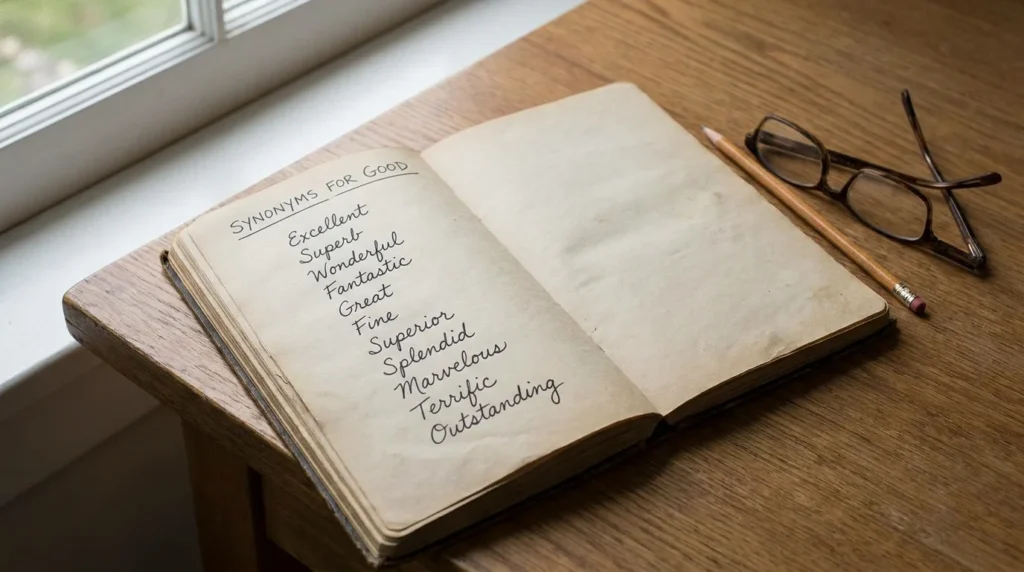
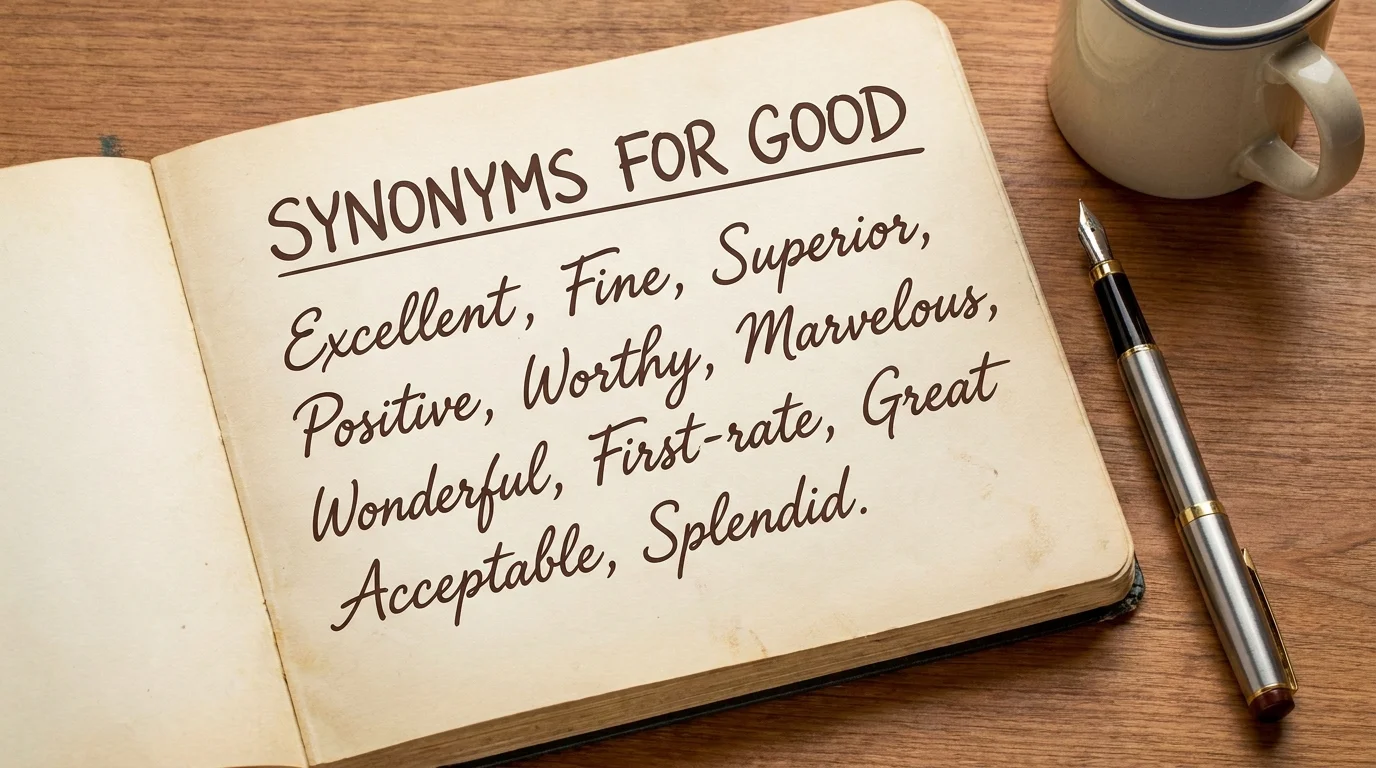
Quick Synonym List
Here are useful alternatives to “good,” grouped by meaning rather than treating every word as interchangeable.
Closest and common alternatives:
- Great
- Fine
- Nice
- Decent
- Excellent
- Wonderful
- Positive
- Satisfactory
- Admirable
- Favorable
Stronger alternatives:
- Outstanding
- Exceptional
- Superb
- Remarkable
- Impressive
- Fantastic
- Brilliant
- Magnificent
- First-rate
For results, performance, or usefulness:
- Effective
- Successful
- Productive
- Useful
- Valuable
- Beneficial
- Helpful
- Reliable
For people and character:
- Kind
- Caring
- Generous
- Honest
- Compassionate
- Admirable
- Respectable
For experiences or things you enjoy:
- Enjoyable
- Pleasant
- Delightful
- Wonderful
- Fantastic
Closest Synonyms for Good
These words can often replace “good,” but they do not all carry exactly the same meaning or strength.
Great
Meaning: Very good; considerably better than average.
How it differs: “Great” is usually stronger and more enthusiastic than “good.” It is extremely common in everyday American English.
Tone: Neutral to enthusiastic; conversational.
Best for: Everyday speech, reviews, recommendations, and informal writing.
Example: “We had a great time at the concert.”
Watch out: “Great” can sound too casual for some formal or academic contexts.
Excellent
Meaning: Extremely good or of very high quality.
How it differs: “Excellent” is stronger and more precise than ordinary “good.” It often suggests a high standard has been met.
Tone: Positive and confident; neutral to formal.
Best for: Performance, quality, work, service, academic results, and professional communication.
Example: “She did an excellent job on the presentation.”
Watch out: Do not use it for something that is merely satisfactory.
Fine
Meaning: Acceptable, satisfactory, or reasonably good.
How it differs: “Fine” is often weaker than “good.” Depending on tone, it can also mean “acceptable” rather than genuinely impressive.
Tone: Neutral and understated.
Best for: Everyday conversation and situations where strong praise is unnecessary.
Example: “The food was fine, but the dessert was better.”
Watch out: “Fine” can sometimes sound lukewarm or reluctant.
Nice
Meaning: Pleasant, agreeable, kind, or enjoyable.
How it differs: “Nice” is broad and often less precise than “good.” It can describe people, experiences, objects, weather, or social behavior.
Tone: Friendly and conversational.
Best for: Everyday conversation.
Example: “That was a nice thing to say.”
Watch out: In professional or academic writing, a more specific word often communicates your meaning better.
Decent
Meaning: Reasonably good or acceptable.
How it differs: “Decent” usually means something is satisfactory but not exceptional.
Tone: Neutral to conversational.
Best for: Describing quality, results, food, prices, or performance when you want moderate praise.
Example: “We found a decent hotel near the airport.”
Watch out: It can sound less complimentary than “good.”
Wonderful
Meaning: Very good, pleasing, or enjoyable.
How it differs: “Wonderful” adds warmth and enthusiasm that “good” may not express.
Tone: Warm and enthusiastic.
Best for: Experiences, people, events, news, and personal reactions.
Example: “It was wonderful to see everyone again.”
Watch out: It may sound overly enthusiastic in highly restrained professional writing.
Stronger Words Than Good
Sometimes “good” is technically correct but too weak for what you want to say. These alternatives communicate stronger approval.
Outstanding
Meaning: Exceptionally good or noticeably better than others.
Example: “Her performance was outstanding.”
Use “outstanding” when something clearly stands above the usual standard.
Exceptional
Meaning: Unusually excellent or far above normal.
Example: “The restaurant provided exceptional service.”
“Exceptional” is stronger and more formal than “good.” It works especially well in professional reviews and formal praise.
Superb
Meaning: Extremely high in quality.
Example: “The hotel offers superb views of the coastline.”
“Superb” is strongly positive but can sound more polished than everyday “great.”
Remarkable
Meaning: Worthy of attention because it is unusual, impressive, or significant.
Example: “She made remarkable progress in just three months.”
“Remarkable” does not simply mean “very good.” It often highlights something noteworthy.
Impressive
Meaning: Causing admiration because of quality, ability, size, or achievement.
Example: “He gave an impressive presentation.”
Choose “impressive” when the result causes admiration rather than simply meeting expectations.
Fantastic
Meaning: Extremely good, enjoyable, or exciting.
Example: “We had a fantastic weekend.”
It is common in conversational English and informal reviews.
Brilliant
Meaning: Extremely good, clever, or skillful.
Example: “That was a brilliant solution to the problem.”
In American English, “brilliant” can describe exceptional intelligence or an excellent idea. It is less neutral than “good.”
Magnificent
Meaning: Extremely impressive, beautiful, or grand.
Example: “The palace has a magnificent interior.”
“M agnificent” is much stronger and more expressive than “good,” so it is not a universal substitute.
First-rate
Meaning: Of the highest quality.
Example: “The clinic provides first-rate care.”
This expression is useful for quality, service, skill, and performance, particularly in reviews and professional writing.
Synonyms for Good When You Mean Effective
“Good” can mean that something works well or produces the desired result. In this sense, words such as “excellent” or “wonderful” may not be the best replacements.
Effective
Something is effective when it produces the intended result.
“This is a good way to save time.”
can become:
“This is an effective way to save time.”
The second sentence is more precise because it focuses on results.
Useful
“Useful” means helpful for a particular purpose.
“This is a good tool for beginners.”
“This is a useful tool for beginners.”
“Useful” is narrower than “good,” but often more informative.
Beneficial
“Beneficial” means producing a positive advantage or effect.
“Regular exercise is beneficial to your health.”
It is particularly useful in formal, professional, and academic writing.
Valuable
“Valuable” emphasizes usefulness, importance, worth, or benefit.
“Her feedback was valuable to the team.”
It does not simply mean “good.” It suggests that something has meaningful worth.
Helpful
“Helpful” means providing assistance or making something easier.
“The guide contains helpful information for new employees.”
Use it when the main idea is assistance rather than general quality.
Successful
“Successful” means achieving the intended result.
“The project was successful.”
This is not a general synonym for “good.” It is appropriate when “good” refers specifically to an outcome or achievement.
Productive
“Productive” means achieving useful results, especially through work or activity.
“We had a good meeting.”
“We had a productive meeting.”
The second version tells the reader why the meeting was good.
Reliable
“Reliable” means dependable and consistently trustworthy.
“She is a good employee.”
“She is a reliable employee.”
The second sentence gives a specific quality rather than general praise.
Synonyms for Good When Describing People
“Good” has several meanings when describing a person. Choosing a synonym requires knowing what quality you mean.
Kind
Use kind when someone treats others with care and consideration.
“My neighbor was very kind to us.”
Caring
Use caring when someone shows concern for other people’s well-being.
“She is a caring teacher who listens to her students.”
Generous
Use generous when someone willingly gives time, money, attention, or support.
“He was generous with his time.”
Honest
Use honest when you mean truthful or sincere.
“She is a good person.”
“She is an honest person.”
The second sentence is more precise if honesty is the quality you want to emphasize.
Compassionate
Use compassionate when someone responds to others’ suffering with concern and a desire to help.
“The doctor was compassionate and patient.”
This is more specific and formal than “good.”
Admirable
Use admirable when someone’s behavior, qualities, or actions deserve respect.
“Her commitment to helping others is admirable.”
Respectable
Use respectable when someone or something meets accepted standards of decency or social respectability.
“He has built a respectable career.”
“Respectable” does not necessarily mean outstanding.
Formal and Professional Alternatives to Good
For professional writing, the best replacement for “good” is often not a stronger synonym. It is a more specific word.
Favorable
Use “favorable” for conditions, opinions, outcomes, responses, or circumstances that are positive.
“The company received favorable reviews from customers.”
Satisfactory
Use “satisfactory” when something meets an expected standard.
“The results were satisfactory.”
This can sound weaker than “good” because it often means the requirements were met but nothing exceptional occurred.
Admirable
Use “admirable” for conduct, effort, qualities, or achievements that deserve approval or respect.
“The team showed admirable dedication.”
Effective
Use “effective” when you want to show that something achieves its intended purpose.
“The revised process is more effective.”
Valuable
Use “valuable” when something provides meaningful benefit, insight, or contribution.
“The consultant provided valuable feedback.”
Beneficial
Use “beneficial” when something creates a positive effect or advantage.
“The policy could be beneficial to small businesses.”
These choices are usually more useful in professional writing than simply replacing “good” with a fancier adjective.
Academic Alternatives to Good
Academic writing often benefits from precision rather than stronger praise.
Instead of:
“The study produced good results.”
consider:
“The study produced significant results.”
But only use “significant” if the intended meaning supports it. In academic contexts, “significant” can have a specific statistical meaning, so it should not be used casually.
Other possibilities include:
- Effective
- Beneficial
- Valuable
- Positive
- Favorable
- Reliable
- Appropriate
- Relevant
- Successful
- Convincing
The best word depends on what the evidence actually shows.
For example:
“The method was good.”
is vague.
“The method was effective.”
focuses on results.
“The method was reliable.”
focuses on consistency or dependability.
“The method was appropriate.”
focuses on suitability.
These sentences are not interchangeable, even though all may describe something positively.
Neutral and Everyday Alternatives
For everyday English, you usually do not need an impressive synonym. Natural choices include:
- Great
- Fine
- Nice
- Decent
- Positive
- Pleasant
- Enjoyable
- Helpful
- Useful
- Reliable
For example:
“That sounds good.”
could become:
“That sounds great.”
if you want more enthusiasm.
Or:
“That sounds fine.”
if you simply mean that the idea is acceptable.
The choice changes the feeling of the sentence.
Are These Words Really Synonyms for Good?
Not all alternatives to “good” are true synonyms. “Good” is unusually broad, so many replacements capture only one part of its meaning.
| Alternative | Relationship | Can Replace Original? | Tone | Best Context |
|---|---|---|---|---|
| Great | Near synonym | Usually | Enthusiastic | Everyday speech |
| Excellent | Near synonym | Usually | Strongly positive | Professional/general |
| Fine | Near synonym | Sometimes | Neutral | Everyday |
| Nice | Contextual alternative | Sometimes | Friendly | Conversation |
| Outstanding | Stronger alternative | Context-dependent | Strong praise | Achievement |
| Effective | Contextual alternative | Only for results | Neutral/professional | Work, academic |
| Useful | Contextual alternative | Only for usefulness | Neutral | Tools, information |
| Beneficial | Contextual alternative | Only for positive effects | Formal | Academic/professional |
| Kind | Contextual alternative | Only for character | Warm | People |
| Reliable | Contextual alternative | Only for dependability | Positive/neutral | People, products |
| Enjoyable | Contextual alternative | Only for experiences | Positive | Activities |
| Satisfactory | Near synonym | Sometimes | Restrained | Standards/results |
The key point is simple: “good” is broader than most of its alternatives.
Comparison of the Best Alternatives
| Word/Phrase | Meaning | Tone | Strength | Best Use | Interchangeable? |
|---|---|---|---|---|---|
| Good | Positive or acceptable quality | Neutral | Moderate | Almost any general context | Yes |
| Great | Very good | Enthusiastic | Strong | Conversation | Usually |
| Excellent | Very high quality | Positive/formal | Very strong | Work, quality, performance | Usually |
| Nice | Pleasant or agreeable | Friendly | Moderate | Everyday conversation | Sometimes |
| Fine | Acceptable or satisfactory | Neutral | Mild | Casual conversation | Sometimes |
| Outstanding | Far above average | Strong praise | Very strong | Achievements | No |
| Effective | Produces desired results | Professional | Specific | Methods, plans, tools | No |
| Useful | Provides practical help | Neutral | Specific | Resources, tools | No |
| Beneficial | Produces an advantage | Formal | Specific | Policies, actions, effects | No |
| Kind | Considerate toward others | Warm | Specific | People | No |
| Reliable | Dependable | Neutral/professional | Specific | People, products, systems | No |
| Enjoyable | Gives pleasure | Positive | Specific | Experiences, activities | No |
How to Choose the Right Synonym for Good
The easiest way to choose is to ask what kind of good you mean.
If you mean very good
Choose excellent, outstanding, exceptional, superb, or remarkable.
If you mean good in everyday conversation
Choose great, nice, fine, or decent.
If you mean something works well
Choose effective, successful, or productive.
If you mean something is helpful
Choose useful, helpful, or beneficial.
If you mean something has worth
Choose valuable.
If you mean someone is dependable
Choose reliable.
If you mean someone has a good character
Choose kind, caring, honest, generous, or compassionate, depending on the specific quality.
If you mean an experience was pleasant
Choose enjoyable, pleasant, delightful, wonderful, or fantastic.
If you mean something meets a required standard
Choose satisfactory or acceptable.
The most precise synonym is usually the one that tells the reader why something is good.
Sentence Transformations
Example 1
Original:
“She did a good job.”
Better Alternative:
“She did an excellent job.”
Why:
“Excellent” increases the strength of the praise.
Example 2
Original:
“The meeting was good.”
Better Alternative:
“The meeting was productive.”
Why:
“Productive” explains that the meeting achieved useful results.
Example 3
Original:
“He is a good manager.”
Better Alternative:
“He is a reliable manager.”
Why:
“Reliable” identifies a specific quality instead of offering broad praise.
Example 4
Original:
“That was a good idea.”
Better Alternative:
“That was a brilliant idea.”
Why:
“Brilliant” adds strong enthusiasm and suggests the idea was especially clever.
Example 5
Original:
“She gave me good advice.”
Better Alternative:
“She gave me valuable advice.”
Why:
“Valuable” emphasizes the practical worth of the advice.
Example 6
Original:
“This is a good method.”
Better Alternative:
“This is an effective method.”
Why:
“Effective” is more precise if the method successfully produces the intended result.
Example 7
Original:
“He is a good person.”
Better Alternative:
“He is a kind person.”
Why:
“Kind” identifies the person’s considerate behavior more clearly.
Example 8
Original:
“We had a good vacation.”
Better Alternative:
“We had a wonderful vacation.”
Why:
“Wonderful” adds warmth and stronger positive emotion.
Example 9
Original:
“The results were good.”
Better Alternative:
“The results were favorable.”
Why:
“Favorable” works well when discussing a positive outcome in a formal or professional context.
Example 10
Original:
“The food was good.”
Better Alternative:
“The food was delicious.”
Why:
If you specifically mean that the food tasted very good, “delicious” is much more precise than “good.”
Grammar and Usage of Good
“Good” is primarily an adjective.
It commonly appears:
- Before a noun: “a good book”
- After a linking verb: “The book is good.”
- In comparisons: “This option is better.”
- In superlatives: “That was the best choice.”
One common mistake is using good where well is required.
“She sings well.”
Here, “well” describes how she sings, so it functions as an adverb.
Compare:
“She is a good singer.”
Here, “good” describes the noun “singer.”
There is also a useful distinction between good at and good for.
“He is good at math.”
means he has skill in math.
“Exercise is good for you.”
means exercise has a positive effect on your well-being.
The preposition changes the meaning.
Common Collocations With Good
“Good” appears naturally in many common combinations.
Good + noun
- Good idea
- Good job
- Good news
- Good reason
- Good choice
- Good example
- Good friend
- Good experience
- Good result
- Good opportunity
Good + at
Use good at to describe ability or skill.
“She is good at explaining difficult ideas.”
Good + for
Use good for when something has a positive effect or is suitable for a purpose.
“Walking is good for your health.”
“This book is good for beginners.”
Good + to
Use good to in certain expressions involving treatment or behavior.
“He has always been good to me.”
This means he has treated the speaker kindly.
Common Mistakes When Replacing Good
Mistake 1: Treating every synonym as interchangeable
“Good,” “effective,” “kind,” and “delicious” can all be positive, but they describe different qualities.
Fix: Identify exactly what is positive about the subject.
Mistake 2: Using a stronger word without justification
Calling an ordinary result “exceptional” exaggerates its quality.
Fix: Match the strength of the word to the facts.
Mistake 3: Using formal words in casual conversation
Words such as “beneficial” and “favorable” can sound unnecessarily formal in ordinary speech.
Fix: Use “helpful,” “good,” or “great” when they communicate the idea naturally.
Mistake 4: Assuming “nice” means exactly “good”
“Nice” often means pleasant or agreeable, not simply high quality.
Fix: Use a more specific word when quality is the main idea.
Mistake 5: Replacing “good” with “well”
“Good” is generally an adjective; “well” is commonly an adverb.
Fix: Say “She is a good writer” but “She writes well.”
Mistake 6: Using “satisfactory” as enthusiastic praise
“Satisfactory” usually means something meets expectations. It does not normally express strong approval.
Fix: Use “excellent” or “outstanding” for strong praise.
Mistake 7: Using “successful” for general quality
A successful project achieves its intended goal, but it may still have weaknesses.
Fix: Use “successful” when the result or outcome is the focus.
Mistake 8: Choosing a synonym just to avoid repetition
Changing every occurrence of “good” can make writing less natural.
Fix: Repeat “good” when it is the clearest and most accurate option.
When “Good” Is Actually the Best Choice
You do not always need a synonym.
“Good” is often better when:
- The exact meaning is obvious from context.
- You are speaking casually.
- A stronger word would exaggerate the situation.
- A more specific synonym would change the meaning.
- You want simple, accessible English.
- Replacing the word would make the sentence sound unnatural.
For example:
“Good morning.”
There is no useful synonym to force into this expression.
Likewise:
“That sounds good to me.”
is perfectly natural. Replacing it with “That sounds excellent to me” changes the tone and may sound overly enthusiastic.
Good writing is not about avoiding repeated words. It is about choosing words that communicate exactly what you mean.
Writing Tips for Using Better Alternatives
A thesaurus is most useful when it helps you become more precise, not when it helps you sound more complicated.
Before replacing “good,” ask:
- What do I actually mean?
Is it effective, enjoyable, kind, reliable, or high quality? - How strong should the praise be?
“Good” and “outstanding” are not equal in intensity. - Who am I writing for?
“Great” may suit a text message, while “beneficial” may fit a formal report. - Does the replacement fit naturally?
A dictionary synonym may not work in the same sentence. - Does the new word add information?
If not, keeping “good” may be the better choice.
The strongest vocabulary choice is often the simplest accurate one.
Editor’s Choice
Excellent
A strong all-purpose alternative when you genuinely want to express high quality or performance. It works well in both everyday and professional English.
Effective
One of the best replacements when “good” means that something works or achieves its purpose. It adds useful precision.
Great
The natural everyday choice when you want a warmer or more enthusiastic version of “good.”
Valuable
Especially useful when describing advice, information, feedback, experience, or contributions that have meaningful worth.
Kind
A better choice than “good” when describing a person’s considerate treatment of others.
Related Questions About Synonyms for Good
What is another word for good?
Common alternatives include great, excellent, fine, nice, decent, wonderful, positive, admirable, outstanding, effective, useful, beneficial, valuable, helpful, and reliable. The best choice depends on the specific meaning of “good” in your sentence.
What is a stronger word than good?
Strong alternatives include excellent, outstanding, exceptional, superb, remarkable, fantastic, brilliant, and magnificent. These words generally express more enthusiasm or a higher level of quality than “good.”
What is a formal synonym for good?
Depending on the meaning, formal alternatives include excellent, satisfactory, favorable, beneficial, effective, valuable, admirable, and appropriate. “Appropriate,” however, means suitable rather than simply good.
What is a professional way to say good?
In professional writing, use a word that identifies the specific quality you mean. Effective works for methods, reliable for performance, valuable for contributions, favorable for outcomes, and excellent for strong praise.
Is “great” better than “good”?
Neither is always better. “Great” is generally stronger and more enthusiastic, while “good” is broader and more neutral. Use “great” when you want stronger approval and “good” when moderate or neutral approval is appropriate.
Is “nice” a synonym for good?
“Nice” is a contextual synonym, not a universal replacement. It commonly means pleasant, agreeable, or friendly. For example, “a nice person” emphasizes friendliness, while “a good result” usually refers to quality or outcome.
What is the best synonym for good in academic writing?
There is no single best replacement. Academic writing usually benefits from precision. Depending on the meaning, use effective, beneficial, reliable, favorable, valuable, appropriate, or successful rather than choosing a stronger word simply for variety.
Key Takeaways
- “Good” is broad, so the best alternative depends on the exact quality you want to describe.
- Use excellent, outstanding, or exceptional when you mean something is far above average.
- Use effective, useful, beneficial, or valuable when you are describing results, usefulness, or positive effects.
- For people, choose specific qualities such as kind, caring, honest, generous, or reliable instead of vague praise.
- Do not replace “good” automatically; keeping the original word is often the clearest and most natural choice.