
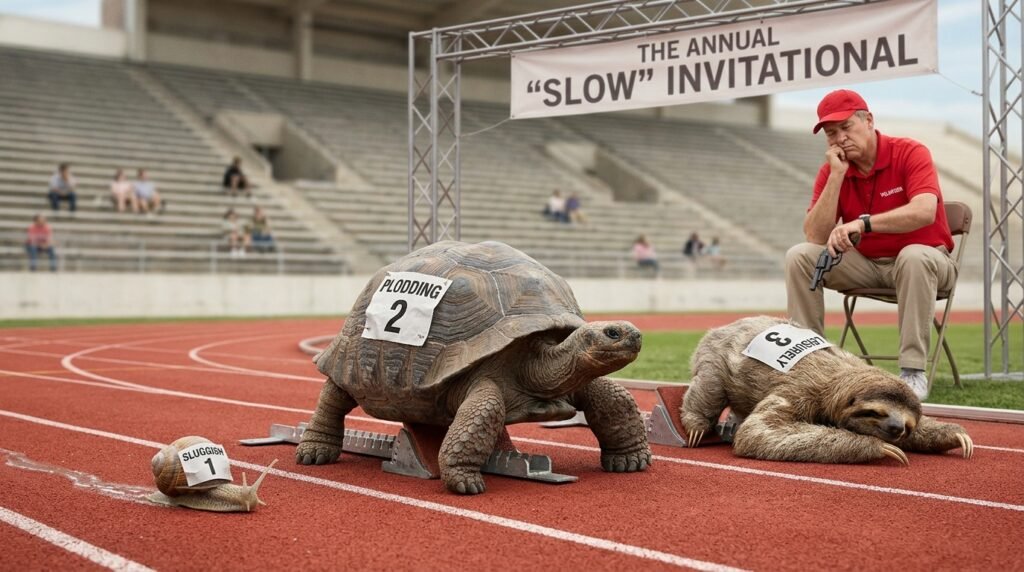
Quick Answer
Some of the best synonyms for slow are sluggish, gradual, leisurely, unhurried, deliberate, steady, tardy, sluggish, plodding, and unresponsive. Use sluggish for a lack of energy or speed, gradual for change over time, leisurely for a relaxed pace, and deliberate for careful action. The best choice depends on what you want to describe.
What Does “Slow” Mean?
Slow is an adjective or adverb that describes something moving, happening, or operating at a low speed or rate.
For example:
The car is slow.
We took a slow walk through the park.
The computer is running slowly.
Progress has been slow.
She gave a slow, careful response.
The word can describe several different situations:
Low speed: A slow car or slow runner.
Gradual change: Slow growth or slow improvement.
Delayed action: Slow service or a slow response.
Careful movement: Slow, deliberate steps.
Low activity or energy: A sluggish afternoon.
Unhurried pace: A slow, relaxing morning.
Because these meanings differ, no single synonym works naturally in every sentence.
40+ Synonyms for Slow
| Synonym | Meaning | Best Context |
|---|---|---|
| Sluggish | Moving or responding with little energy | People, systems, computers |
| Gradual | Happening slowly over time | Change, growth, improvement |
| Leisurely | Proceeding at a relaxed pace | Walks, meals, activities |
| Unhurried | Not rushed or hurried | People, actions, schedules |
| Deliberate | Done carefully and intentionally | Decisions, movements, speech |
| Steady | Moving or progressing at a consistent pace | Progress, movement |
| Tardy | Late or delayed | Arrivals, formal contexts |
| Plodding | Moving slowly with heavy, steady steps | Walking, writing style |
| Crawling | Moving extremely slowly | Traffic, progress |
| Languid | Slow and relaxed, sometimes lacking energy | Movement, atmosphere |
| Measured | Controlled and carefully paced | Speech, movement, decisions |
| Unresponsive | Reacting slowly or not reacting | People, devices, systems |
| Lethargic | Lacking energy or enthusiasm | People, behavior |
| Poky | Slow or taking too long; informal | People, vehicles, processes |
| Lumbering | Moving slowly and awkwardly | Large animals, machines |
| Labored | Requiring visible effort | Movement, breathing, speech |
| Protracted | Lasting longer than expected | Discussions, disputes, processes |
| Delayed | Happening later than expected | Services, deliveries, events |
| Late | Occurring after the expected time | Arrivals, deadlines |
| Unsteady | Lacking consistent movement or control | Walking, physical movement |
| Creeping | Moving or developing very slowly | Growth, change, movement |
| Incremental | Happening in small stages | Progress, improvements |
| Moderate | Neither fast nor extreme | Speed, pace, growth |
| Relaxed | Free from pressure or hurry | Activities, atmosphere |
| Easygoing | Relaxed and not easily hurried | Personality, behavior |
| Unpressured | Not forced to act quickly | Decisions, activities |
| Lagging | Falling behind in progress or speed | Performance, development |
| Stalled | Stopped or making no progress | Projects, negotiations |
| Halting | Hesitant, interrupted, or uneven | Speech, movement |
| Ponderous | Slow and heavy, sometimes awkward | Movement, writing |
| Cumbersome | Difficult to handle or operate efficiently | Processes, systems |
| Inefficient | Using more time or resources than necessary | Work, systems |
| Delayed-response | Responding after a noticeable wait | Technical descriptions |
| Apathetic | Showing little interest or motivation | Attitudes, behavior |
| Inert | Inactive or lacking movement | Systems, substances, descriptions |
| Stagnant | Showing little or no development | Economies, ideas, progress |
| Drawn-out | Continuing longer than necessary | Meetings, explanations |
| Prolonged | Continuing for an extended period | Events, conditions |
| Unhurriedly | At a relaxed pace; adverb | Actions, movement |
| Gradually | Slowly over a period; adverb | Change, development |
| Sluggishly | With little energy or speed; adverb | Movement, responses |
| Leisurely | At a relaxed pace; adjective or adverb | Walking, activities |
These words have different shades of meaning. For example, gradual usually describes a process, while sluggish describes a lack of speed or energy. Choose the word that best fits the situation.
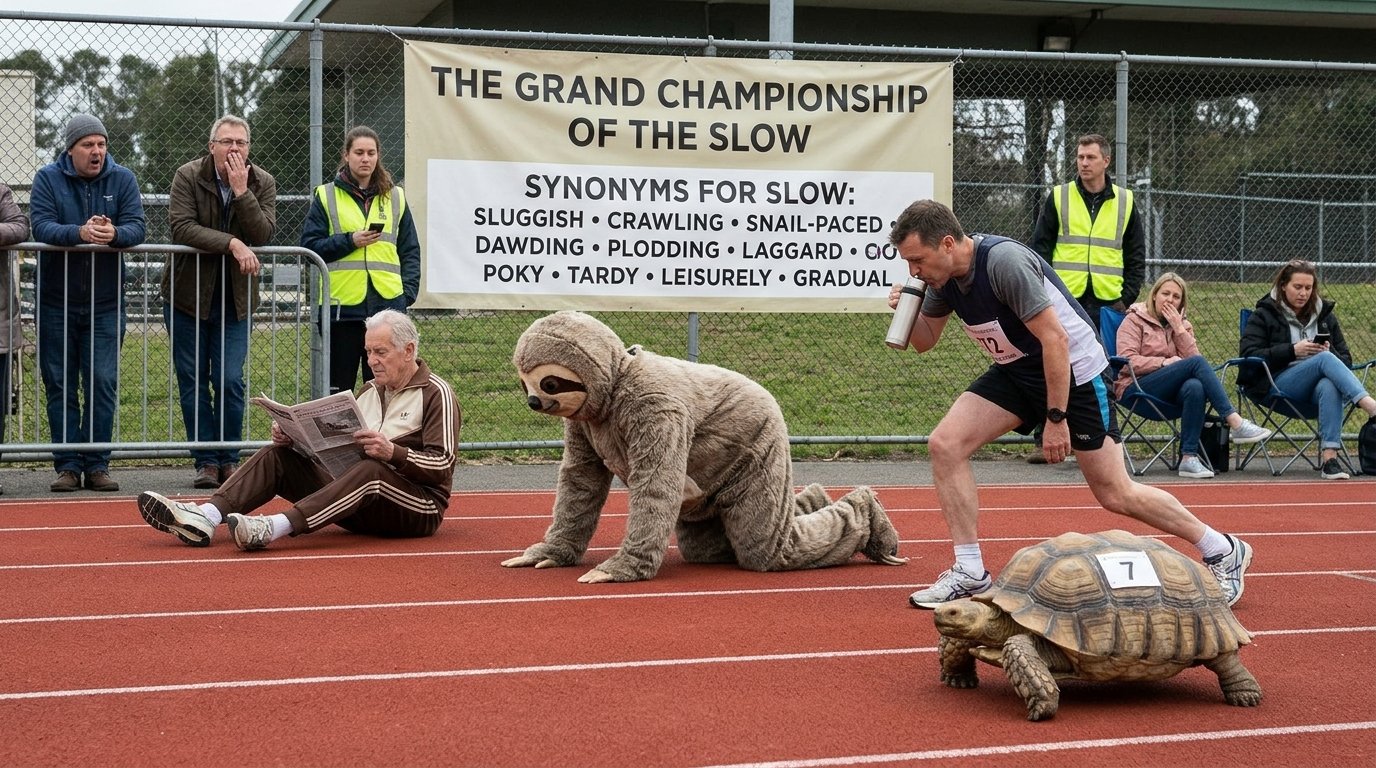
Best Synonyms for Slow
1. Sluggish
Sluggish describes something that moves, operates, or responds more slowly than expected. It often suggests low energy or poor performance.
Example:
My computer is slow today.
Alternative:
My computer is sluggish today.
Best for: Computers, economic activity, movement, and low-energy behavior.
2. Gradual
Gradual describes a change or process that happens slowly over time rather than suddenly.
Example:
The company experienced slow growth.
Alternative:
The company experienced gradual growth.
Best for: Growth, improvement, change, recovery, and development.
Important distinction: “Gradual” does not necessarily mean inefficient or excessively slow. It emphasizes a step-by-step process.
3. Leisurely
Leisurely suggests a relaxed pace without pressure or urgency.
Example:
We took a slow walk through the garden.
Alternative:
We took a leisurely walk through the garden.
Best for: Walks, meals, trips, activities, and relaxed routines.
4. Unhurried
Unhurried describes an action performed without rushing.
Example:
She spoke in a slow, calm manner.
Alternative:
She spoke in an unhurried manner.
Best for: Speech, decisions, movement, and relaxed situations.
5. Deliberate
Deliberate describes an action performed carefully, intentionally, and often at a controlled pace.
Example:
He made slow movements while handling the fragile object.
Alternative:
He made deliberate movements while handling the fragile object.
Best for: Decisions, movements, speech, and careful actions.
Important distinction: Deliberate does not simply mean slow. It emphasizes intention and control.
6. Steady
Steady describes movement or progress that happens consistently, without sudden changes in speed or direction.
Example:
The team made slow progress toward its goal.
Alternative:
The team made steady progress toward its goal.
Best for: Progress, movement, improvement, and consistent performance.
7. Tardy
Tardy means late or delayed. It is more formal than “late” in some contexts.
Example:
The employee was slow in submitting the report.
Alternative, if the report arrived late:
The employee was tardy in submitting the report.
Best for: Attendance, submissions, and formal descriptions of lateness.
Important distinction: Tardy refers to lateness, not necessarily low speed.
8. Plodding
Plodding describes slow, heavy, steady movement. It can also describe writing or work that feels dull and laborious.
Example:
The hikers made slow progress up the hill.
Alternative:
The hikers made plodding progress up the hill.
Best for: Walking, difficult journeys, and descriptions of laborious progress.
9. Crawling
Crawling can describe literal movement on hands and knees or something progressing extremely slowly.
Example:
Traffic was moving very slowly.
Alternative:
Traffic was crawling.
Best for: Traffic, queues, and extremely slow progress.
10. Lethargic
Lethargic means lacking energy, alertness, or enthusiasm.
Example:
He felt slow and tired after lunch.
Alternative:
He felt lethargic after lunch.
Best for: Describing low energy or reduced activity.
11. Measured
Measured describes an action performed at a controlled, deliberate pace.
Example:
She answered in a slow, thoughtful voice.
Alternative:
She answered in a measured voice.
Best for: Speech, decisions, movements, and formal descriptions.
12. Stagnant
Stagnant describes a situation in which there is little or no development, movement, or progress.
Example:
The business experienced slow growth for several years.
If growth has stopped almost entirely:
The business experienced stagnant growth.
Best for: Economies, business development, ideas, and situations with little progress.
Important distinction: Stagnant is stronger than slow because it suggests little or no movement forward.
Synonyms for Slow in Formal Writing
Formal writing often benefits from precise terms that explain what kind of slowness you mean.
Useful alternatives include:
Gradual
Measured
Protracted
Delayed
Incremental
Unhurried
Sluggish
Prolonged
Inefficient
Stagnant
Examples
Original:
The project experienced slow progress.
Alternative:
The project experienced gradual progress.
Original:
The decision-making process was slow.
Alternative:
The decision-making process was protracted.
Use “protracted” when a process lasts longer than expected or desired.
Original:
The economy was slow.
Alternative:
Economic activity was sluggish.
The right choice depends on whether you mean gradual change, delayed completion, or weak performance.
Synonyms for Slow in Academic Writing
Academic writing should describe speed, development, and delay precisely.
Useful choices include:
Gradual
Incremental
Measured
Protracted
Sluggish
Delayed
Steady
Limited
Stagnant
Examples
Original:
The participants showed slow improvement.
Alternative:
The participants showed gradual improvement.
Original:
The research process was slow.
Alternative:
The research process was protracted.
Original:
The economy experienced slow growth.
Alternative:
The economy experienced sluggish growth.
Avoid using “sluggish” when the data merely show gradual growth without indicating weakness. The word can suggest underperformance.
Synonyms for Slow in Professional Writing
In business and workplace communication, the best alternative depends on the issue.
Useful options include:
Delayed
Protracted
Gradual
Sluggish
Inefficient
Incremental
Steady
Unhurried
Examples
The response was slow.
→ The response was delayed.
The approval process was slow.
→ The approval process was protracted.
Sales were slow this quarter.
→ Sales were sluggish this quarter.
The team made slow progress.
→ The team made steady, incremental progress.
Use “inefficient” only when the process wastes time or resources. A slow process is not necessarily inefficient.
Synonyms for Slow in an Essay
When writing an essay, choose an alternative that communicates the precise kind of slowness.
When describing change
Use gradual or incremental.
The country experienced slow social change.
→ The country experienced gradual social change.
When describing a delay
Use delayed or protracted.
The investigation was slow.
→ The investigation was protracted.
When describing a lack of progress
Use stagnant or lagging.
The economy remained slow.
→ The economy remained stagnant, if development had largely stopped.
When describing careful movement
Use deliberate or measured.
The speaker used slow gestures.
→ The speaker used measured gestures.
Do not replace “slow” automatically. The best alternative depends on what the sentence is trying to communicate.
Synonyms for Slow When Describing a Person
When describing a person, “slow” can refer to movement, thinking, responding, or working. Choose a word that avoids unintended judgment.
Useful alternatives include:
Unhurried
Sluggish
Deliberate
Leisurely
Lethargic
Plodding
Hesitant
Measured
Examples
Slow walker → unhurried walker
Slow response → delayed response
Slow worker → worker who takes longer to complete tasks
Slow, careful thinker → deliberate thinker
Slow-moving person with little energy → lethargic person
Be careful with descriptions of intelligence. Calling someone “slow” can sound insulting when referring to their thinking. More precise wording, such as “takes more time to process information,” is often more respectful.
Synonyms for Slow When Describing Movement
If something is moving at a low speed, consider:
Leisurely
Unhurried
Sluggish
Plodding
Crawling
Lumbering
Measured
Gradual
Examples
Slow walk → leisurely walk
Slow traffic → crawling traffic
Slow movement of a large animal → lumbering movement
Slow, careful steps → measured steps
Slow movement with little energy → sluggish movement
Each word creates a different impression, so choose based on the movement you want to describe.
Synonyms for Slow When Describing Progress
When “slow” describes development or progress, useful alternatives include:
Gradual
Incremental
Steady
Sluggish
Lagging
Stagnant
Protracted
Limited
Examples
Slow progress → gradual progress
Slow improvement → incremental improvement
Slow economic growth → sluggish economic growth
Slow progress compared with expectations → lagging progress
Almost no progress → stagnant progress
“Steady” is not an exact synonym for “slow.” It emphasizes consistency, so use it when progress is regular rather than necessarily low in speed.
Synonyms for Slow When Describing a Computer or System
When a device or system takes too long to respond, consider:
Sluggish
Unresponsive
Lagging
Delayed
Inefficient
Slow to respond
Examples
Slow computer → sluggish computer
Slow internet connection → lagging internet connection
Slow response from an application → delayed response
System that barely responds → unresponsive system
These terms describe different problems. “Lagging” often refers to noticeable delays, while “unresponsive” suggests that the system responds very little or not at all.
Synonyms for Slow When Describing Speech
When someone speaks slowly, the best alternative depends on their delivery.
Useful choices include:
Measured
Deliberate
Unhurried
Drawn-out
Halting
Hesitant
Leisurely
Examples
Slow speech → measured speech
Slow, carefully chosen words → deliberate speech
Slow speech with pauses and uncertainty → halting speech
Speech that takes too long → drawn-out speech
“Halting” and “hesitant” suggest interruptions or uncertainty, not simply a low speaking speed.
Synonyms for Slow When Describing Business or Sales
When a business is not progressing or selling as quickly as expected, consider:
Sluggish
Lagging
Stagnant
Gradual
Limited
Protracted
Delayed
Examples
Slow sales → sluggish sales
Slow growth → gradual growth
Slow performance compared with competitors → lagging performance
No meaningful growth → stagnant growth
Slow approval process → protracted approval process
Choose “stagnant” only when progress has largely stopped, and “lagging” when performance is falling behind a reference point.
Synonyms for Slow in Everyday Conversation
For casual speech, natural alternatives include:
Taking its time
Moving slowly
Taking a while
Unhurried
Leisurely
Sluggish
Crawling
Dragging
Examples
The internet is slow today.
→ The internet is really sluggish today.
The traffic is slow.
→ The traffic is barely moving.
This process is slow.
→ This process is taking forever.
“Taking forever” is an informal exaggeration, not a literal synonym.
Slow vs. Sluggish
Slow is a general word for low speed or rate. Sluggish often suggests low energy, weak performance, or a delayed response.
Compare:
The car is slow.
This means the car does not move quickly.
The car feels sluggish.
This suggests that the car responds or accelerates poorly.
Use “sluggish” when the lack of speed feels like a performance problem.
Slow vs. Gradual
Slow can describe speed, action, or a process. Gradual specifically describes something that develops in stages or over time.
Compare:
The car made a slow turn.
The company experienced gradual growth.
“Gradual” works well for changes, but it usually cannot replace “slow” when describing the speed of a moving object.
Slow vs. Leisurely
Leisurely suggests a relaxed pace without urgency. Slow is neutral and can be positive or negative.
Compare:
We took a slow walk because we were tired.
We took a leisurely walk because we wanted to enjoy the scenery.
The second sentence suggests that the relaxed pace was intentional and enjoyable.
Slow vs. Deliberate
Deliberate means intentional and carefully controlled. It may involve slow movement, but the focus is on purpose rather than speed.
Compare:
He made slow movements.
He made deliberate movements.
The first describes speed. The second suggests that he was acting carefully and intentionally.
Slow vs. Delayed
Slow describes a low speed or rate. Delayed means something happened later than expected.
Compare:
The service was slow.
This means the service took a long time.
The service was delayed.
This suggests that it started or occurred later than expected.
Slow vs. Steady
Steady describes consistency rather than speed.
Compare:
The company made slow progress.
The company made steady progress.
Slow progress may be limited in speed. Steady progress is consistent and may still be reasonably fast.
Slow vs. Stagnant
Stagnant is stronger than “slow” when describing progress or development. It suggests little or no meaningful movement.
Compare:
The economy experienced slow growth.
The economy remained stagnant.
The first indicates growth at a low rate. The second suggests that growth was minimal or absent.
Stronger Synonyms for Slow
If you want to emphasize extreme slowness, consider:
Sluggish
Crawling
Plodding
Ponderous
Lumbering
Glacial
Painfully slow
Excruciatingly slow
Examples
Slow traffic → Crawling traffic
Slow progress → Glacial progress
Slow movement by a large machine → Ponderous movement
An extremely slow process → A painfully slow process
“Glacial” is figurative and suggests an extremely slow rate. “Ponderous” often implies heaviness or awkwardness.
Softer or More Positive Synonyms for Slow
When slowness is intentional or pleasant, consider:
Leisurely
Unhurried
Relaxed
Measured
Steady
Gradual
Gentle
Deliberate
Examples
Slow morning → Relaxed morning
Slow walk → Leisurely walk
Slow, careful movement → Measured movement
Slow improvement → Gradual improvement
These alternatives can make the description sound more positive and less critical.
10 Sentence Transformations Using Synonyms for Slow
1. Slow progress
Original:
The team made slow progress.
Alternative:
The team made gradual progress.
2. Slow computer
Original:
My computer is slow.
Alternative:
My computer is sluggish.
3. Slow walk
Original:
We took a slow walk through the park.
Alternative:
We took a leisurely walk through the park.
4. Slow response
Original:
The company gave a slow response.
Alternative:
The company gave a delayed response.
5. Slow growth
Original:
The business experienced slow growth.
Alternative:
The business experienced gradual growth.
6. Slow traffic
Original:
Traffic was moving slowly.
Alternative:
Traffic was crawling.
7. Slow decision-making
Original:
The committee’s decision-making was slow.
Alternative:
The committee’s decision-making was protracted.
8. Slow movement
Original:
The animal made slow movements.
Alternative:
The animal made measured movements.
9. Slow improvement
Original:
Her writing showed slow improvement.
Alternative:
Her writing showed incremental improvement.
10. Slow economic activity
Original:
The economy experienced slow activity.
Alternative:
The economy experienced sluggish economic activity.
Best Synonyms for Slow by Context
| Context | Best Alternatives |
|---|---|
| General speed | Sluggish, unhurried, leisurely |
| Walking | Leisurely, plodding, unhurried |
| Traffic | Crawling, sluggish, barely moving |
| Growth | Gradual, incremental |
| Progress | Gradual, steady, lagging |
| Computer | Sluggish, lagging, unresponsive |
| Response | Delayed, sluggish, unresponsive |
| Speech | Measured, deliberate, halting |
| Decision-making | Deliberate, measured, protracted |
| Business performance | Sluggish, lagging, stagnant |
| Economic activity | Sluggish, stagnant, gradual |
| Relaxing activity | Leisurely, unhurried, relaxed |
| Extremely slow movement | Crawling, lumbering, plodding |
| Long process | Protracted, prolonged, drawn-out |
| Formal writing | Gradual, measured, delayed |
| Casual conversation | Taking a while, crawling, sluggish |
Common Mistakes When Using Synonyms for Slow
1. Using “gradual” to describe a vehicle’s speed
Less natural:
The car is gradual.
Better:
The car is slow.
“Gradual” usually describes a process or change, not the speed of a vehicle.
2. Using “leisurely” for an unwanted delay
The customer service response was leisurely.
This may sound as though the relaxed pace was intentional or acceptable.
Better:
The customer service response was delayed.
3. Using “stagnant” when progress is merely slow
“Stagnant” suggests little or no progress.
If a business is growing slowly but still growing, gradual or sluggish may be more accurate.
4. Using “tardy” to describe low speed
“Tardy” means late or delayed, not simply moving slowly.
Instead of:
The car was tardy on the highway.
Use:
The car was slow on the highway.
5. Using “deliberate” when you only mean slow
“Deliberate” implies intention or careful control.
A slow computer is not necessarily a deliberate computer.
Use sluggish or slow to respond when describing poor performance.
6. Using “inefficient” as an exact synonym
A slow process is not automatically inefficient. It may be slow because the task requires care or detailed review.
Use “inefficient” only when the process wastes time, effort, or resources.
7. Using “lethargic” for every slow action
“Lethargic” describes a lack of energy or alertness.
It is suitable for a tired person but usually not for a gradual increase in temperature.
8. Using “protracted” to describe a low-speed movement
“Protracted” refers to something that lasts longer than expected, not necessarily something that moves slowly.
A protracted meeting is one that takes a long time. A slow walk describes low movement speed.
9. Using “steady” when you mean slow
“Steady” emphasizes consistency. A steady pace can be fast or slow.
Choose “gradual” or “sluggish” when speed itself is the main point.
10. Using “slow” as an insult
Calling someone “slow” can sound disrespectful when referring to their intelligence or ability to understand.
Instead, describe the specific situation:
She needs more time to process complex information.
This is clearer and more respectful than labeling the person.
When Should You Keep the Word “Slow”?
You do not always need to replace “slow.” It is simple, familiar, and useful in almost every kind of writing.
Keep slow when:
You mean low speed without extra implications.
The context is clear.
You want a neutral tone.
A synonym would change the meaning.
You are writing simple instructions or everyday dialogue.
You do not need to emphasize a particular type of slowness.
For example:
The vehicle was moving slowly through the narrow street.
This sentence is clear and natural. Replacing “slowly” with “lethargically” or “deliberately” could suggest a different meaning.
How to Choose the Right Synonym for Slow
Ask yourself what kind of slowness you mean.
Does something move at a low speed?
Use slow, sluggish, crawling, or plodding.
Does a change happen over time?
Use gradual or incremental.
Is the pace relaxed and enjoyable?
Use leisurely or unhurried.
Is an action careful and intentional?
Use deliberate or measured.
Is something happening later than expected?
Use delayed or tardy.
Does a person or system lack energy or responsiveness?
Use sluggish or lethargic for low energy, and unresponsive for a system that barely reacts.
Is progress falling behind?
Use lagging or sluggish.
Has progress almost stopped?
Use stagnant.
Does something last longer than expected?
Use protracted, prolonged, or drawn-out.
The best synonym is the one that expresses the intended meaning accurately, rather than simply making the sentence sound more sophisticated.
True Synonyms vs. Related Alternatives
| Alternative | Relationship to “Slow” | Interchangeable? | Best Use |
|---|---|---|---|
| Sluggish | Close synonym | Often | Low speed or responsiveness |
| Gradual | Contextual synonym | Only for processes or change | Development over time |
| Leisurely | Contextual synonym | Sometimes | Relaxed pace |
| Unhurried | Contextual synonym | Sometimes | Lack of urgency |
| Deliberate | Related but different | Sometimes | Intentional, careful action |
| Steady | Related but different | Sometimes | Consistent pace |
| Tardy | Related to delay | No | Lateness |
| Protracted | Duration-related alternative | Sometimes | Something lasting too long |
| Crawling | Strong contextual synonym | Sometimes | Extremely slow movement |
| Lethargic | Energy-related alternative | Sometimes | Low energy or alertness |
| Stagnant | Progress-related alternative | Sometimes | Little or no development |
| Lagging | Performance-related alternative | Sometimes | Falling behind |
| Inefficient | Related but different | No | Wasted time or resources |
| Delayed | Timing-related alternative | Sometimes | Happening later than expected |
| Ponderous | Descriptive alternative | Sometimes | Heavy, slow movement or style |
| Inert | Related but different | Rarely | Inactivity or lack of movement |