
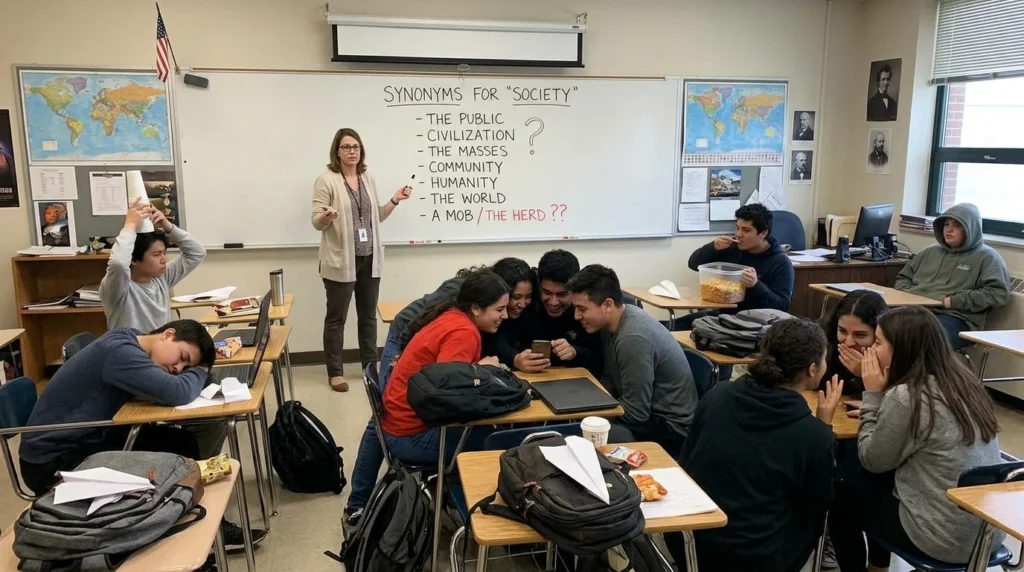
Quick Answer
Some of the best synonyms for society are community, civilization, population, culture, public, social group, human community, social order, social system, and humanity. Use community for people connected by shared interests or location, population for people in an area, and civilization for an organized stage of human development. The best choice depends on the intended meaning.
What Does “Society” Mean?
Society is a noun that commonly refers to a group of people living together within an organized system of relationships, institutions, customs, and rules. It can also describe a particular social group or the experience of interacting with other people.
For example:
Society depends on cooperation and shared responsibilities.
Modern society faces many environmental challenges.
The local society organized a charity event.
She enjoys the company and society of her friends.
The word has several related meanings:
An organized group of people: People who live together and share institutions, rules, or social relationships.
A community or social group: People connected by location, identity, interests, or common goals.
A particular social environment: The customs, expectations, and relationships that influence people’s lives.
Social interaction: The companionship of other people, as in “enjoying the society of friends.”
A formal association: An organization established around a shared purpose, such as a scientific society or historical society.
Because “society” has several meanings, no single synonym works naturally in every sentence. The best replacement depends on whether you mean a group of people, a culture, an organized social system, or a formal association.
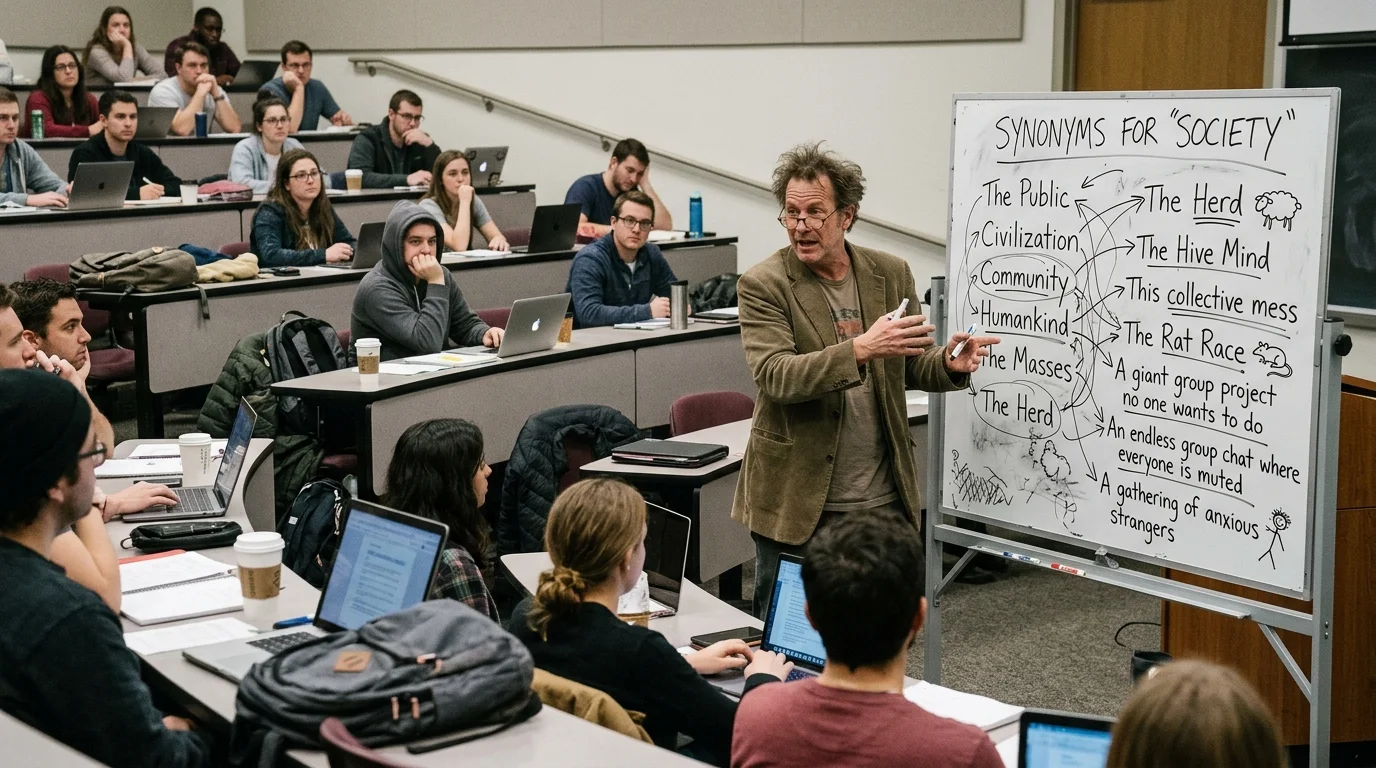
41+ Synonyms for Society
The following words and phrases are useful alternatives, although some are contextual substitutes rather than exact synonyms.
| Synonym or alternative | Meaning | Best context |
|---|---|---|
| Community | People connected by location or shared interests | Local groups and shared identity |
| Civilization | An organized and developed human society | History and social development |
| Population | People living in a particular area | Demographics and statistics |
| Culture | Shared beliefs, customs, values, and practices | Anthropology and social studies |
| Public | People considered as a general group | Public opinion and public services |
| Humanity | Human beings collectively | Broad discussions of humankind |
| Humankind | All human beings | General and philosophical writing |
| Social group | People connected through relationships or common characteristics | Sociology and social research |
| Social order | The organization and stability of social relationships | Politics and sociology |
| Social system | Interconnected institutions, roles, and relationships | Academic and sociological writing |
| Social structure | The organized relationships and institutions within a group | Sociology and research |
| Human community | People living or working together | General and academic writing |
| Collective | A group acting or considered together | Organizations and shared activity |
| Population group | A defined group of people | Research and demographics |
| People | Human beings considered collectively | Everyday writing |
| Citizens | Members of a political community or state | Government and civic life |
| Nation | A people or political community with a shared identity | Politics and history |
| Nationhood | The condition or status of being a nation | Political and historical writing |
| Public sphere | The space where people discuss shared concerns | Political theory and communication |
| Social environment | The social conditions surrounding people | Education and behavioral studies |
| Social world | The relationships and groups within which people live | Personal and academic writing |
| Human world | The world of human relationships and activity | Philosophical or literary writing |
| Civic community | People connected through civic life and participation | Local government and citizenship |
| Fellowship | A sense or group of companionship and shared purpose | Social relationships and associations |
| Association | An organized group formed around a shared interest | Clubs and professional organizations |
| Organization | People working together within a structured body | Business and institutions |
| Institution | An established social structure or organization | Education, government, and sociology |
| Social institution | An established system that meets social needs | Family, education, law, and religion |
| Network | People or groups connected through relationships | Professional and social connections |
| Public community | A group of people sharing public concerns | Civic discussions |
| Local community | People living in a particular locality | Neighborhoods and towns |
| Collective society | People considered as a whole | General or theoretical writing |
| Social body | A society viewed as an organized whole | Formal or historical writing |
| Social fabric | The relationships and connections that hold society together | Social commentary |
| Civil community | People organized around shared civic life | Political and historical discussions |
| Social order | An established pattern of social organization | Sociology and political theory |
| Cultural group | People sharing cultural characteristics | Anthropology and social studies |
| Subculture | A group with distinctive practices within a larger culture | Cultural studies |
| Social class | A group defined by economic or social position | Sociology and inequality |
| Elite | A group with comparatively high status or influence | Politics and social hierarchy |
| General populace | The ordinary people of a place or country | News and formal writing |
| Public at large | People generally, rather than a specific group | Official statements and public communication |
| Human population | All people in a specified area or globally | Demographics and science |
| Social network | A web of relationships among people or groups | Sociology and communication |
Important: Some alternatives describe only one part or feature of society. For example, culture refers to shared beliefs and practices, while social structure refers to organized relationships. Neither is a complete substitute for “society” in every sentence.
Best Synonyms for Society
1. Community
Community is one of the most useful alternatives when “society” refers to people connected by location, identity, interests, or a shared purpose.
Example:
Society must work together to protect local resources.
Alternative:
The community must work together to protect local resources.
The alternative focuses more on a particular group of people working together.
Best for: Neighborhoods, local groups, shared interests, and community initiatives.
Watch out: A community is often smaller or more specifically connected than society as a whole.
2. Civilization
Civilization refers to an organized and developed human society, often discussed in terms of institutions, technology, cities, culture, and historical development.
Example:
Society has changed dramatically over thousands of years.
Alternative:
Human civilization has changed dramatically over thousands of years.
Best for: History, archaeology, social development, and broad discussions of human progress.
Watch out: Civilization often implies a historical or developmental perspective. It is not a direct replacement for every meaning of “society.”
3. Population
Population refers to the people living in a particular place or belonging to a defined group.
Example:
Society in the region is growing rapidly.
More precise alternative, if you mean the number of people:
The region’s population is growing rapidly.
Best for: Demographics, statistics, public health, and population studies.
Watch out: “Population” emphasizes the people themselves, often as a count or defined group, rather than their relationships, institutions, or customs.
4. Culture
Culture refers to the beliefs, values, customs, traditions, and practices shared by a group.
Example:
Society shapes the way people communicate.
Alternative:
Culture shapes the way people communicate.
Best for: Traditions, shared beliefs, customs, identity, and anthropology.
Watch out: Society and culture overlap, but they are not identical. A society is a group of people and their organized relationships; culture is the shared way of life that may characterize them.
5. Humanity
Humanity refers to human beings collectively. It is useful when discussing people across countries, cultures, or historical periods.
Example:
Society faces serious environmental challenges.
Alternative:
Humanity faces serious environmental challenges.
Best for: Global issues, ethics, philosophy, and discussions of humankind.
Watch out: “Humanity” is broader than a particular society and can also mean compassion or humaneness.
6. Public
Public refers to people considered collectively, especially in relation to public opinion, services, institutions, or shared concerns.
Example:
Society expressed concern about the proposed law.
Alternative:
The public expressed concern about the proposed law.
Best for: News, public opinion, government, and civic affairs.
Watch out: “The public” does not necessarily include every member of a society or describe the relationships and institutions that make up society.
7. Social Structure
Social structure refers to the organized patterns of relationships, roles, institutions, and social positions within a society.
Example:
Society influences how people interact with one another.
More specific alternative:
Social structure influences how people interact with one another.
Best for: Sociology, academic essays, and discussions of inequality or social roles.
Watch out: This describes how society is organized, not the entire society itself.
8. Social System
Social system describes a set of interconnected relationships, roles, institutions, and processes that operate within a group.
Example:
Society depends on cooperation among its institutions.
Alternative:
The social system depends on cooperation among its institutions.
Best for: Sociology, public policy, education, and institutional analysis.
Watch out: “Social system” emphasizes how components work together, rather than simply referring to the people in a society.
9. Social Order
Social order refers to the organization and stability of relationships, rules, and institutions within a group.
Example:
Society relies on shared rules and expectations.
Alternative:
Social order relies on shared rules and expectations.
Best for: Law, politics, sociology, and discussions of stability or social change.
Watch out: Social order is one aspect of society, not a complete synonym for it.
10. Social Fabric
Social fabric is a figurative expression describing the relationships, shared values, and connections that hold a society together.
Example:
Economic inequality can weaken society.
Alternative:
Economic inequality can weaken the social fabric.
Best for: Essays, social commentary, journalism, and discussions of cohesion or division.
Watch out: “Social fabric” is metaphorical. It emphasizes the connections within society rather than society as a whole.
Synonyms for Society in Academic Writing
Academic writing often benefits from terms that identify the precise aspect of society being discussed.
Useful choices include:
Community
Civilization
Population
Social structure
Social system
Social institutions
Social order
Social environment
Human population
Cultural group
Social relationships
Public sphere
Examples
Original:
Society influences individual behavior.
Alternative:
The social environment influences individual behavior.
This emphasizes the conditions and relationships surrounding individuals.
Original:
Society is affected by economic inequality.
Alternative:
Social structures are affected by economic inequality.
This focuses on organized relationships and institutions.
Original:
Society is becoming more diverse.
Alternative:
The population is becoming more diverse.
This works if you mean the characteristics of the people living in an area.
Tip: In academic writing, use the term that matches your argument rather than replacing “society” merely to avoid repetition.
Synonyms for Society in an Essay
The best alternative in an essay depends on the topic and the point you are making.
| Essay topic | Useful alternatives |
|---|---|
| Social change | Society, social structure, social system |
| History | Civilization, human societies |
| Culture and traditions | Culture, cultural group, community |
| Population growth | Population, human population |
| Government and citizens | Public, citizens, civic community |
| Social inequality | Social structure, social hierarchy |
| Shared values | Culture, social norms, social fabric |
| Global problems | Humanity, human civilization |
| Local issues | Community, local population |
| Relationships and connections | Social network, social fabric |
Examples
Original:
Society must address climate change.
Alternative:
Humanity must address climate change.
Original:
Society influences the development of children.
Alternative:
A child’s social environment influences their development.
Original:
Society has changed significantly over time.
Alternative:
Human civilization has changed significantly over time.
Each alternative narrows or shifts the meaning. Choose the one that accurately reflects the point of your essay.
Synonyms for Society in Formal Writing
In formal writing, useful alternatives include:
Community
Civilization
Population
The public
Human society
Social structure
Social system
Social institutions
Social order
The general populace
Examples
Original:
Society needs better access to education.
Alternative:
The public needs better access to education.
This is suitable if you mean the people who need access to a service.
Original:
Society is changing rapidly.
Alternative:
Social structures are changing rapidly.
This is appropriate when the focus is on institutions and relationships.
Original:
Society has experienced significant growth.
If you mean the number of people, write:
The population has experienced significant growth.
Tip: Formal language is not automatically more precise. A familiar word such as “society” may be better than a technical term that changes the meaning.
Synonyms for Society in Sociology
Sociology examines human relationships, institutions, group behavior, inequality, and social change. Depending on the specific topic, useful terms include:
Social structure
Social system
Social institutions
Social order
Community
Social group
Social class
Social network
Social environment
Cultural group
Population
Civilization
Examples
Society influences people’s opportunities.
could become:
Social structures influence people’s opportunities.
This focuses on the arrangements and institutions that affect people’s lives.
Society is shaped by shared norms.
could become:
Social norms help shape collective behavior.
This emphasizes shared expectations rather than the entire social group.
Society includes many different groups.
could become:
Social groups form part of the broader society.
This makes the relationship between groups and society explicit.
Synonyms for Society in Politics
When discussing government, citizenship, public opinion, or political participation, alternatives include:
The public
Citizens
The electorate
The populace
The nation
Civic community
Civil society
Public sphere
Political community
Examples
Original:
Society wants greater transparency from the government.
Alternative:
The public wants greater transparency from the government.
Original:
Society plays a role in democratic decision-making.
Alternative:
Civil society plays a role in democratic decision-making.
Important: These terms are not identical. “The electorate” refers to people eligible to vote, while “civil society” commonly refers to organizations and associations outside the state and commercial sector.
Synonyms for Society When Describing a Group of People
If you mean a collection of people connected by a shared feature, consider:
Community
Social group
Population
Collective
Association
Organization
Network
Cultural group
General populace
Local community
Examples
Society came together to support the families.
Alternative:
The community came together to support the families.
Society is concerned about the issue.
Alternative:
The public is concerned about the issue.
Society includes people from many backgrounds.
Alternative:
The population includes people from many backgrounds.
Choose a term based on the size, connection, and purpose of the group you mean.
Synonyms for Society Meaning “Civil Society”
Civil society is a specific term for organizations, associations, and groups that operate outside direct government control and, in common usage, outside the primary commercial sector. Examples can include charities, advocacy groups, professional associations, and community organizations.
Related terms include:
Civic community
Voluntary sector
Nonprofit sector
Community organizations
Civic organizations
Voluntary associations
Example:
Society plays an important role in holding institutions accountable.
If the intended meaning is organized public participation outside government, a more precise sentence is:
Civil society plays an important role in holding institutions accountable.
Watch out: “Civil society” is not a direct synonym for the entire society. It describes a particular part of social life.
Synonyms for Society Meaning “Companionship”
In some contexts, “society” refers to spending time with other people or enjoying their company.
Useful alternatives include:
Company
Companionship
Fellowship
Association
Company of others
Social interaction
Example:
She enjoys the society of close friends.
Alternative:
She enjoys the company of close friends.
In modern everyday English, “company” is usually more natural in this meaning.
Watch out: This use of “society” is different from society as an organized group of people.
Synonyms for Society Meaning “Formal Association”
Sometimes “society” refers to an organization created around a particular purpose.
Examples include a historical society, a scientific society, or a literary society.
Possible alternatives include:
Association
Organization
Club
Fellowship
Institute
Professional association
Learned society
Example:
She joined the historical society.
Alternative:
She joined the historical association.
The alternatives may work, but an organization’s official name should be preserved when referring to a specific group.
Society vs. Community
Society usually refers to a broader organized group of people and their social relationships. Community often refers to people connected by location, shared interests, identity, or a common purpose.
Compare:
Society faces many challenges.
This can refer to a broad social system.
The community faces many challenges.
This often refers to a particular locality or group.
Use “community” when shared identity, location, or interests are important.
Use “society” when discussing the wider social system or human relationships at a broader level.
Society vs. Civilization
Civilization usually emphasizes the historical development and organization of human life, including institutions, cities, technology, and cultural achievements.
Compare:
Society has changed over the centuries.
Civilization has changed over the centuries.
Both can be correct, but “civilization” often places greater emphasis on long-term human development.
Use “civilization” when discussing historical societies, large-scale social development, or the organization of human life over time.
Society vs. Population
Population refers to the people living in a particular place or belonging to a defined group. Society includes their relationships, institutions, customs, and shared social life.
Compare:
Society is growing more diverse.
The population is growing more diverse.
The second is more appropriate when describing the characteristics of people in an area.
Use “population” for demographic size, composition, and trends.
Society vs. Culture
Society refers to people and their organized relationships. Culture refers to the beliefs, values, customs, traditions, and practices shared by people.
Compare:
Society influences people’s behavior.
Culture influences people’s behavior.
Both may be true, but they emphasize different influences.
Use “culture” when the focus is on shared beliefs, practices, values, or traditions.
Society vs. Humanity
Humanity means human beings collectively, while “society” can refer to a particular organized group or social system.
Compare:
Society faces environmental problems.
Humanity faces environmental problems.
“Humanity” is more suitable when the issue affects people across the world or concerns human beings collectively.
Use “humanity” for global, philosophical, or species-wide discussions.
Society vs. Public
The public refers to people considered collectively, often in relation to public opinion, services, or shared issues. Society is broader and includes institutions, relationships, and social organization.
Compare:
Society is concerned about the new law.
The public is concerned about the new law.
The second is more natural when referring to public opinion.
Use “the public” when the focus is how people generally respond to an issue.
Society vs. Social Structure
Social structure describes the organized patterns of relationships, roles, institutions, and positions within society.
Compare:
Society shapes people’s opportunities.
Social structure shapes people’s opportunities.
The second is more specific when you are discussing how institutions, class, or social roles affect opportunities.
Use “social structure” when you mean the organization of relationships within a society rather than the whole society itself.
10 Sentence Transformations Using Synonyms for Society
1. A General Social Issue
Original:
Society must address climate change.
Alternative:
Humanity must address climate change.
Why: “Humanity” emphasizes people globally rather than a particular social system.
2. A Local Problem
Original:
Society came together to help families affected by the flood.
Alternative:
The community came together to help families affected by the flood.
Why: “Community” highlights people connected by place or shared concern.
3. Population Growth
Original:
Society is growing rapidly in the region.
Alternative, if you mean the number of people:
The population is growing rapidly in the region.
Why: “Population” is more precise when discussing the number of people.
4. Historical Development
Original:
Society has evolved over thousands of years.
Alternative:
Human civilization has evolved over thousands of years.
Why: “Civilization” emphasizes long-term human development.
5. Shared Traditions
Original:
Society shapes people’s customs and beliefs.
Alternative:
Culture shapes people’s customs and beliefs.
Why: “Culture” focuses on shared customs and beliefs.
6. Public Opinion
Original:
Society supports greater investment in public education.
Alternative:
The public supports greater investment in public education.
Why: “The public” emphasizes people’s collective opinion.
7. Social Inequality
Original:
Society influences access to opportunities.
Alternative:
Social structures influence access to opportunities.
Why: “Social structures” highlights the organized systems that affect people’s opportunities.
8. Social Connections
Original:
Technology is changing society.
Alternative:
Technology is changing the social fabric.
Why: This figurative alternative emphasizes changes in relationships and social connections, rather than every aspect of society.
9. Political Participation
Original:
Society helps hold public institutions accountable.
Alternative:
Civil society helps hold public institutions accountable.
Why: “Civil society” is more specific when referring to organized civic groups and associations.
10. Companionship
Original:
He enjoys the society of his friends.
Alternative:
He enjoys the company of his friends.
Why: “Company” is more natural in contemporary English when referring to companionship.
Best Synonyms for Society by Context
| Context | Best alternatives |
|---|---|
| General writing | Community, people, social group |
| Academic writing | Social structure, social system, population |
| Sociology | Social structure, social institutions, social order |
| History | Civilization, human societies |
| Culture and traditions | Culture, cultural group |
| Demographics | Population, human population |
| Politics | Public, citizens, nation |
| Civic participation | Civil society, civic community |
| Local issues | Community, local population |
| Global issues | Humanity, humankind |
| Social inequality | Social structure, social class |
| Shared values | Culture, social norms |
| Social relationships | Social network, social fabric |
| Formal association | Association, organization, learned society |
| Companionship | Company, fellowship |
| Public opinion | The public, general populace |
Common Mistakes When Using Synonyms for Society
1. Using “community” for every meaning
A community usually refers to a group connected by location, interests, identity, or shared purpose. It does not always describe an entire society.
Instead of:
Community has changed over centuries.
You may mean:
Society has changed over centuries.
2. Using “civilization” when you mean a local group
“Civilization” generally refers to large-scale, organized human development. It is usually too broad for a neighborhood or small group.
For example:
Our civilization organized a neighborhood cleanup.
is less natural than:
Our community organized a neighborhood cleanup.
3. Using “population” when you mean social relationships
Population describes people as a group, often statistically. It does not automatically include their customs, institutions, or relationships.
If you are discussing social behavior, “society” or “social structure” may be more accurate.
4. Treating “culture” and “society” as identical
Culture consists of shared beliefs, values, customs, and practices. Society includes people and their organized relationships.
The terms overlap but are not interchangeable in every sentence.
5. Using “the public” to mean everyone in a society
“The public” often refers to people considered collectively in a particular context. It may not include every person or every social group.
For example, “public opinion” does not necessarily represent every individual in a country.
6. Confusing “civil society” with society as a whole
Civil society refers to a particular part of social life, often including associations, charities, advocacy organizations, and civic groups.
It should not automatically replace “society” when you mean all people and institutions.
7. Using overly technical language unnecessarily
Terms such as “social structure” and “social system” are useful in academic writing, but they can sound unnatural in casual conversation.
Instead of:
The social system is having a picnic.
Write:
The community is having a picnic.
8. Using “nation” when you mean society
A nation can refer to a people with a shared identity or a political community. Society is broader and can exist within or across national boundaries.
Choose “nation” when national identity or political organization is relevant.
9. Replacing society just to avoid repetition
“Society” is a clear, useful word. Replacing every occurrence with a different term can make your writing less precise.
Use a synonym when it adds a meaningful distinction, not merely for variety.
When Should You Keep the Word “Society”?
You do not always need to replace “society.”
“Society” is often the best choice when discussing:
The organization of human relationships
Social rules and institutions
Broad social change
The relationship between individuals and groups
Social problems and responsibilities
How people live together
General patterns of social behavior
For example:
Society plays an important role in shaping individual behavior.
This sentence is clear and natural. Replacing “society” with “civilization,” “population,” or “community” may change the meaning rather than improve the sentence.
Use a more specific alternative when the context calls for it. If you mean the number of people, use “population.” If you mean shared customs, use “culture.” If you mean local people working together, use “community.”
How to Choose the Right Synonym for Society
Ask yourself what aspect of society you want to describe.
Do you mean people connected by location or shared interests?
Use community.
Do you mean organized human development over history?
Use civilization.
Do you mean the number or characteristics of people in an area?
Use population.
Do you mean customs, traditions, and shared beliefs?
Use culture.
Do you mean people generally, especially their opinions?
Use the public.
Do you mean all human beings?
Use humanity or humankind.
Do you mean relationships, institutions, and social positions?
Use social structure.
Do you mean the way institutions and relationships operate together?
Use social system.
Do you mean organizations and associations outside direct government control?
Use civil society.
Do you mean companionship?
Use company or fellowship.
The best synonym is the one that communicates your intended meaning more accurately—not necessarily the most formal or sophisticated word.
True Synonyms vs. Related Alternatives
| Alternative | Relationship to “society” | Interchangeability |
|---|---|---|
| Community | Close contextual synonym | Often, depending on scale |
| Civilization | Related term emphasizing organized human development | Context-dependent |
| Population | Group of people in an area or category | Only when population is the intended meaning |
| Culture | Shared beliefs, values, and practices | Not generally interchangeable |
| Humanity | Human beings collectively | Suitable for broad, global contexts |
| The public | People considered collectively in a specific context | Context-dependent |
| Social group | A group connected by shared characteristics or relationships | Sometimes |
| Social structure | Organization of social relationships and institutions | Not a direct synonym |
| Social system | Interconnected social relationships and institutions | Not a direct synonym |
| Social order | Organization and stability of social relationships | Not a direct synonym |
| Social fabric | Figurative description of social connections | Context-dependent |
| Civil society | Civic groups and associations outside the state | Not interchangeable with society as a whole |
| Association | Organized group with a shared purpose | Only for formal group meanings |
| Organization | Structured group with a purpose | Only in specific contexts |
| Company | Companionship or the presence of others | Only for the companionship meaning |
| Nation | People or political community connected by national identity | Context-dependent |
| Citizens | Members of a political community or state | Only when citizenship is relevant |