

Quick Answer: What Are the Best Synonyms for Some?
Some of the best synonyms and alternatives for “some” are several, a few, certain, various, multiple, particular, a number of, a handful of, a portion of, selected, certain ones, and specific. Use several for an unspecified number, a few for a small quantity, various for different types, and particular for specific people or things. The best replacement depends on the context.
What Does “Some” Mean?
Some is a determiner or pronoun used to refer to an unspecified quantity, number, or selection of people or things.
For example:
I bought some apples.
Some students arrived early.
Would you like some water?
Some people prefer reading to watching television.
I agree with some of your suggestions.
The word can express several related meanings:
An unspecified quantity: Some water is left.
An unspecified number: Some students were absent.
A selection from a larger group: Some of the books are missing.
A particular but unnamed person or thing: Some person called earlier.
An approximate or notable amount: It took some effort to finish.
Because “some” has several uses, no single synonym works in every sentence. Choose an alternative that preserves the intended meaning.
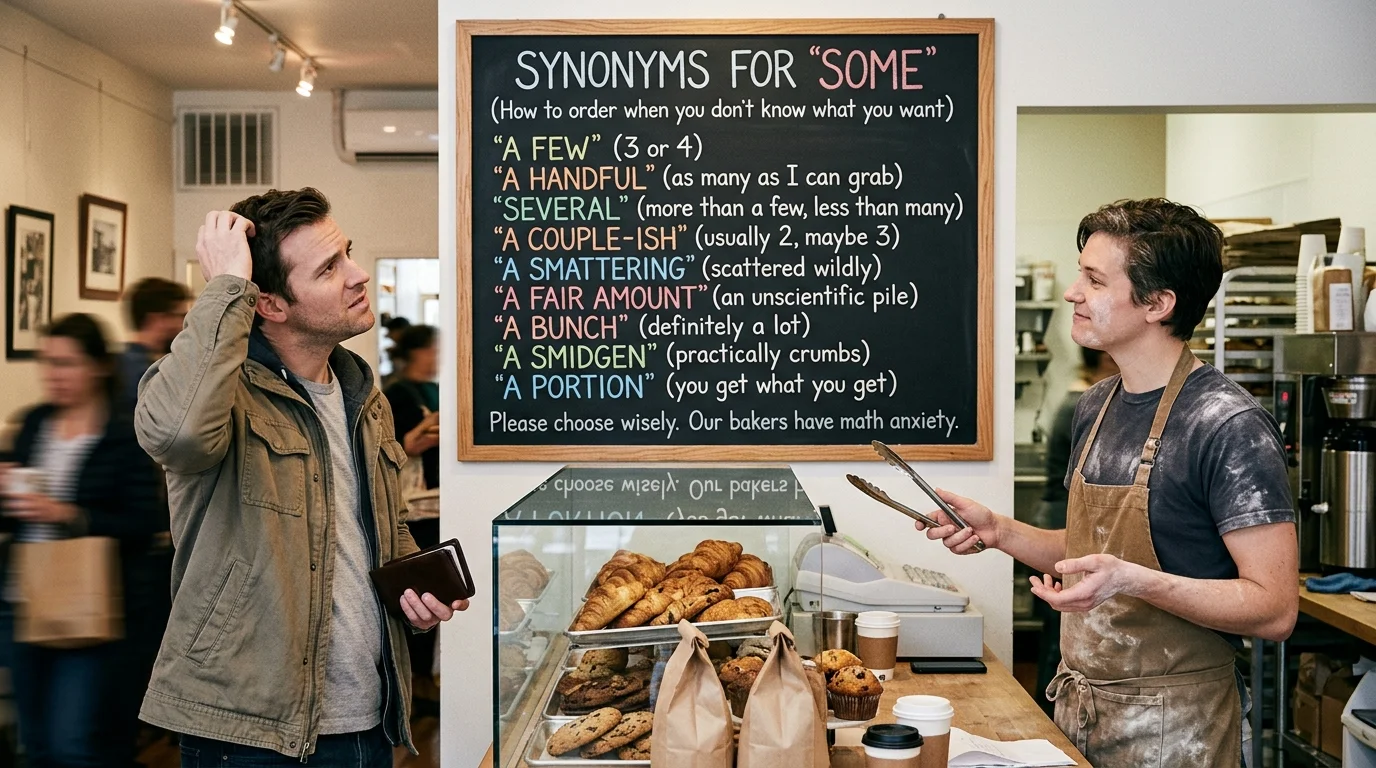
40+ Synonyms and Alternatives for Some
| Synonym or alternative | Meaning | Best context |
|---|---|---|
| Several | More than two, but not a large number | Countable items |
| A few | A small number | Casual and general writing |
| Certain | Particular but not fully identified | People, items, or situations |
| Various | Different types or kinds | Variety and diversity |
| Multiple | More than one | Formal and technical writing |
| A number of | An unspecified number | General and professional writing |
| A handful of | A small number or amount | Informal writing |
| A couple of | Usually two, sometimes approximately two | Conversational English |
| Numerous | A large number | Formal descriptions |
| Many | A large number | Countable nouns |
| Several of | A number from a particular group | Specific selections |
| A portion of | A part of a whole | Food, resources, quantities |
| Part of | One section or element of something | General use |
| A few of | A small selection from a group | People or objects |
| Certain ones | Particular members of a group | Informal and general writing |
| Specific | Clearly identified or defined | Instructions and formal writing |
| Particular | One or more distinct items | Emphasis or selection |
| Selected | Chosen from a larger group | Reports and professional writing |
| Various kinds of | Different categories or types | Classification |
| Different | Not the same; distinct | Comparing items |
| Individual | One person or thing considered separately | Formal writing |
| A selection of | A chosen group of items | Products, examples, options |
| A range of | A variety extending across categories | Professional writing |
| An assortment of | A mixture of different items | Products and collections |
| A variety of | Different types or forms | General and formal writing |
| A share of | A part allocated to someone or something | Resources and responsibilities |
| A fraction of | A small part of a whole | Quantities and proportions |
| A percentage of | A proportion expressed as a percentage | Statistics and reports |
| A subset of | A smaller group within a larger group | Academic and technical writing |
| Somewhat | To a limited degree | Adverbs and adjectives |
| Partly | To some extent, but not completely | Explanations |
| To some extent | Partially or within limits | Formal and academic writing |
| In part | Partially | Formal writing |
| At least a few | A minimum small number | Emphasizing a minimum |
| One or more | At least one | Instructions and technical writing |
| A limited number of | A restricted quantity | Formal descriptions |
| A small amount of | A limited quantity of something uncountable | Water, time, money |
| A little | A small amount | Uncountable nouns |
| A bit of | A small amount | Informal speech |
| An amount of | An unspecified quantity | General descriptions |
| A certain amount of | An unspecified but relevant quantity | Formal and general writing |
| A measure of | An amount or degree of something | Formal descriptions |
Important: These alternatives are not all direct synonyms. Some describe number, others describe variety, part of a whole, or degree. Always match the alternative to the meaning of “some” in your sentence.
Best Synonyms for Some
1. Several
Several is a useful alternative when you mean more than two items or people, but not necessarily a large number.
Example:
Some students asked questions.
More specific:
Several students asked questions.
Why choose it? It makes the quantity sound more definite than “some,” even though the exact number remains unknown.
Best for: Countable nouns, reports, and everyday writing.
2. A Few
A few means a small number of people or things.
Example:
I have some questions.
If the number is small:
I have a few questions.
Why choose it? It communicates that the quantity is limited.
Best for: Conversations, informal writing, and small quantities of countable items.
3. Certain
Certain refers to particular people or things without identifying them completely.
Example:
Some rules apply to everyone.
If you mean specific rules:
Certain rules apply to everyone.
Why choose it? It emphasizes that only particular items or cases are being discussed.
Best for: Formal writing, policies, explanations, and general statements.
4. Various
Various emphasizes differences among people or things.
Example:
Some methods can solve the problem.
If you mean different methods:
Various methods can solve the problem.
Why choose it? It highlights variety rather than simply an unspecified number.
Best for: Academic writing, reports, descriptions, and comparisons.
5. Multiple
Multiple means more than one. It is common in technical, professional, and formal writing.
Example:
Some factors affect the results.
If you want to emphasize that several factors are involved:
Multiple factors affect the results.
Why choose it? It sounds direct and precise when discussing several causes, options, steps, or components.
Best for: Reports, business writing, science, and technical explanations.
6. A Number Of
A number of refers to an unspecified number of people or things.
Example:
Some employees attended the training.
Alternative:
A number of employees attended the training.
Why choose it? It can sound more formal and is useful in reports.
Best for: Workplace communication, reports, and general writing.
7. Particular
Particular emphasizes one or more specific people or things.
Example:
Some details need attention.
If you mean specific details:
Particular details need attention.
Why choose it? It directs attention to selected items rather than an unspecified quantity.
Best for: Explanations, instructions, and formal writing.
8. A Handful Of
A handful of usually means a small number or amount. It is informal and sometimes suggests that the quantity is surprisingly small.
Example:
Some people stayed until the end.
Alternative:
A handful of people stayed until the end.
Why choose it? It creates a more conversational, vivid description.
Best for: Informal writing, stories, and casual speech.
9. Numerous
Numerous means a large number of people or things.
Example:
Some studies have examined this issue.
If many studies are involved:
Numerous studies have examined this issue.
Why choose it? It emphasizes quantity, but use it only when the number is genuinely large.
Best for: Formal writing, research summaries, and reports.
10. A Variety Of
A variety of emphasizes different types rather than just a number of items.
Example:
The shop sells some products.
If the products differ in type:
The shop sells a variety of products.
Why choose it? It highlights diversity and choice.
Best for: Descriptions, product pages, reports, and general writing.
Synonyms for Some in Formal Writing
In formal writing, you can replace “some” with a more precise expression when the context supports it.
Useful options include:
Several
Certain
Various
Multiple
A number of
A proportion of
A selection of
A range of
A subset of
A limited number of
Examples
Original:
Some participants completed the survey.
Alternative:
Several participants completed the survey.
Original:
Some factors influenced the results.
Alternative:
Various factors influenced the results.
Original:
Some of the data was missing.
Alternative:
A portion of the data was missing.
Choose the alternative that accurately describes the quantity or selection. Formal language is not automatically more precise if the word changes the meaning.
Synonyms for Some in Academic Writing
Academic writing benefits from precise descriptions of quantities, groups, and evidence.
Consider these alternatives:
Several
Multiple
Certain
Various
A proportion of
A subset of
A number of
Some participants
Selected
A limited number of
Examples
Some participants reported improvements.
could become:
Several participants reported improvements.
Some variables affected the outcome.
could become:
Multiple variables affected the outcome.
Some members of the sample were excluded.
could become:
A subset of the sample was excluded.
Use a subset of when you mean a defined group within a larger group. Use a proportion of when you want to emphasize the share or percentage of the whole.
Synonyms for Some in Professional Writing
In business communication, “some” can be replaced by a more specific phrase when useful.
| Original phrase | Alternative |
|---|---|
| Some employees | Several employees |
| Some customers | Certain customers |
| Some departments | Multiple departments |
| Some products | A selection of products |
| Some opportunities | Several opportunities |
| Some changes | Specific changes |
| Some resources | A portion of the resources |
| Some locations | Various locations |
For example:
Some departments will receive updated software.
could become:
Several departments will receive updated software.
If the departments have already been identified, specific departments may be more appropriate.
Synonyms for Some in Essays
When writing an essay, avoid replacing “some” merely to sound sophisticated. Choose a more precise alternative if it improves the meaning.
Original:
Some people believe that technology improves education.
Possible alternatives:
Certain people believe that technology improves education.
Several people believe that technology improves education.
Many people believe that technology improves education.
These sentences do not mean exactly the same thing. Certain people emphasizes a particular group, several people suggests a modest number, and many people suggests a larger number.
If the quantity is unknown, keeping some people may be the most accurate choice.
Synonyms for Some When Referring to People
When “some” refers to people, consider:
Several people
A few people
Certain individuals
Various people
A number of people
A handful of people
Some individuals
Selected individuals
Multiple people
Particular people
Examples
Some people prefer working alone.
Certain individuals prefer working alone.
A few people arrived early.
Several people volunteered to help.
Choose based on whether you mean a small number, a specific group, or people with different preferences.
Synonyms for Some When Referring to Things
When “some” refers to objects or countable items, useful alternatives include:
Several
A few
Multiple
Various
A selection of
An assortment of
A range of
Certain
Selected
A number of
Examples
I bought some books.
I bought several books.
The store offers some styles.
The store offers a range of styles.
Some items were damaged.
Several items were damaged.
The alternative should reflect the number or variety you want to communicate.
Synonyms for Some When Referring to an Amount
When “some” refers to an uncountable noun, choose an expression that describes quantity.
Useful options include:
A little
A bit of
A small amount of
A portion of
A quantity of
A certain amount of
A measure of
Part of
Examples
I need some water.
I need a little water.
We spent some time discussing the plan.
We spent a bit of time discussing the plan.
Some of the money was missing.
A portion of the money was missing.
Be careful: a little and a small amount of imply a limited quantity. They are not exact replacements if “some” refers to a large or unknown amount.
Synonyms for Some Meaning “A Few”
If you mean a small number, try:
A few
Several
A handful of
A small number of
A couple of
A limited number of
A few of
A small group of
Examples:
Some guests arrived early.
A few guests arrived early.
Some students stayed after class.
A small group of students stayed after class.
Remember that a couple of usually means two, while a few means a small number that may be greater than two.
Synonyms for Some Meaning “Certain” or “Specific”
Sometimes “some” refers to particular people or things rather than an unknown quantity.
Useful alternatives include:
Certain
Particular
Specific
Selected
Identified
Individual
Designated
Certain ones
Examples:
Some requirements must be met.
Certain requirements must be met.
Some files need to be reviewed.
Specific files need to be reviewed.
Use specific when the items are clearly identified or need to be identified. Use certain when referring to particular cases without necessarily naming them.
Synonyms for Some Meaning “Various”
When you want to emphasize differences or variety, use:
Various
Different
Diverse
A range of
A variety of
An assortment of
Multiple types of
Several kinds of
Examples:
Some solutions are available.
Various solutions are available.
The store sells some products.
The store sells an assortment of products.
Different and diverse emphasize variation, while several mainly emphasizes number.
Some vs. Several
Some refers to an unspecified quantity. Several usually suggests more than two, but not a large number.
Some students were absent. — The number is unspecified.
Several students were absent. — More than two students were absent, probably not a large group.
Use several when the quantity can reasonably be described as a small or moderate number. Keep some when you do not want to suggest a particular range.
Some vs. A Few
A few specifically suggests a small number of countable items. Some is broader.
I have some questions. — The number is unspecified.
I have a few questions. — The number is small.
For uncountable nouns, use some water or a little water, not a few water.
Some vs. Various
Some refers to an unspecified amount or selection. Various emphasizes different kinds.
Some books were missing. — An unspecified number were missing.
Various books covered the topic. — Different books or types of books covered it.
Use various when variety matters more than the number.
Some vs. Multiple
Multiple means more than one, while some leaves the quantity unspecified.
Some reasons explain the delay.
Multiple reasons explain the delay.
The second sentence explicitly indicates more than one reason. In professional or technical writing, multiple can be useful when you want to emphasize that several factors are involved.
Some vs. Certain
Certain often means particular or specific, while some can simply mean an unspecified amount.
Some rules apply to visitors.
Certain rules apply to visitors.
The second sentence suggests that particular rules apply, rather than all rules. This is especially useful in policies, instructions, and formal explanations.
Some vs. Many
Many suggests a large number. Some does not specify whether the quantity is small or large.
Some people attended the event.
Many people attended the event.
Use many only when the number is reasonably large. Otherwise, some is safer and more neutral.
Some vs. Any
Some and any are both used for unspecified quantities, but they often appear in different sentence types.
I have some questions.
Do you have any questions?
I don’t have any questions.
“Some” is common in affirmative statements and offers or requests. “Any” is common in questions and negative statements, though both words have other uses.
They are not interchangeable in every context.
Stronger Alternatives to Some
If you want to express a larger quantity, consider:
Numerous
Many
A large number of
A substantial number of
A wide range of
A considerable amount of
A significant proportion of
Example:
Some studies support the theory.
If a large number of studies support it:
Numerous studies support the theory.
Do not use a stronger quantity word unless the facts support it.
More Specific Alternatives to Some
When you know more about the quantity or selection, replace “some” with a more informative phrase.
A few — a small number
Several — more than two, usually a modest number
Multiple — more than one
Many — a large number
A portion of — part of a whole
A subset of — a smaller group within a larger group
A selection of — chosen items
A range of — a variety extending across types or options
A limited number of — a restricted quantity
Specific — clearly identified items
The goal is to provide useful detail without inventing a quantity you do not know.
10 Sentence Transformations Using Synonyms for Some
1. Some students
Original: Some students arrived early.
Alternative: Several students arrived early.
Why: “Several” suggests more than two students, usually a modest number.
2. Some questions
Original: I have some questions.
Alternative: I have a few questions.
Why: “A few” suggests a small number of questions.
3. Some methods
Original: Some methods are more effective.
Alternative: Various methods are more effective.
Why: “Various” emphasizes differences among methods.
4. Some factors
Original: Some factors affect the outcome.
Alternative: Multiple factors affect the outcome.
Why: “Multiple” emphasizes that more than one factor is involved.
5. Some employees
Original: Some employees attended the meeting.
Alternative: A number of employees attended the meeting.
Why: This can sound slightly more formal while keeping the exact number unspecified.
6. Some people
Original: Some people prefer quiet places.
Alternative: Certain people prefer quiet places.
Why: “Certain” emphasizes particular people or groups.
7. Some products
Original: The store sells some products online.
Alternative: The store offers a selection of products online.
Why: “A selection of” suggests that only chosen products are available.
8. Some money
Original: Some money was missing.
Alternative: A portion of the money was missing.
Why: “A portion of” emphasizes that part of the total amount was missing.
9. Some research
Original: Some research supports this explanation.
Alternative: Several studies support this explanation.
Why: This works if the evidence consists of multiple studies. Do not use it if the evidence is not actually made up of studies.
10. Some opportunities
Original: Some opportunities are available.
Alternative: Several opportunities are available.
Why: “Several” communicates a modest number rather than an unspecified quantity.
Best Synonyms for Some by Context
| Context | Best alternatives |
|---|---|
| General writing | Several, a few, certain |
| Small quantity | A few, a little, a handful of |
| Countable items | Several, multiple, a number of |
| Uncountable amount | A little, a portion of, a small amount of |
| Formal writing | Certain, multiple, a proportion of |
| Academic writing | Several, a subset of, a proportion of |
| Professional writing | Multiple, selected, a range of |
| Different types | Various, diverse, an assortment of |
| Specific items | Particular, specific, selected |
| Large quantity | Many, numerous, a substantial number of |
| Products | A selection of, a range of, an assortment of |
| People | Several people, certain individuals, a few people |
| Data | A subset of, a portion of, a proportion of |
| Time | A little time, some time, a short period |
| Money | A portion of, a certain amount of, a little |
Common Mistakes When Using Synonyms for Some
1. Using “several” when the quantity is unknown
“Several” generally suggests more than two and usually a modest number.
If you do not know whether the number is small or large, some may be more accurate.
2. Using “a few” for uncountable nouns
Incorrect:
I need a few water.
Correct:
I need a little water.
Use a few with countable nouns, such as questions, books, or people. Use a little with uncountable nouns, such as water, time, or money.
3. Using “various” when you only mean quantity
“Various” emphasizes different types, not simply an unspecified number.
Various students attended.
This may suggest different groups or kinds of students. If you only mean an unknown number, some students or several students may be clearer.
4. Using “numerous” for a small number
“Numerous” means many. It should not replace “some” when only a few items are involved.
5. Treating “certain” and “specific” as exact equivalents
Both can refer to particular items, but specific often suggests that the items are clearly identified. Certain can refer to particular cases without naming them.
6. Using “multiple” when you mean many
“Multiple” means more than one, not necessarily a large number. If you mean a large quantity, use many, numerous, or a more precise figure when available.
7. Using “a portion of” for countable people or objects
“A portion of” usually works best for a part of a whole, especially an amount or resource.
For a group of people, some of the participants or a subset of the participants may be more natural.
8. Making vague writing more complicated
Replacing “some” with a longer expression does not automatically improve the sentence.
Some people enjoy reading.
This is clear and natural. Unless the context calls for more detail, you do not need to change it.
When Should You Keep the Word “Some”?
“Some” is often the best choice because it is simple, neutral, and flexible.
Keep it when:
The exact quantity is unknown.
You do not want to imply a small or large number.
The sentence is conversational.
The amount does not need further explanation.
A more specific synonym could change the meaning.
You are making a general statement rather than describing a measured quantity.
For example:
Some people prefer working in the morning.
This sentence is clear. Replacing “some” with “numerous,” “several,” or “a few” would change the implied quantity.
A good synonym should improve precision, not merely make the sentence sound more formal.
How to Choose the Right Synonym for Some
Ask yourself what you want “some” to communicate.
Do you mean a small number?
Use a few, a handful of, or a small number of.
Do you mean more than two, but not a large number?
Use several.
Do you mean more than one?
Use multiple.
Do you mean different kinds?
Use various, diverse, or a variety of.
Do you mean particular people or things?
Use certain, particular, or specific.
Do you mean part of a whole?
Use a portion of, part of, or a subset of.
Do you mean a large number?
Use many, numerous, or a substantial number of, if accurate.
Do you mean a small amount of something uncountable?
Use a little, a bit of, or a small amount of.
Do you mean an unspecified quantity?
Keep some if you do not have a reason to be more specific.
True Synonyms vs. Related Alternatives
| Alternative | Relationship to “Some” | Interchangeable? | Best use |
|---|---|---|---|
| Several | Near synonym | Context-dependent | A modest number |
| A few | Narrower alternative | Context-dependent | A small number |
| Certain | Contextual synonym | Often | Particular cases |
| Various | Contextual alternative | Sometimes | Different types |
| Multiple | Near synonym | Sometimes | More than one |
| Many | Stronger quantity term | No | A large number |
| Numerous | Stronger quantity term | No | A large number |
| A portion of | Part-whole expression | Sometimes | Part of an amount |
| A subset of | Narrower group expression | Sometimes | Part of a larger group |
| A selection of | Selection phrase | Sometimes | Chosen items |
| A range of | Variety phrase | Sometimes | Multiple options or types |
| A little | Quantity alternative | Only with uncountable nouns | A small amount |
| A handful of | Informal quantity phrase | Context-dependent | A small number |
| Specific | Precision term | Sometimes | Clearly identified items |
| A number of | Quantity phrase | Usually, with countable nouns | An unspecified number |