
Quick Answer
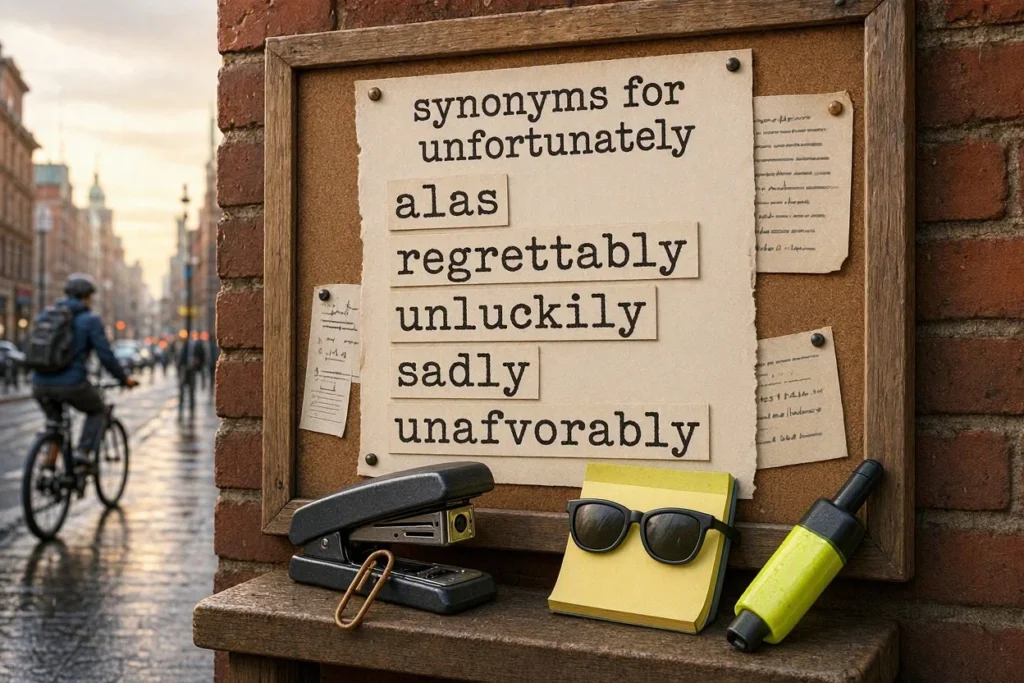
Some of the best synonyms for unfortunately are regrettably, sadly, unluckily, disappointingly, unhappily, to our regret, to our disappointment, and much to our disappointment. Use regrettably for formal writing, sadly for an emotional tone, and disappointingly when expectations are not met. The best choice depends on the situation and intended tone.
What Does “Unfortunately” Mean?
Unfortunately is an adverb used to introduce information about an undesirable, disappointing, or unfavorable situation. It often signals that something did not happen as hoped or that a problem has occurred.
For example:
Unfortunately, the event has been canceled.
Unfortunately, I cannot attend the meeting.
The weather was unfortunately too poor for the trip.
Unfortunately, we missed the last train.
The word does not always express sadness. Sometimes, it simply introduces an inconvenient fact or an unwanted result.
Compare these sentences:
Unfortunately, the store is closed.
Sadly, the store is closed.
The first sentence communicates an inconvenient fact. The second sounds more emotional and may suggest that the closure is disappointing or upsetting.
Because “unfortunately” can express regret, disappointment, bad luck, or inconvenience, the best synonym depends on the meaning you want to emphasize.

35+ Synonyms for Unfortunately
Here are useful alternatives, with their meanings and the situations in which they work best.
| Synonym or phrase | Meaning | Best context |
|---|---|---|
| Regrettably | With regret; it is unfortunate that something happened | Formal writing |
| Sadly | In a way that causes sadness or disappointment | Emotional or personal writing |
| Unluckily | Because of bad luck | Casual or descriptive writing |
| Disappointingly | In a way that fails to meet expectations | Reviews and results |
| Unhappily | In an unfortunate or unhappy manner | Literary or descriptive writing |
| To our regret | Something happened that we regret | Formal communication |
| To my regret | Something happened that I personally regret | Personal or formal writing |
| To our disappointment | Something did not meet our expectations | General and professional writing |
| Much to our disappointment | A result was particularly disappointing | Expressive writing |
| Much to my dismay | Something caused considerable concern or disappointment | Descriptive writing |
| Sadly enough | Emphasizes a disappointing or sad fact | Informal writing |
| I’m sorry to say | Introduces unwelcome information politely | Emails and conversations |
| I regret to say | Introduces information with regret | Formal communication |
| I regret to inform you | Politely introduces bad news | Business emails and official letters |
| It is unfortunate that | States that a situation is undesirable | Formal writing |
| As luck would have it | Introduces an outcome caused by luck; often ironic | Stories and conversation |
| By bad luck | Because of an unlucky circumstance | Casual writing |
| Through no fault of our own | Something happened without our responsibility | Explanations and formal communication |
| Against our wishes | Contrary to what we wanted | Personal and formal writing |
| Contrary to expectations | Different from what was expected | Academic and professional writing |
| Disappointingly enough | Introduces a result that is disappointing | Informal or descriptive writing |
| To make matters worse | Introduces an additional problem | Stories and explanations |
| Worse still | Introduces something even more negative | Formal and informal writing |
| Even worse | Emphasizes a further negative development | General writing |
| As it turned out | Introduces what actually happened, sometimes unexpectedly | Narrative writing |
| In an unfortunate turn of events | Introduces an unexpected negative development | Stories and reports |
| Unfortunately for us | Highlights an unfavorable outcome for a particular group | General writing |
| At an inconvenient time | Describes something happening when it causes inconvenience | Everyday and professional writing |
| With unfortunate consequences | Describes negative results | Formal writing |
| Against our expectations | Describes an outcome different from what was anticipated | Formal writing |
| To our dismay | Something caused worry or disappointment | Descriptive writing |
| Much to my chagrin | Something caused embarrassment, annoyance, or disappointment | Literary or sophisticated writing |
| To no avail | Without achieving the desired result | When an attempt fails |
| In vain | Without success or the intended outcome | Formal and literary writing |
| For our misfortune | Because of an unfortunate circumstance | Uncommon; often better rephrased |
Important: These alternatives are not all direct synonyms. Some express regret, others emphasize sadness or bad luck, and several introduce an additional problem or an unsuccessful result. Choose one that preserves the meaning of your original sentence.
Best Synonyms for Unfortunately
1. Regrettably
Regrettably is one of the closest alternatives to “unfortunately.” It communicates that a situation is undesirable or causes regret, and it is particularly suitable for formal or professional writing.
Example:
Unfortunately, we cannot approve your application.
Alternative:
Regrettably, we cannot approve your application.
Best for: Official notices, business correspondence, reports, and formal announcements.
Watch out: “Regrettably” can sound more formal or impersonal than “unfortunately.”
2. Sadly
Sadly emphasizes sadness, disappointment, or an unpleasant reality. It is often warmer and more emotional than “unfortunately.”
Example:
Unfortunately, the old building must be demolished.
Alternative:
Sadly, the old building must be demolished.
Best for: Personal writing, emotional news, reflective passages, and sensitive situations.
Watch out: Use “sadly” when sadness is relevant. It may sound overly emotional when introducing a routine inconvenience.
3. Unluckily
Unluckily highlights the role of bad luck rather than regret alone.
Example:
Unfortunately, it started raining just as we arrived.
Alternative:
Unluckily, it started raining just as we arrived.
Best for: Casual stories and situations involving chance or bad luck.
Watch out: “Unluckily” is less common and may sound less natural than “unfortunately” in many sentences.
4. Disappointingly
Disappointingly is useful when an outcome falls short of expectations.
Example:
Unfortunately, the team lost the final match.
Alternative:
Disappointingly, the team lost the final match.
Best for: Reviews, performance reports, competitions, and discussions of results.
Watch out: It emphasizes disappointment, not simply that a fact is inconvenient or undesirable.
5. To Our Disappointment
This phrase works when an outcome fails to meet the expectations of a person or group.
Example:
Unfortunately, the concert was canceled.
Alternative:
To our disappointment, the concert was canceled.
Best for: Personal accounts, reports, and explanations of unmet expectations.
Watch out: Use it when the disappointment belongs to “us.” If you are speaking only for yourself, use “to my disappointment.”
6. Much to Our Disappointment
Much to our disappointment gives greater emphasis to the emotional impact of an unfavorable result.
Example:
Unfortunately, the restaurant was fully booked.
Alternative:
Much to our disappointment, the restaurant was fully booked.
Best for: Stories, personal experiences, and expressive writing.
Watch out: This phrase is longer and more emotional than “unfortunately.”
7. To My Dismay
To my dismay expresses a strong feeling of worry, disappointment, or distress when something undesirable happens.
Example:
Unfortunately, I discovered that my flight had been canceled.
Alternative:
To my dismay, I discovered that my flight had been canceled.
Best for: Narratives, personal essays, and situations involving a meaningful setback.
Watch out: “Dismay” is stronger than ordinary inconvenience and can sound dramatic in everyday messages.
8. I’m Sorry to Say
I’m sorry to say is a polite way to introduce disappointing or unwelcome information.
Example:
Unfortunately, we cannot offer you the position.
Alternative:
I’m sorry to say that we cannot offer you the position.
Best for: Conversations, customer service, and polite professional messages.
Watch out: This phrase works best when a speaker is personally delivering the news. It is not a universal replacement in descriptions of events.
9. I Regret to Inform You
I regret to inform you is a formal expression used to introduce bad news.
Example:
Unfortunately, your application was unsuccessful.
Alternative:
I regret to inform you that your application was unsuccessful.
Best for: Official letters, application decisions, formal notices, and business emails.
Watch out: It can sound stiff or overly formal in casual communication.
10. To Make Matters Worse
To make matters worse introduces an additional problem that makes an already difficult situation even worse.
Example:
Unfortunately, our car broke down. Then it started raining.
Improved:
Our car broke down, and, to make matters worse, it started raining.
Best for: Narratives, explanations, and descriptions of a series of problems.
Watch out: This is not a direct synonym for “unfortunately.” It signals that a new negative development compounds an existing problem.
Synonyms for Unfortunately in Formal Writing
In formal writing, the best alternatives are usually clear, restrained, and professional.
Consider these options:
Regrettably
To our regret
It is unfortunate that
I regret to inform you
I regret to say
With regret
To our disappointment
Contrary to expectations
Examples
Original:
Unfortunately, the proposal was rejected.
Formal alternatives:
Regrettably, the proposal was rejected.
It is unfortunate that the proposal was rejected.
Original:
Unfortunately, we must postpone the meeting.
Formal alternative:
We regret that we must postpone the meeting.
Tip: In formal writing, avoid using an elaborate phrase when a short, direct sentence would be clearer.
Synonyms for Unfortunately in Academic Writing
Academic writing generally benefits from precise, neutral language rather than emotional expressions.
Useful alternatives include:
Regrettably
Contrary to expectations
Disappointingly
It is unfortunate that
Despite these efforts
The results did not support
The outcome was unfavorable
Examples
Original:
Unfortunately, the experiment did not produce the expected results.
Alternative:
The experiment did not produce the expected results.
The second sentence may be better because it communicates the finding directly without adding an unnecessary judgment.
Another example:
Original:
Unfortunately, the results were inconclusive.
Alternative:
Regrettably, the results were inconclusive.
In an academic paper, however, you might simply write:
The results were inconclusive.
Tip: Do not automatically add “regrettably” to research findings. Use it only when the author’s evaluation or disappointment is relevant.
Synonyms for Unfortunately in Professional Emails
Professional emails often need to communicate bad news without sounding rude, overly emotional, or unnecessarily formal.
Useful alternatives include:
Regrettably
I’m sorry to say
We regret to inform you
I regret to inform you
Unfortunately, we are unable to
We are sorry that
We regret that
Example 1: Declining a Request
Original:
Unfortunately, we cannot approve your request.
Alternative:
Regrettably, we are unable to approve your request at this time.
Example 2: Sharing a Delay
Original:
Unfortunately, the delivery will be delayed.
Alternative:
We’re sorry to let you know that the delivery will be delayed.
Example 3: Rejecting an Application
Original:
Unfortunately, you were not selected.
Alternative:
We regret to inform you that you were not selected.
Tip: In workplace communication, a brief explanation and a helpful next step may be more valuable than replacing “unfortunately” with a more elaborate phrase.
Synonyms for Unfortunately in Casual Conversation
In everyday conversation, simple expressions often sound more natural than formal alternatives.
Try:
Sadly
Badly enough
As luck would have it
It turns out
The bad news is
I’m afraid
By bad luck
Much to my disappointment
Examples
Unfortunately, I can’t come tonight.
More conversational:
Sadly, I can’t come tonight.
Or:
I’m afraid I can’t come tonight.
Or simply:
The bad news is that I can’t come tonight.
These alternatives have different tones. “I’m afraid” is a polite way to introduce unwelcome information, while “the bad news is” is more direct and conversational.
Synonyms for Unfortunately in Essays
When writing an essay, choose an alternative based on whether you are discussing an undesirable result, an unmet expectation, or a setback.
Useful choices include:
Regrettably
Sadly
Disappointingly
Contrary to expectations
Despite these efforts
In an unfortunate turn of events
The outcome was unfavorable
Examples
Original:
Unfortunately, the policy failed to achieve its goals.
Alternative:
The policy failed to achieve its intended goals.
Original:
Unfortunately, the project was delayed.
Alternative:
Regrettably, the project was delayed.
The first example shows that you may not need a synonym at all. Removing “unfortunately” can make an analytical sentence more direct and objective.
Synonyms for Unfortunately When Giving Bad News
When you need to deliver disappointing information, the best alternative depends on your relationship with the reader and the seriousness of the news.
| Situation | Suggested wording |
|---|---|
| Formal rejection | “We regret to inform you that…” |
| Polite refusal | “I’m sorry, but…” |
| Workplace delay | “Regrettably, the schedule has changed.” |
| Personal disappointment | “Sadly, it didn’t work out.” |
| Unwanted result | “The outcome was disappointing.” |
| An additional problem | “To make matters worse…” |
| Unexpected negative event | “In an unfortunate turn of events…” |
For sensitive news, a straightforward and considerate message is usually better than an overly elaborate expression.
Unfortunately vs. Regrettably
Unfortunately introduces an unfavorable fact or outcome. Regrettably places more emphasis on regret and tends to sound more formal.
Compare:
Unfortunately, the meeting has been canceled.
Regrettably, the meeting has been canceled.
Both are correct. The second sounds more formal and may suggest a stronger sense of regret.
Use “unfortunately” for general situations and everyday writing.
Use “regrettably” when you want a more formal or official tone.
Unfortunately vs. Sadly
Sadly emphasizes sadness, loss, or disappointment. Unfortunately is broader and can introduce an inconvenient fact without strong emotion.
Compare:
Unfortunately, the shop is closed.
Sadly, the shop is closing permanently.
The first communicates an inconvenience. The second suggests a more emotional situation.
Use “sadly” when the situation genuinely involves sadness or disappointment.
Unfortunately vs. Unluckily
Unluckily highlights bad luck or chance, while unfortunately covers a wider range of undesirable situations.
Compare:
Unfortunately, I cannot attend the event.
Unluckily, I missed the bus by a few seconds.
The second example is a more natural fit for “unluckily” because it highlights a chance event.
Use “unfortunately” as the general-purpose choice. Use “unluckily” when bad luck is central to the meaning.
Unfortunately vs. Disappointingly
Disappointingly suggests that an outcome did not meet expectations. Unfortunately does not necessarily imply that expectations were involved.
Compare:
Unfortunately, the flight was canceled.
Disappointingly, the film received poor reviews.
The first sentence may simply report an inconvenience. The second emphasizes that the result fell short of expectations.
Unfortunately vs. Alas
Alas is a literary or old-fashioned interjection that expresses sorrow, regret, or disappointment.
Compare:
Unfortunately, we ran out of time.
Alas, we ran out of time.
Both communicate an unwanted outcome, but “alas” sounds more dramatic or literary.
Use “alas” in creative writing, poetry, or deliberately theatrical speech. It is usually unsuitable for routine business emails.
Unfortunately vs. “I’m Afraid”
I’m afraid is a polite expression often used to introduce bad news or a refusal.
Compare:
Unfortunately, we cannot extend the deadline.
I’m afraid we cannot extend the deadline.
Both are natural. The second can sound more conversational and considerate when speaking directly to someone.
Use “I’m afraid” in customer service, workplace messages, and polite conversations.
Unfortunately vs. “As It Happens”
These expressions are not interchangeable in every context.
As it happens introduces a fact or coincidence, often something unexpected. It does not necessarily indicate that the situation is bad.
Compare:
Unfortunately, I cannot help you today.
As it happens, I can help you today.
The second sentence is actually positive in this example.
Use “as it happens” when introducing a relevant coincidence or unexpected fact, not as a general replacement for “unfortunately.”
Unfortunately vs. “To Make Matters Worse”
To make matters worse introduces an additional negative development.
Compare:
Unfortunately, the train was delayed.
The train was delayed, and, to make matters worse, the station was crowded.
The second phrase makes sense when a problem is followed by another problem.
Use “unfortunately” to introduce an unfavorable fact. Use “to make matters worse” when something adds to an existing difficulty.
10 Sentence Transformations Using Synonyms for Unfortunately
1. A General Disappointment
Original:
Unfortunately, we missed the deadline.
Alternative:
Regrettably, we missed the deadline.
Why: “Regrettably” sounds more formal and emphasizes regret.
2. A Sad Event
Original:
Unfortunately, the old theater is closing.
Alternative:
Sadly, the old theater is closing.
Why: “Sadly” emphasizes the emotional impact of the closure.
3. An Unlucky Situation
Original:
Unfortunately, it began to rain during our picnic.
Alternative:
Unluckily, it began to rain during our picnic.
Why: “Unluckily” highlights the role of chance, though “unfortunately” is more natural in many contexts.
4. A Poor Result
Original:
Unfortunately, the team performed below expectations.
Alternative:
Disappointingly, the team performed below expectations.
Why: “Disappointingly” directly emphasizes the gap between expectations and results.
5. A Formal Rejection
Original:
Unfortunately, your application was not successful.
Alternative:
We regret to inform you that your application was unsuccessful.
Why: This is a conventional formal expression for delivering bad news.
6. A Polite Refusal
Original:
Unfortunately, I cannot attend the meeting.
Alternative:
I’m afraid I cannot attend the meeting.
Why: “I’m afraid” is a natural, polite alternative in direct communication.
7. An Unexpected Problem
Original:
Unfortunately, the power went out during the presentation.
Alternative:
In an unfortunate turn of events, the power went out during the presentation.
Why: The longer phrase emphasizes an unexpected negative development.
8. An Additional Difficulty
Original:
Unfortunately, we missed the train, and it began to rain.
Alternative:
We missed the train, and, to make matters worse, it began to rain.
Why: The phrase highlights the second problem, which makes the situation more difficult.
9. A Failed Attempt
Original:
Unfortunately, our efforts did not produce a solution.
Alternative:
Our efforts did not produce a solution.
Why: Removing “unfortunately” makes the sentence more direct and objective.
10. A Disappointing Experience
Original:
Unfortunately, the restaurant was fully booked.
Alternative:
Much to our disappointment, the restaurant was fully booked.
Why: This version emphasizes the disappointment felt by the people involved.
Best Synonyms for Unfortunately by Context
| Context | Best alternatives |
|---|---|
| General writing | Regrettably, sadly |
| Formal writing | Regrettably, to our regret |
| Academic writing | Regrettably, or omit the word |
| Professional email | We regret to inform you, I’m sorry to say |
| Casual conversation | Sadly, I’m afraid, the bad news is |
| Personal disappointment | Sadly, to my disappointment |
| Bad luck | Unluckily, by bad luck |
| Unmet expectations | Disappointingly, to our disappointment |
| Literary writing | Alas, to my dismay |
| An additional problem | To make matters worse, worse still |
| Unexpected negative event | In an unfortunate turn of events |
| Failed attempt | In vain, to no avail |
| Objective reporting | State the fact directly |
Common Mistakes When Using Synonyms for Unfortunately
1. Using “sadly” for every inconvenience
“Sadly” suggests sadness or disappointment. It can sound overly emotional when describing a routine issue.
Less natural:
Sadly, the printer is out of paper.
More natural:
Unfortunately, the printer is out of paper.
2. Using “regrettably” in casual conversation
“Regrettably” is correct, but it can sound stiff in an everyday text message.
Formal:
Regrettably, I will be unable to attend.
Casual:
Sorry, I can’t make it.
3. Using “unluckily” when luck is irrelevant
“Unluckily” focuses on chance or bad luck. It is not always appropriate when a situation results from a deliberate decision or a known limitation.
Instead of:
Unluckily, the office does not accept cash.
Use:
Unfortunately, the office does not accept cash.
4. Treating “however” as a direct synonym
“However” introduces contrast, not necessarily an unfavorable situation.
Unfortunately, the event was canceled.
The event was canceled. However, the venue offered a refund.
The words perform different functions.
5. Using “to make matters worse” for a single problem
This phrase generally signals that a further problem has appeared.
If there is only one issue, “unfortunately” or “regrettably” is usually clearer.
6. Using “as it happens” to introduce bad news
“As it happens” introduces a relevant or coincidental fact. It does not automatically communicate regret or disappointment.
Choose it only when the sense of coincidence fits the sentence.
7. Making a sentence unnecessarily dramatic
Expressions such as “much to my dismay,” “alas,” and “in an unfortunate turn of events” can be effective, but they may exaggerate ordinary situations.
Choose a phrase that matches the seriousness of the event.
8. Replacing “unfortunately” just to avoid repetition
“Unfortunately” is a natural and widely understood word. If it accurately expresses the intended meaning, there is no need to replace it with a longer or less familiar expression.
9. Adding unnecessary emotional judgment to academic writing
Academic writing often benefits from reporting findings directly.
Instead of:
Unfortunately, the experiment failed.
Consider:
The experiment did not produce the expected result.
The second sentence is more objective.
10. Confusing an unsuccessful result with regret
“In vain” and “to no avail” describe attempts that fail to achieve their intended result. They do not simply mean “unfortunately.”
For example:
We tried in vain to contact the supplier.
This means the attempt was unsuccessful, not merely that the situation was unfortunate.
True Synonyms vs. Related Alternatives
Not every phrase in a synonym list can replace “unfortunately” without changing the meaning.
| Word or phrase | Relationship | Interchangeability |
|---|---|---|
| Regrettably | Close synonym | Usually interchangeable |
| Sadly | Emotional near synonym | Depends on context |
| Unluckily | Near synonym emphasizing chance | Context-dependent |
| Disappointingly | Emphasizes unmet expectations | Context-dependent |
| To our regret | Phrase-level equivalent | Often interchangeable |
| To our disappointment | Emphasizes disappointment | Context-dependent |
| I’m afraid | Polite way to introduce unwelcome information | Suitable in direct communication |
| I regret to inform you | Formal bad-news expression | Suitable in official communication |
| Alas | Literary expression of regret | Limited to suitable tones |
| To make matters worse | Introduces an additional problem | Not a direct synonym |
| However | Signals contrast | Not interchangeable |
| As it happens | Introduces a relevant or coincidental fact | Not interchangeable |
| In vain | Describes an unsuccessful attempt | Not interchangeable |
| To no avail | Describes a failed effort | Not interchangeable |
| Worse still | Introduces a further negative development | Not a direct synonym |
When Should You Keep the Word “Unfortunately”?
You do not need to replace “unfortunately” every time it appears.
It is often the best choice when you want to:
Introduce an inconvenient fact.
Explain why something cannot happen.
Communicate an unfavorable outcome neutrally.
Deliver bad news without sounding overly emotional.
Keep a sentence simple and direct.
For example:
Unfortunately, the store is closed today.
This sentence is clear and natural. Replacing it with “Regrettably, the establishment is not operating today” would make it more formal without necessarily making it better.
Use a synonym when it adds a useful distinction, such as greater formality, stronger sadness, a sense of bad luck, or a clearer connection to unmet expectations.
How to Choose the Right Synonym for Unfortunately
Ask yourself what you want the word to communicate.
Do you want a formal tone?
Use regrettably, to our regret, or we regret to inform you.
Do you want to express sadness?
Use sadly.
Was the result caused by bad luck?
Consider unluckily, although “unfortunately” may still sound more natural.
Did the result fall short of expectations?
Use disappointingly or to our disappointment.
Are you politely delivering bad news?
Use I’m sorry to say, I’m afraid, or I regret to inform you, depending on the level of formality.
Did a second problem make an existing situation worse?
Use to make matters worse or worse still.
Are you writing an objective report or academic paper?
Consider stating the fact directly instead of adding “unfortunately.”
The best alternative is the one that preserves your meaning while matching the tone and purpose of the sentence.